. Introduction
Stołowe Mountains National Park was created on September 16, 1993, to protect entire ecosystems, provide areas for recreation, and for educational and scientific purposes. The national park was formed based on the previously existing Stołowogórski Landscape Park, created in 1981. It is located in southern Poland, north-west of the Kłodzko region, near the Polish-Czech border in the Central Sudetic Mountains (Kondracki, 1994). It covers ca 63 km2, including two highest peaks – Szczeliniec Wielki (919 m asl) and Skalniak (915 m asl) and ca 105 km2 of buffer zone, where famous health resorts such as Duszniki Zdrój, Polanica Zdrój or Kudowa Zdrój are located. The development of these resorts since the mid-19th century has significantly influenced the entire Stołowe Mountains region (https://pngs.gov.pl/).
The geographic location of the region on the border of the Czech Republic and Poland has resulted in a complex history for this area. Human activity in the Stołowe Mountains dates back to the Paleolithic era, and it was crossed by the Amber Route in ancient times. One of the first known tourist events occurred in the 16th century when a Jesuit climbed Szczeliniec Wielki (Marek, 2020). Later, the rapid development of industry and health resorts in the 19th century, when the region was part of Prussia, began to affect the natural character of the area. Although, after the Second World War when Kłodzko Land became part of Poland, along with mass resettlements of the population, the industry collapsed, it was soon replaced by massive touristic movements, still posing the main threat to the nature of Stołowe Mountains National Park, as the park is visited by over a million people annually (https://pngs.gov.pl/).
Stołowe Mountains National Park is best known for its unique geological formations. Its landscape is mostly shaped by a plate geological structure related to the sedimentary origin of the rocks (Staffa, 1992). The Stołowe Mountains form an isolated block, tectonically raised above the surrounding area of mostly Upper Cretaceous sediments (Pulinowa, 1989). The rock formations of the area are composed of two alternating sandstone layers with intercalations of marl-claystones (Kowalski, 1983). Although the soil layer of Stołowe Mountains is usually shallow, it has a mosaic character, contributing to the diversity of ecosystems observed there. The most characteristic soils of the park are sandy, acidic, and nutrient-poor spodosols derived from sandstone. However, large areas are also covered by cambisols of different fertility derived from marls and granites, and fluvisols can be found along streams and peatbogs (Kabała et al., 2003).
The biota of Stołowe Mountains National Park has been intensively studied since the 19th century. The vegetation of the park is shaped not only by diverse habitat conditions but is also transformed by many years of human activity. While currently, almost 90% of the area is covered by forest habitats, composed mostly of planted spruce (Picea abies) forest, the natural forest in this area was mainly composed of fir (Abies alba) and beech (Fagus sylvatica), which can still be observed in some parts of the park. On Wielkie Torfowisko Batorowskie, vegetation typical of peat bogs has developed. An important component of the flora of the Stołowe Mountains is pioneer rock vegetation, with numerous species of mosses, lichens, and liverworts. Diverse grassland communities cover an area of approximately 300 ha of the national park (Pender & Gołąb, 2003). To date, 1006 taxa (including 938 species) of vascular plants have been reported from the Stołowe Mountains area (Świerkosz et al., 2008).
Despite a long history of biota research in the Stołowe Mountains, knowledge of its mycobiota remains fragmentary, making this national park one of the least explored mycologically in Poland (Kujawa, 2017). Until 2013, only 56 species of fungi were reported from the area of the national park (Chachulski, 2013). A one-week-long, fifth field session of the Polish Mycological Society in 2016 resulted in the observation of almost 300 fungal species (Kujawa, 2017). Research performed in late summer and autumn of 2017 in an area of only 91.2 ha near the Czerwona Woda stream by the Institute of Dendrology PAS confirmed the occurrence of 240 fungal taxa (Jagodziński et al., 2017). The authors reported 22 species red-listed in Poland (as defined in Wojewoda & Ławrynowicz, 2006) and 2 protected ones (as defined by Rozporządzenie Ministra Środowiska z dnia 9 października 2014 r. w sprawie ochrony gatunkowej grzybów, Dz.U. 2014 poz. 1408), namely: Ganoderma lucidum (Curtis) P.Karst. and Microglossum viride (Schrad. ex J.F.Gmel.) Gillet. In a subsequent inventory near Kudowski Potok, the same authors reported 217 fungal taxa, including one protected (Ganoderma lucidum (Curtis) P.Karst.) and 48 red-listed species (Jagodziński et al., 2021). Among these, 5 species were classified as critically endangered (category E on “Redlist of the macrofungi in Poland” by Wojewoda & Ławrynowicz, 2006), namely: Byssocorticium atrovirens (Fr.) Bondartsev & Singer, Cantharellus friesii Quél., Ceriporia purpurea (Fr.) Donk, Crystallicutis serpens (Tode) El-Gharabawy, Leal-Dutra & G.W.Griff., and Mycoacia fuscoatra (Fr.) Donk. Pietras et al. (2025) performed an inventory in 2021, between the beginning of September and the first half of November. They reported 190 fungal taxa, including Cortinarius pellstonianus Ammirati & A.H. Sm, species not previously reported from Poland.
The Global Biodiversity Information Facility (https://www.gbif.org/) is currently the most widely used database for integrating data on organism distributions. Currently, 164 Basidiomycota occurrences from Stołowe Mountains are recorded in GBIF (https://doi.org/10.15468/dl.yczef6; accessed 2024, August 20). Four of them are from the “Protected Fungi of Poland” dataset shared by the Polish Mycological Society.
A list of the species names from the aforementioned sources is provided in Supplementary Table S1. In total, 316 fungal species have been reported from the Stołowe Mountains National Park.
Recently, rapid biodiversity inventories, often called bioblitzes, involving experts, have gained popularity as a method for generating biodiversity datasets for understudied areas (Parker et al., 2018; Gorczak et al., 2021). Although the number of species recorded during bioblitzes is highly dependent on environmental conditions and the specialists involved, short field trips and fieldwork organized by mycological societies, national parks, museums, and amateur naturalist groups are rich sources of information on fungal diversity (Kujawa et al., 2015, 2018). Mycological field courses organized by universities can also be considered a form of bioblitz, as they present similar opportunities, bringing together a large number of participants (i.e., students) and expert mycologists (i.e., mycology teachers).
Herein, we report the fungal diversity of the Stołowe Mountains National Park as a result of a mycological summer school, “From fungal morphology to genotype, ” organized jointly by the University of Warsaw (Warsaw, Poland), Charles University (Prague, Czech Republic), and Copenhagen University (Copenhagen, Denmark), from August 28 to September 3, 2023. The goal was to collect and identify fungi using phenotype, along with sequence data that has been made available in the GenBank (https://www.ncbi.nlm.nih.gov/genbank/) and GBIF databases. We also compared our results with previously published fungal inventories for this region.
. Materials and methods
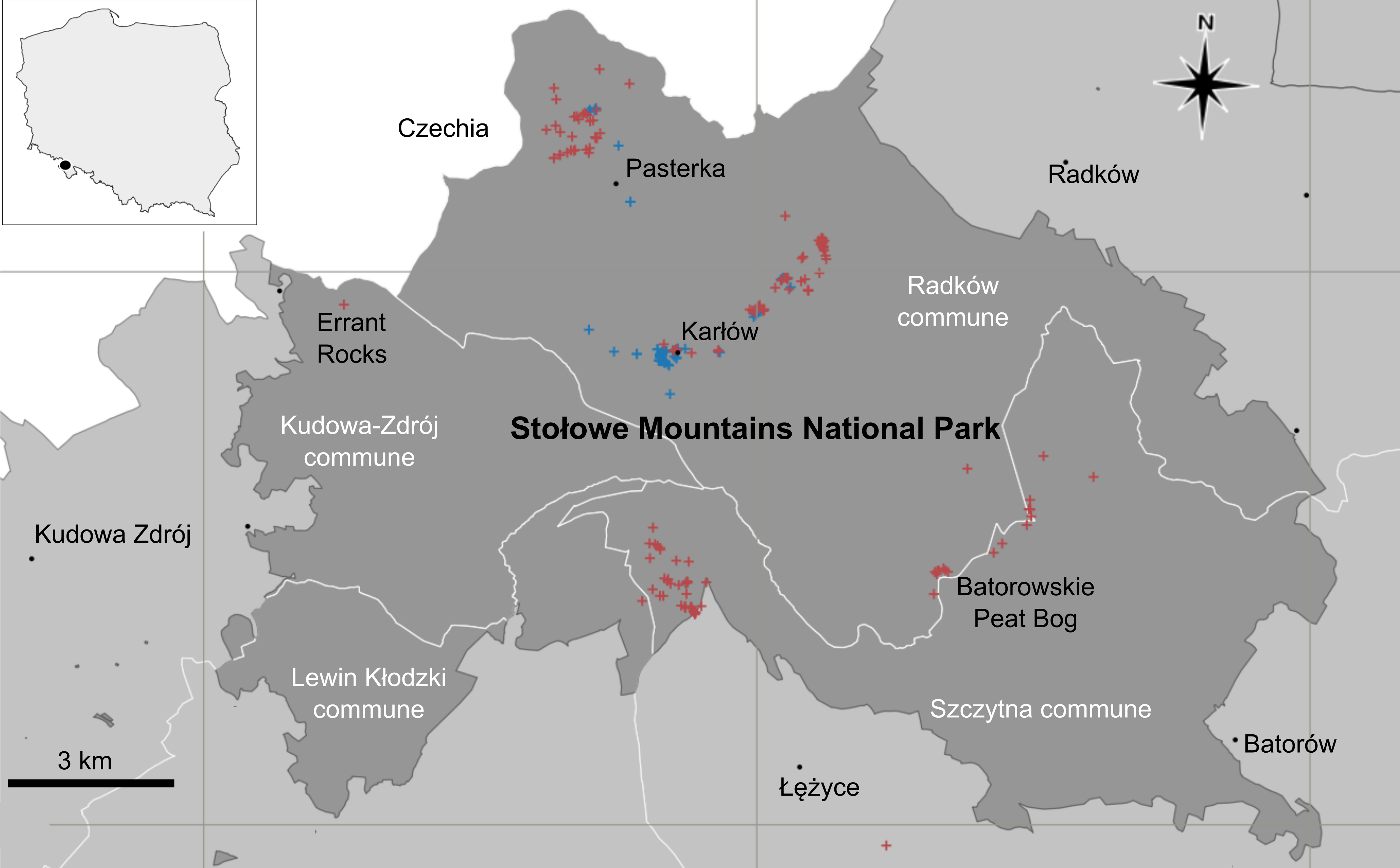
Fungi were recorded in Stołowe Mountains National Park (Lower Silesia Voivodeship, Poland) between August 28 and September 3, 2023, by participants of the summer school “From fungal morphology to genotype” (42 students and eight teachers). The sampled sites represented 4 main areas of Stołowe Mountains National Park (Figure 1), mostly representing meadows near Pasterka, beech and spruce forests near Karłów, Rogowa Kopa, and Skalne Grzyby, as well as peat bogs near Wielkie Torfowisko Batorowskie. All collection events were recorded using the PlutoF Biodiversity Platform (https://plutof.ut.ee/) and the Plutof GO mobile app (https://plutof.ut.ee/go). All observations were recorded using the Danish Fungal Atlas (https://svampe.databasen.org/en/). The participants were asked to provide as much metadata as possible, including the plant species occurring at the collection site. The plants were identified based on morphology by the participants. Records were manually checked for redundant observations and filtered out. Data were displayed on a map of forest districts retrieved from the Forest Data Bank (https://www.bdl.lasy.gov.pl/; accessed January 6, 2024) using QGIS 3.34 Prizren (http://www.qgis.org).
Figure 1
Sampling sites in Stołowe Mountains National Park. Red crosses – specimen sampling sites; blue crosses – observation registration sites; black dots – major villages or cities; dark grey – national park; white continuous lines – municipal boundaries, names of municipalities are given in white; Czechia is depicted in white. Upper left corner: contour map of Poland showing the location of Stołowe Mountains National Park.
The nomenclature was aligned using the GBIF species matching tool (https://www.gbif.org/tools/species-lookup), and later corrected to follow current name status registered in Mycobank (https://mycobank.org/; accessed 2025, November 24). For selected specimens, morphological identification was confirmed by sequencing of ITS rDNA, using standard DNA barcoding protocol (Schoch et al., 2012; White et al., 1990). The sequences obtained in this study were deposited in the International Nucleotide Sequence Database Collaboration under the following GenBank accession numbers: OR807107-OR807125. Voucher specimens were deposited in the Herbarium of the Faculty of Biology, University of Warsaw (WA). The data on species occurrences were also deposited in GBIF (Occurrence dataset, https://doi.org/10.15468/49xfns). Finally, the protective status of all records was annotated according to the Regulation of the Polish Minister of the Environment on the protection of fungal species (Dz.U. 2014 poz. 1408), the “Redlist of the macrofungi in Poland” (Wojewoda & Ławrynowicz, 2006), the IUCN Red List of Threatened Species (https://www.iucnredlist.org/, 2020; accessed 2024, August 25), and the Digital Catalogue of Biodiversity of Poland (Piskorski et al., 2023; Wilk et al., 2023). All collected specimen records with metadata are also available in Supplementary Table S2, and observations with metadata are available in Supplementary Table S3.
Information on the distribution of fungal species in the Stołowe Mountains National Park was compiled based on Jagodziński et al. (2017), Jagodziński et al. (2021), Pietras et al. (2025), and GBIF (https://doi.org/10.15468/dl.yczef6; accessed on 20 August 2024). GBIF records created during this inventory with the iNaturalist app (https://www.inaturalist.org) and Danish Fungal Atlas (https://svampe.databasen.org/en/) were manually filtered. A table containing all species listed in these sources was created, and species names were standardized according to the current nomenclatural status in Mycobank (https://mycobank.org/; accessed November 3, 2025), which allowed duplicate records to be removed.
. Results
The one-week inventory yielded 86 collections and 33 observations representing 13 Ascomycota and 106 Basidiomycota species (119 species, 146 occurrences in total). ITS rDNA sequences were obtained for 14 specimens (adequate accession numbers are provided in Table S3). In this study, we did not find any strictly protected species (SP), and only one partially protected (PP) species in Poland (Sparassis brevipes Krombh.) was recorded. Additionally, we noted 18 fungal species listed on the “Red List of the macrofungi in Poland” in the following threat categories: six endangered (E), seven rare (R), four vulnerable (V), and one data-deficient (I). Five species of Russula detected in this study are listed in the Global IUCN Red List in the least-concern (LC) category (https://redlist.info/iucn/species_list/; accessed 2025, August 08). Finally, our study resulted in the discovery of 4 species new for Poland: Cortinarius semiodoratus Rob.Henry, Cortinarius sommerfeltii Høil., Inocybe occulta Esteve-Rav., and Inocybe vaurasii Esteve-Rav., E.Larss. & Pancorbo, as well as 69 species that were not previously reported in Stołowe Mountains National Park (as checked in published species lists by Jagodziński et al., 2017; Jagodziński et al., 2021; Pietras et al., 2025; and GBIF database, https://doi.org/10.15468/dl.yczef6; accessed on 20 August 2024).
In the list of recorded species, those for which specimens were collected are in bold, and the rest of the records are based on observations. The following abbreviations and symbols are used in the list of species. Record character: protection status: PP – partially protected species; Ex, E, V, and R – categories of threat according to the “Red list of the macrofungi in Poland” (Wojewoda & Ławrynowicz, 2006); DD, CR, VU, and LC – categories of threat according to the IUCN Red List of Threatened Species (https://www.iucnredlist.org/, 2020); *– taxon not previously reported from the Stołowe Mountains National Park; ** – taxon not previously reported from Poland.
List of recorded species
Ascomycota
Calycina citrina (Hedw.) Gray
*Cejpia hystrix (De Not.) Baral
*Cistella acuum (Alb. & Schwein.) Svrček
*Eutypa spinosa (Pers.) Tul. & C.Tul.
Hymenoscyphus fraxineus (T.Kowalski) Baral, Queloz & Hosoya
Hypoxylon fragiforme (Pers.) J.Kickx f.
*Jackrogersella cohaerens (Pers.) L.Wendt, Kuhnert & M.Stadler
*Lasiosphaeria ovina (Pers.) Ces. & De Not.
Leotia lubrica (Scop.) Pers.
*Neodasyscypha cerina (Pers.) Spooner
Xylaria hypoxylon (L.) Grev.
Xylaria longipes Nitschke
Xylaria polymorpha (Pers.) Grev.
Basidiomycota
*Agrocybe arvalis (Fr.) R. Heim & Romagn.
*Amanita crocea(Quél.) Singer
Amanita excelsa (Fr.) Bertill.
Amanita fulva Fr.
Amanita muscaria (L.) Lam.
Amanita regalis (Fr.) Michael – V.
Amanita rubescens Pers.
*Amanita submembranacea (Bon) Gröger
Calocera furcata (Fr.) Fr. – R.
Calocera viscosa (Pers.) Fr.
Cantharellus amethysteus (Quél.) Sacc.
*Cellypha goldbachii (Weinm.) Donk
*Clavaria fragilis Holmsk.
Clavulina coralloides (L.) J. Schröt.
*Clavulinopsis helvola (Pers.) Corner
Climacocystis borealis (Fr.) Kotl. & Pouzar – R.
Clitopilus prunulus (Scop.) P. Kumm. – LC.
Collybiopsis peronata (Bolton) R. H. Petersen
*Conocybe ochrostriata Hauskn.
*Cortinarius bataillei J. Favre – E.
*Cortinarius biformis Fr. – R.
Cortinarius bolaris (Pers.) Zaw.
*Cortinarius rubellus Cooke
Cortinarius sanguineus (Wulfen) Gray
**Cortinarius semiodoratus Rob. Henry
**Cortinarius sommerfeltii Høil.
*Cortinarius torvus (Fr.) Fr.
*Crepidotus kubickae Pilát
Cyanosporus caesius (Schrad.) McGinty
Cystoderma amianthinum (Scop.) Fayod
Dacrymyces stillatus Nees
Daedaleopsis confragosa (Bolton) J. Schröt.
*Entoloma pseudocoelestinum Arnolds
*Flammula alnicola (Fr.) P. Kumm.
Fomitopsis betulina (Bull.) B. K. Cui, M. L. Han & Y. C. Dai
Fomitopsis pinicola (Sw.) P. Karst.
*Galerina ampullaceocystis P. D. Orton – E.
*Geastrum fimbriatum Fr. – R.
*Geastrum michelianum (Sacc.) W. G. Sm. – E.
*Gloeophyllum abietinum (Bull.) P. Karst.
*Hydropus marginellus (Pers.) Singer – E.
*Hygrocybe chlorophana (Fr.) Wünsche – R.
Hygrocybe conica (Schaeff.) P. Kumm.
*Hygrocybe helobia (Arnolds) Bon
*Hygrocybe miniata (Fr.) P. Kumm.
*Hymenochaete carpatica Pilát
Hypholoma fasciculare (Huds.) P. Kumm.
*Inocybe assimilata (Britzelm.) Sacc.
*Inocybe flocculosa Sacc.
*Inocybe goniopusio Stangl
*Inocybe mixtilis (Britzelm.) Sacc.
**Inocybe occulta Esteve-Rav., Bandini, B. Oertel & G. Moreno
*Inocybe pelargonium Kühner
*Inocybe petiginosa (Fr.) Gillet
*Inocybe sindonia (Fr.) P. Karst.
**Inocybe vaurasii Esteve-Rav., E. Larss. & Pancorbo
*Inosperma pisciodorum (Donadini & Riousset) Matheny & Esteve-Rav.
Laccaria amethystina Cooke
Laccaria laccata (Scop.) Cooke
Laccaria proxima (Boud.) Pat.
Laccaria tortilis (Bolton) Cooke
Lactarius camphoratus (Bull.) Fr.
*Lactarius fuliginosus (Krapf) Fr.
Lactarius helvus (Fr.) Fr.
Lactarius lignyotus Fr.
Lactarius pallidus Pers.
*Lactarius pterosporus Romagn.
*Lactarius trivialis (Fr.) Fr. – R.
*Leptoporus mollis (Pers.) Quél. – E.
*Leucogyrophana sororia (Burt) Ginns
*Lulesia popinalis (Fr.) T. J. Baroni, B. E. Lechner & Niveiro – V.
*Marasmius oreades (Bolton) Fr.
Marasmius wettsteinii Sacc. & P. Syd.
*Megacollybia platyphylla (Pers.) Kotl. & Pouzar
*Mutatoderma mutatum (Peck) C. E. Gómez
Mycena galopus (Pers.) P. Kumm.
*Mycena viridimarginata P. Karst.
*Mycetinis scorodonius (Fr.) A. W. Wilson & Desjardin
*Mycoacia nothofagi (G. Cunn.) Ryvarden
*Neofavolus suavissimus (Fr.) Seelan, Justo & Hibbett
*Peniophora limitata (Chaillet ex Fr.) Cooke
*Peniophora violaceolivida (Sommerf.) Massee
*Phaeoclavulina eumorpha (P. Karst.) Giachini
Phaeotremella foliacea (Pers.) Wedin, J. C. Zamora & Millanes, I.
Pholiota flammans (Batsch) P. Kumm.
*Pleurotus pulmonarius (Fr.) Quél. – V.
*Psilocybe semilanceata (Fr.) P. Kumm.
*Resupinatus poriaeformis (Pers.) Thorn, Moncalvo & Redhead
Rhizochaete radicata (Henn.) Gresl., Nakasone & Rajchenb.
*Rhodonia placenta (Fr.) Niemelä, K. H. Larss. & Schigel – E.
*Rickenella fibula (Bull.) Raithelh.
*Rickenella swartzii (Fr.) Kuyper
*Roridomyces roridus (Fr.) Rexer
Russula claroflava Grove – LC.
Russula cyanoxantha (Schaeff.) Fr. – LC.
*Russula integra (L.) Fr. – LC.
*Russula xerampelina (Schaeff.) Fr. – LC.
*Schizophyllum commune Fr.
*Sparassis brevipes Krombh. – PP, V.
Trametes versicolor (L.) Lloyd
Tremella mesenterica Retz.
Tricholomopsis decora (Fr.) Singer – R.
*Tylopilus felleus (Bull.) P. Karst.
Xenasmatella vaga (Fr.) Stalpers
*Xerocomellus porosporus (Imler ex Watling) Šutara
Figure 2
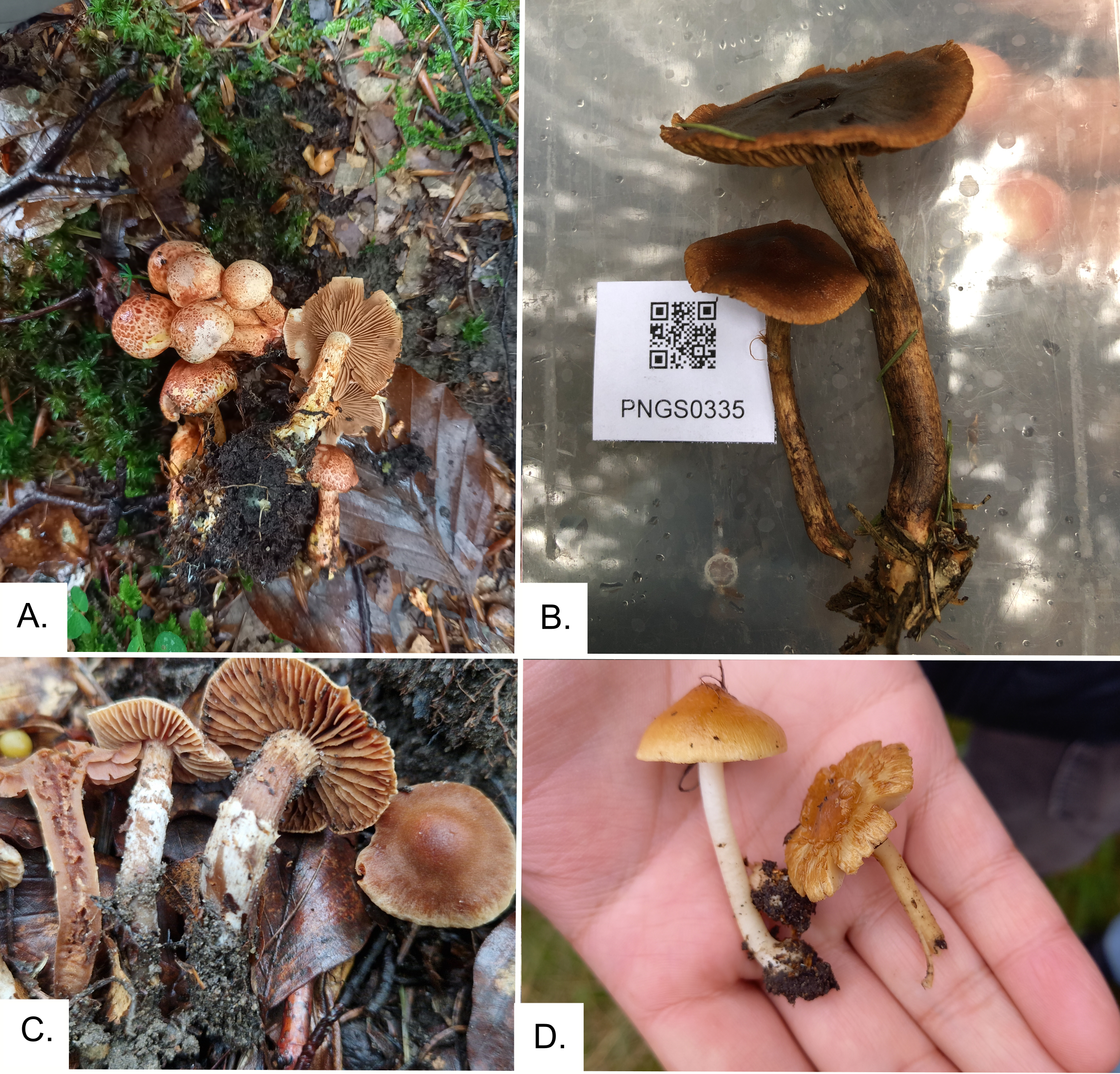
Selected fungi from Stołowe Mountains National Park one common species (A) and three that were recorded for the first time in Poland (B–D): A. Cortinarius bolaris (Pers.) Zaw. (photo Tereza Ježková); B. Cortinarius sommerfeltii Høil. (photo Alma Njeri Agha); C. Cortinarius semiodoratus Rob.Henry (photo Jacob Heilmann-Clausen); D. Inocybe occulta Esteve-Rav. (photo Tereza Ježková).
. Discussion
. Taxonomic difficulties
Although most of the abovementioned taxa were unambiguously identified, a more detailed explanation is needed in a few cases. Several Cortinarius and Inocybe representatives were present among the species not previously reported from Poland. These taxa are known from neighboring countries, indicating that the representatives of these genera are poorly studied or rarely reported from Poland. For example, Cortinarius sommerfeltii, reported herein, was not previously reported from the area, but C. pellstonianus was reported by Pietras (2025). According to Huymann et al. (2024), these names refer to the same taxon. However, because no formal synonymization was performed, in the Mycobank database, these species are treated separately (Huymann et al., 2024). Consequently C. sommerfeltii is considered as a taxon not previously reported from Poland in this paper. For another example, Inocybe vaurasii is reported here as new to Poland. However, this species was delimited only in 2022 (Esteve-Raventós et al., 2022), and only 17 occurrence records are known to date from Denmark. This species could have been reported previously under the other taxonomic treatment, e.g. I. salicis (Wojewoda, 2003). Another representative of this genus reported here was I. goniopusio. This species seems not to be known from Poland (Wojewoda, 2003; Gierczyk et al., 2018; Gierczyk et al., 2015). However, in the Danish Fungal Atlas and in Bandini et al. (2020) it is treated as synonymous with I. pseudoasterospora var. microsperma Kuyper & Keizer, which has been recorded from Poland (Kujawa & Gierczyk, 2016; Kujawa et al., 2015; Kujawa, 2022). Even though the record reported here is the first one from the country supported by ITS rDNA sequence, it was decided that this species should not be considered new to Poland.
We have also reported Geastrum michelianum. This species is usually reported on the Polish checklist under the name Geastrum triplex. However, as the species G. triplex was described from the Java island, the name G. michelianum (described from England) should be used for all European occurrence records (Zamora et al., 2014).
. Rarely reported species
Among the recorded species, some taxa are characterized by a low number of known occurrences, i.e., fewer than five sites. For example, Amanita submembranacea is reported in GREJ from only four localities in Poland (Kujawa, 2022) and 12 literature sources (Kujawa et al., 2025). In the Global Biodiversity Information Facility (GBIF), two additional occurrences are available, contributed by the Swedish Museum of Natural History and the International Nucleotide Sequence Database Collaboration (EMBL-EBI) (GBIF.org; July 14, 2025). The conservation status of this species in Poland remains unknown (Wojewoda, 2003). It can potentially be confused with A. olivaceogrisea based on similarities in cap color and a greying volva (Kibby, 2023).
Cellypha goldbachii is known from only two localities in Poland: one, available in GREJ (Kujawa, 2022), was reported in 2015 from Kuyavian-Pomeranian Voivodeship, and one reported by Ślusarczyk (2025). The occurrence reported herein is the third record for Poland (Kujawa et al., 2025). Additionally, the ITS rDNA of the specimen was sequenced to confirm its identity. C. goldbachii is also included in the Red List of fungi (macromycetes) of the Czech Republic, where it is classified as data deficient (Zíbarová et al., 2024).
Clavulinopsis helvola is rarely reported in Poland (Gierczyk et al., 2017; Wojewoda, 2003), with a total of 18 confirmed records in GREJ (Kujawa, 2022), and 23 literature sources report its presence in Poland (Kujawa et al., 2025). Owing to insufficient data, the endangerment status of this species is unknown. Nevertheless, it is categorized as endangered in some European countries (Wojewoda, 2003).
The conservation status of Mutatoderma mutatum (also known as Hyphoderma mutatum) is unknown in Poland. Wojewoda (2003) provided 10 localities of the fungus in Poland, mostly in the vicinity of Kraków. In Czechia, Mutatoderma mutatum has been confirmed to occur, although GBIF lists only three records to date (GBIF.org; November 5, 2025). An online Czech mycological resource, MYKOLOGIE. NET, suggests that it may be more widespread (MYKOLOGIE.NET, 2025), as well as another online resource that presents a total of 12 records in 10 localities (Portál Informačního systému ochrany přírody, 2026). Thus, its actual frequency in Czechia remains unclear (L. Zíbarová pers. com.). It is not surprising as one can expect a certain level of overlooking due to general insufficient sampling of corticioid fungi. Additionally, some of the Polish records in GBIF appear to represent duplicate observations stemming from split herbarium specimens (GBIF.org; 01 September 2025). A total of 18 literature sources report its presence in Poland (Kujawa et al., 2025), which highlights the scarcity of data on this species in GBIF. However, it might be that this specific taxon remains undersampled in Poland as according to the GBIF database it is widely spread across western European countries.
All of the above demonstrates the extent to which biodiversity data are scattered in different sources that are not as easily accessible as public data repositories. Some of the resources used here are written in Polish, and others are written in Czech. Consequently, if the data have not been uploaded to open public repositories, such as GBIF, its interoperability for further analysis is limited. This highlights the need to encourage scientists and institutions to share their data in GBIF.
However, when using the platform, one must realize that not all data shared in GBIF are uploaded by qualified biodiversity researchers. Some fungal data originate from the iNaturalist app, which can be used by any amateur wanting to contribute to biodiversity research. Consequently, data for some species that can only be identified using microscopy or molecular methods may be of low quality (Nguyen et al., 2013; Crous et al., 2024).
. Comparison with other national parks located in mountainous areas of Poland
In total, approximately 316 fungal species have been reported from Stołowe Mountains National Park (Chachulski, 2013; Kujawa, 2017; Jagodziński et al., 2017; Jagodziński et al., 2021; Pietras et al., 2025; GBIF and this study). This is a relatively small number in comparison with other national parks located in mountainous areas of Poland. For example, 1100 macromycetes species were reported from the Pieniński National Park (Gumińska, 1969, 1972, 1976, 1981, 1990, 1969, 1999a, 1999b; Gumińska & Wojewoda, 2004; Chachuła, 2012, 2014, 2016; Chachuła et al., 2020), and an additional 500 micromycetes species are also listed (Kućmierz, 1976a, 1976b). Similarly, the number of macromycetes species from the Gorce Mountains National Park (comparable in size to Stołowe Mountains National Park) includes 1042 species (Wojewoda et al., 2016). In contrast, only 675 fungal species were reported from the Magurski National Park (Chachuła, 2014), although it is much larger. More than 1300 fungal species were reported from the Bieszczadzki National Park (Gierczyk et al., 2019), making it comparable with Białowieża National Park and one of the most valuable mycological areas in the country.
. Conclusions
The short-term inventory performed herein has broadened the knowledge about the mycobiota of Stołowe Mountains National Park. Here, 69 species that have been recorded for the first time in the park are reported. This constitutes over 15% of the fungal species reported from Stołowe Mountains National Park. This result indicates that the diversity of the mycobiota remains understudied in comparison with other national parks.
Supplementary material
The following supplementary material is available for this article:
Table S1. List of species reported from Stołowe Mountains National Park.
Table S2. Detailed table of all specimen records with metadata.
Table S3. Detailed table of all observation records with associated metadata.
Acknowledgments
We thank the Stołowe Mountains National Park for supporting the inventory coordination.
We acknowledge the data collection contributions of participants in the Field Mycology Course: from the University of Warsaw: Magdalena Fus, Jakub Guzek, Anna Jurczyk, Grzegorz Ostrowski, Weronika Pokładek; from the University of Kopenhagen: Alma Njeri Agha, Anne Sofie Lawætz Andersen, Sanjana Sudheer Bhat, Oliver Velano Hessel, Andreas Christian H. Lausen, Mathilde Krarup Nilsson; from Heidelberg University: Ben Brick, Laura Schütz; and from Charles University in Prague: Tereza Ježková, Pavel Jirkovský, Magda Podlešáková.
We also thank Felix Vissing for helping us to translate notes from the Danish Fungal Atlas.
We thank Tereza Ježková for language correction.
We thank the reviewers for their contributions to this article.
This activity was organised as part of the 4EU+ Alliance cooperation, with the participation of member universities: University of Warsaw, Charles University, University of Copenhagen and Heidelberg University.