
. Introduction
Pollination is a key process determining reproductive success in flowering plants, directly influencing both fruit set and seed production (Klein et al., 2007). The efficiency of pollination depends on multiple factors, including the mode of pollen transfer, availability of pollinators, and the plant’s breeding system (Ollerton et al., 2009; Tymoszuk et al., 2024). Differences between self- and cross-pollination often lead to substantial variation in reproductive output, with important consequences for plant fitness and population persistence (Lloyd, 1992).
Mixed mating systems, in which both self- and cross-pollination occur within the same population, are common among angiosperms and have been reported in approximately 42% of seed plant species (Stebbins, 1970; Stephens et al., 2023; Zych et al., 2014). In species relying on biotic pollination, particularly those dependent on insects, temporal and spatial fluctuations in pollinator abundance may limit opportunities for cross-pollination (van Ginkel & Flipphi, 2020). Under such conditions, self-pollination can act as a mechanism of reproductive assurance; however, it is frequently associated with reduced seed production or lower offspring quality (Fenster & Marten-Rodriguez, 2007; Tymoszuk-Rydzewska et al., 2026). In contrast, cross-pollination often enhances reproductive success by increasing genetic diversity and improving seed set (Antoń & Denisow, 2018). Experimental manipulation of pollination modes therefore provides valuable insight into plant reproductive biology and the relative importance of different mating strategies (Barrett & Harder, 2017).
Nigella damascena L. (Ranunculaceae) is a popular annual species cultivated as an ornamental plant and prized for its delicate flowers and unique fruits (Scognamiglio et al., 2024). Its seeds exhibit potential as a natural medicine with antioxidant, anti-inflammatory, and antimicrobial properties (Klimek-Chodacka et al., 2020; Salehi et al., 2021). The species is regarded as important for maintaining local biodiversity of pollinators (Liao et al., 2020). Despite its widespread cultivation and well-documented ecological significance, information on the fruit set and seed production under controlled pollination treatments is scarce (however, see Zaitoun et al., 2008).
The flowers of N. damascena are bisexual and actinomorphic, characterized by conspicuous petaloid sepals and highly specialized nectar leaves (Galipot et al., 2021; Hu et al., 2012; Yao et al., 2019). The species exhibits protandry, although overlap between male and female function occurs during later stages of anthesis, with stigma receptivity peaking approximately on the fifth day of the flower lifespan (Łabęcka et al., 2026). Nectar production increases progressively during anthesis and changes from sucrose-dominant to sucrose-rich composition over time. In addition to nectar, flowers provide pollen as a floral reward for insect visitors (Zaitoun et al., 2008). They also possess visually conspicuous pseudonectaries, which are considered important visual and tactile cues for pollinators (Liao et al., 2020). These floral characteristics suggest adaptation to insect-mediated pollination and indicate the potential ecological importance of pollinator activity for reproductive success in this species.
Understanding the pollination system of N. damascena is important for clarifying its breeding system and ensuring high seed yield in this ornamental species propagated from seed. Therefore, the aim of the present study was to investigate the effects of different pollination treatments (spontanous autogamy, induced self-pollination, geitonogamy, open pollination, induced cross-pollination, and supplemental cross-pollination) on fruit set and seed number per fruit in Nigella damascena. Specifically, we tested (1) whether its reproductive output varies among the different modes of pollen transfer, (2) whether natural pollination is pollen-limited, and (3) whether the reproductive patterns are consistent across two consecutive years.
. Materials and methods
. Study site and plant material
The experiment was carried out in 2024 and 2025 at the Botanical Garden in Lublin, eastern Poland (51°16'N, 22°30'E), located at approximately 200 m above sea level. The area has a moderately continental climate, marked by chilly winter air temperatures that frequently drop below 0 °C (32 °F), and comfortably warm summers. Experimental plots were established in six replicates, each covering an area of 1 m², and were distributed within the Ornamental Plants Section of the garden. All plots were situated on loess-derived soil with a slightly acidic to neutral reaction (pH 6–7). In both study years, sowing was performed on 11 April, which corresponds to the recommended sowing period for this species (Wolski et al., 2017).
The investigated species, Nigella damascena L. (Ranunculaceae), is an annual herbaceous plant native to southern Europe (Kim et al., 2024). It has subsequently expanded its range northwards and is currently also found in North Africa and south-western Asia, where it typically grows in moist, non-cultivated habitats (Dönmez et al., 2021; Jabbour et al., 2021). The gynoecium is formed by 2–10 centrally located carpels that are fused into a compound pistil. The fruit is a 5–9-celled syncarpous follicular capsule (Tamura, 1993). Seeds are ovoid in shape, anthracite black in color, and measure approximately 3.0 mm in length and 2.3 mm in width (Margout et al., 2013).
. Pollination treatments
To examine the effects of different pollination modes on reproductive success in Nigella damascena, we applied six pollination treatments: (i) self-pollination – spontaneous autogamy with pollinator exclusion was applied by enclosing intact flowers in fine mesh bags (1 × 1 mm mesh size) throughout the flowering period to prevent pollen transfer by external agents; (ii) induced self-pollination involved emasculated flowers that were hand-pollinated using pollen from the same flower. After pollination, the flowers were covered with mesh bags to exclude pollinators; (iii) geitonogamy was carried out on emasculated flowers that were hand-pollinated with pollen originating from a different flower of the same individual plant. These flowers were enclosed in mesh bags to prevent additional pollen transfer; (iv) open pollination involved flowers left fully exposed to naturally occurring pollination agents; (v) induced cross-pollination was performed on emasculated flowers that were subsequently enclosed in fine mesh bags to exclude insects. These flowers were hand-pollinated using pollen collected from flowers of different individuals to check cross-compatibility; (vi) supplemental cross-pollination (flowers hand-pollinated with pollen from unrelated donor plants and subsequently left open to natural pollinator visitation) to quantify pollen limitation.
In each study year, 15–25 flowers originating from 3–5 randomly selected plants were used for each pollination treatment. In the induced cross-pollination and supplemental cross-pollination treatments, pollen was collected from at least n = 6 donor plants to minimize donor-specific effects.
Descriptive statistics (mean ± standard deviation) were calculated for each pollination treatment and pooled across the years to facilitate biological interpretation of the results. Statistical analyses were performed to evaluate the effects of pollination treatment and year on fruit set and seed production. Fruit set was defined as the proportion of flowers that developed into fruits and was analyzed using a generalized linear model (GLM) with binomial error distribution and a logit link function. The numbers of fruits and flowers were specified for each experimental unit. Pollination treatment and year were included in the model as fixed effects, and open pollination was used as the reference category. Seed number per fruit was analyzed using a generalized linear model with Poisson error distribution and a log link function. Model parameters are presented as regression coefficients (β), standard errors (SE), z-values, and associated p-values. All statistical analyses were performed using Statistica (version 13.1).
. Results
Pollination treatment significantly affected fruit set (Tables 1, 2; Figure 1a). Fruit set varied among pollination treatments in both study years, ranging from 50.0 ± 11.5% in self-pollinated flowers in 2025 to 100.0 ± 0.0% under supplemental cross-pollination in 2024. Compared with open pollination, induced self-pollination (β = –2.075, p = 0.009), self-pollination (β = –2.378, p = 0.003), and geitonogamy (β = –1.676, p = 0.046) significantly reduced the probability of fruit set. Induced cross-pollination also resulted in a significantly lower fruit set compared with open pollination (β = –2.260, p = 0.005). In contrast, supplemental cross-pollination did not differ significantly from open pollination (β = 0.150, p = 0.885). The effect of year was not statistically significant (β = –0.373, p = 0.266). Moreover, the interaction between pollination treatment and year was not statistically significant (p > 0.05), indicating that the treatment effects were consistent across study years.
Table 1
Descriptive statistics of fruit set (%) and seed number per fruit in N. damascena under different pollination treatments in 2024 and 2025. Values are means ± SD.
Table 2
Effects of pollination treatment on fruit set in N. damascena. Fruit set (proportion of flowers setting fruit) was analyzed using a generalized linear model (GLM) with binomial error distribution and logit link. Open pollination was used as the reference category.
Figure 1
Mean fruit set (%) (a) and seed number per fruit (b) in Nigella damascena under different pollination treatments. Values are pooled across the 2024 and 2025 growing seasons and presented as treatment means. Statistical significance among pollination treatments was assessed using generalized linear models (GLMs) with binomial error distribution and logit link function for fruit set and Poisson error distribution with log link function for seed number per fruit. Significance codes: *** p < 0.001, ** p < 0.01, * p < 0.05, ns = not significant.
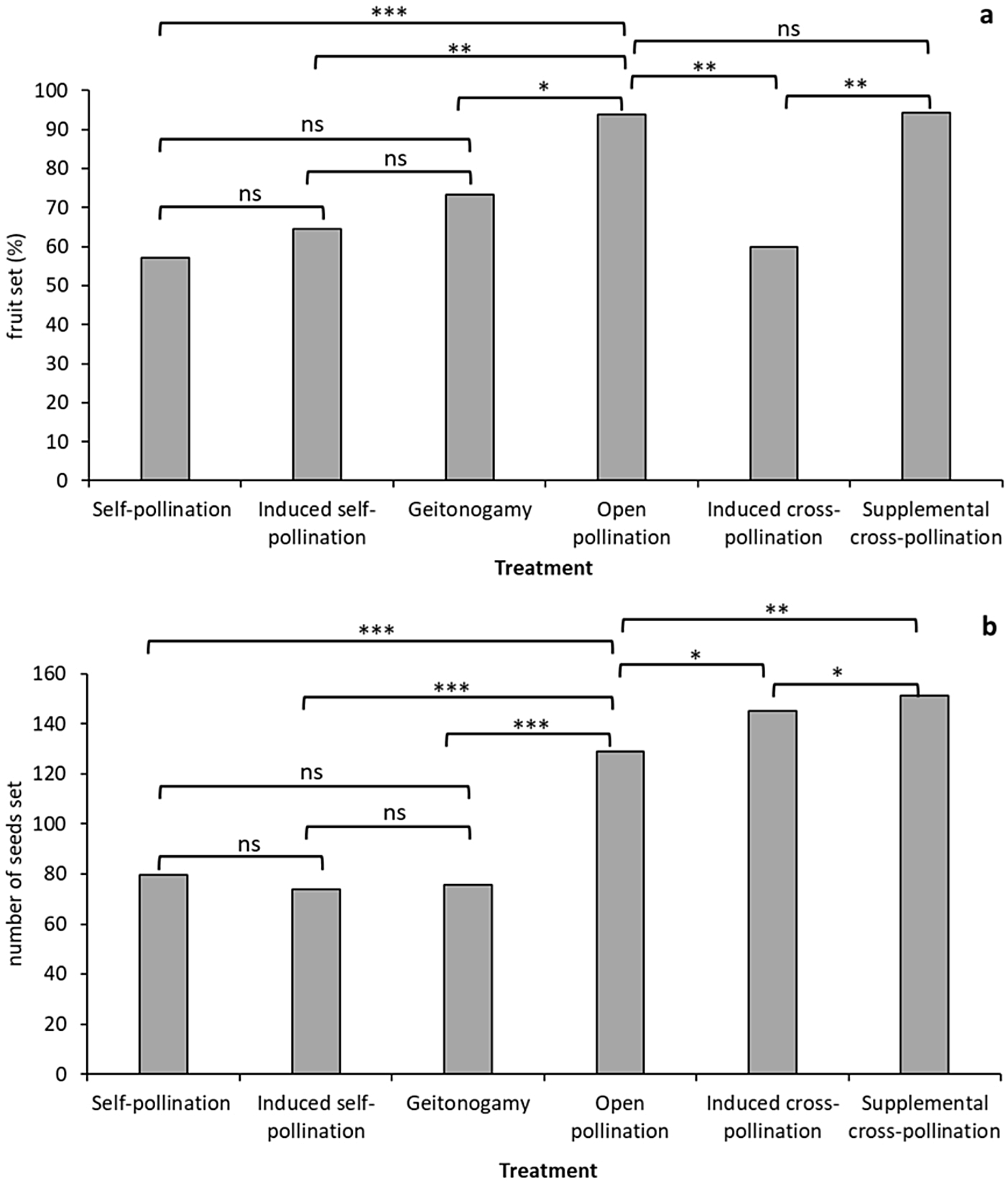
Seed production was also significantly influenced by pollination treatment (Tables 1, 3; Figure 1b). The number of seeds per fruit ranged from 67.2 ± 10.8 in induced self-pollination in 2025 to 156.7 ± 6.8 under supplemental cross-pollination in 2024 (Table 1). Self-pollination (β = –0.48, p < 0.001), induced self-pollination (β = −0.54, p < 0.001), and geitonogamy (β = –0.53, p < 0.001) significantly reduced the number of seeds per fruit compared with open pollination. In contrast, induced cross-pollination significantly increased seed production (β = 0.12, p = 0.011), and a similar increase was observed in the supplemental cross-pollination treatment (β = 0.17, p = 0.001). The effect of year was not statistically significant (β = –0.05, p = 0.073). Similarly, no significant interaction between pollination treatment and year was detected for seed number per fruit (p > 0.05).
Table 3
Effects of pollination treatments on seed number per fruit in N. damascena. Seed number per fruit was analyzed using a generalized linear model (GLM) with Poisson error distribution and log link. Open pollination was used as the reference category.
. Discussion
The pollination treatments significantly affected both fruit set and seed number per fruit in Nigella damascena. Our results indicate that the species is characterized by a mixed mating system and exhibits partial self-compatibility. Although individuals were capable of producing fruits and seeds through self-pollination, reproductive performance was substantially higher following cross-pollination, particularly in terms of seed production. This highlights the important role of insect pollinators; however, the significant increase in seed yield under supplemental pollination suggests that natural pollinator service does not fully saturate the reproductive potential of N. damascena in the studied environment. Consequently, the relative contribution of self- and cross-fertilization to reproduction may vary depending on pollen quality, pollinator activity, and environmental conditions (e.g., nutrient or water resource availability). Importantly, these reproductive responses remained stable across the study years, as no significant year effect was detected.
Reproductive assurance through mixed mating systems is widespread among angiosperms (Cruden & Lyon, 2019; Goodwillie et al., 2005; van Ginkel & Flipphi, 2020) and represents a common evolutionary strategy within the Ranunculaceae (Bosch et al., 2001). Our findings for N. damascena are highly congruent with reproductive models described in other members of the family Ranunculaceae, such as Anemone sylvestris (Douglas & Cruden, 1994), Aquilegia spp. (Eckert & Schaefer, 1998), and various Delphinium species (Williams et al., 2001), where selfing provides a reproductive assurance mechanism when outcrossing is unreliable (e.g., due to pollinator or mate limitation).
The successful fruit set following geitonogamy confirms that N. damascena is self-compatible. However, the fact that the manual pollen transfer yielded higher fruit formation than spontaneous self-pollination illustrates a phenomenon described by Harder & Aizen (2010), where even self-compatible species depend on pollinators to effectively deliver pollen to the stigma for fruit initiation. This suggests that, while selfing provides reproductive assurance in the sense of Cruden & Lyon (2019), it is not a passive process in N. damascena and requires a functional pollinator service to be fully realized. Nevertheless, the low seed number per fruit observed in our geitonogamy treatment reinforces the findings of Husband & Schemske (1996), indicating that self-pollen is the primary limiting factor for seed production due to early-acting inbreeding depression.
While partial self-compatibility in N. damascena ensures a degree of reproductive success, performance was significantly lower across all selfing treatments compared to open pollination (GLM, p < 0.05; Table 2). This disparity was particularly pronounced in seed production; self-pollination yielded only 79.7 seeds per fruit, representing nearly a 50% reduction compared to the 151.3 seeds recorded under supplemental cross-pollination (Table 1). Such a substantial decline in seed production suggests the presence of strong early-acting inbreeding depression, where selfed embryos may be aborted at significantly higher rates than outcrossed ones (Lloyd, 1992). The reduction in seed set observed in our study species is consistent with the meta-analysis by Husband & Schemske (1996), who documented that inbreeding depression in self-compatible species is often most acute during the stages of seed development and maturation.
Notably, the markedly lower fruit set observed in the induced cross-pollination treatment compared to other open-pollination treatments likely stems from the physical stress associated with emasculation and flower handling (Ashman et al., 2004; Harder & Aizen, 2010). Manual interference during the bud stage can trigger premature ethylene production or cause mechanical damage to the receptacle and stigma, potentially leading to flower abortion (Herbertsson et al., 2017). However, fruits that successfully reached maturity contained a high number of seeds (145.0), confirming that cross-pollination inherently enhances seed output when the floral functionality is maintained. This contrast between low fruit set and high seed number per fruit further supports the conclusion that pollen quality (outcrossing) is the primary driver of seed yield in this species. This trend is reflected in the meta-analysis by Larson & Barrett (2000), which demonstrated that pollen limitation is more frequently manifested in seed production than in fruit set, particularly in multi-ovulate species where high pollen loads are essential for full fertilization.
Our findings are consistent with documented effects of insect-mediated pollination within the genus Nigella. Zaitoun et al. (2008) reported that cross-pollinated N. damascena plants exhibited significantly higher seed sets (by approximately 20–30%) and produced heavier seeds than self-pollinated ones, further emphasizing the qualitative benefits of outcrossing. Similarly, in N. sativa, fruit set was limited to 46% under restricted pollinator activity, whereas enhanced pollination significantly boosted both fruit formation and seed set (Abu-Hammour & Wittmann, 2011). The key role of pollinators was also emphasized by Munawar et al. (2009) and Abu-Hammour et al. (2010), who demonstrated that honeybee visitation significantly increased fruit production and seed number in self-compatible Nigella species. Our study highlights the significance of insect pollinators, demonstrating their essential role in optimizing the transition from basic reproductive assurance via self-pollination to achieving maximum yields through outcrossing.
Although our study clearly demonstrated substantial differences in fruit set and seed number among pollination treatments, reproductive success was assessed exclusively using quantitative parameters. We did not evaluate seed mass, thousand-seed weight, fruit biomass, or capsule size, which may also represent economically important traits in ornamental and medicinal cultivation of N. damascena. Consequently, it cannot be excluded that the lower seed numbers in the self-pollination treatments were partially compensated for by greater individual seed mass or altered allocation patterns. Future studies should therefore integrate both quantitative and qualitative reproductive parameters to provide a more comprehensive assessment of pollination effectiveness and reproductive performance in this species.
The findings of our study have practical implications for the cultivation and commercial production of N. damascena. As an annual ornamental and medicinal species, its economic value depends on reliable fruit set for the production of well-developed inflated follicular capsules used in floral arrangements, as well as high seed yields for propagation and the extraction of bioactive compounds such as β-elemene (Fico et al., 2003; Sieniawska et al., 2019). Since seed quantity directly influences the total yield of these economically valuable secondary metabolites (D’Antuono et al., 2002), ensuring robust pollinator services is critical for maximizing both the aesthetic and pharmacological potential of the crop.
. Conclusions
In conclusion, N. damascena exhibits a mixed mating system in which self-compatibility provides reproductive assurance, while cross-pollination substantially enhances reproductive output. Our results demonstrate that pollinator-mediated pollen transfer is crucial, as it not only maximizes seed yield but is also essential for maintaining a high fruit set, which was significantly reduced under self-pollination treatments. However, because seed quality traits and fruit biometric parameters were not assessed, further studies are needed before drawing broader conclusions regarding horticultural and pharmaceutical production efficiency.