
. Introduction
Weeds are one of the plant-disturbing organisms that can inhibit plant growth, development, and productivity (Shah et al., 2022). The presence of weeds in cultivated plants reduces yields by 20–80% (Gharde et al., 2018). The decline in crop yields varies greatly depending on various factors, including the competitive ability of plants, types of weeds, plant age, weed age, cultivation techniques, and duration of competition (Chauhan, 2020). Goosegrass (Eleusine indica (L.) is one of the weeds often found on agricultural land Gaertn) (Ma et al., 2015). This weed is very sensitive to environmental conditions, i.e., if the conditions are not suitable, it will die quickly (Chauhan & Johnson, 2008). The spread of goosegrass is very fast because its light seeds are easily carried away by the wind and then spread over the planting area (Takano et al., 2016). Goosegrass is considered a weed that is detrimental to cultivated plants because it is physically able to compete with them in terms of space, light, and chemical gain for water, nutrients, and essential gases and in allelopathy events (Arrieta et al., 2009).
Weed management is generally done manually, apart from mechanical means and spraying of chemical herbicides. Mechanical weed management requires a lot of energy if it is done over large areas and requires several requirements (Shahzad et al., 2021). Control of weeds by weeding (by clearing) requires a lot of manpower, time, and costs because the roots of these weeds are not deep but thick and strong to anchor the soil, making it difficult to pull them out (Abouziena & Haggag, 2016; Shamkuwar et al., 2019). Mechanical weed management is also difficult to implement because it requires large costs and is impractical (Loddo et al., 2021). So far, farmers have been controlling weeds by means of weeding and the use of chemical herbicides. Chemical control using herbicides intensively and unwisely can have a negative effect (Üstüner et al., 2020). Van Bruggen et al. (2018) stated that glyphosate herbicides have a negative effect on human health and the environment. It was further shown by Üstüner et al. (2020) that herbicides have a negative effect on living organisms and cause environmental pollution. Based on this, it is necessary to look for other control alternatives that are environmentally friendly, but still effective for controlling weeds.
Weed biological control is an alternative, ecologically friendly control by utilizing natural enemies (living organisms) to reduce weed populations (Telkar et al., 2015; Sharma et al., 2020). Several groups of insects have been developed to control weeds in several places. For example, 468 biological control agent species have been used against 175 species of target weeds in 48 plant families in 90 countries (Schwarzländer et al., 2018). Weed biological control is developed using weed pathogens, such as fungi, bacteria, or other microbes (Charudattan, 2001). One of the biological control agents that is often used is the fungus group because fungi are most commonly found in plants and have destructive properties, can be produced in large quantities, can be formulated, and can penetrate plants directly (Thambugala et al., 2020).
In previous studies, several weed pathogenic fungi were used for biological control of weeds, including Chaetomium sp., Curvularia sp., and Fusarium sp. (Ziaulhak et al., 2019). The three weed pathogenic fungi were able to overcome several test weeds (Soesanto et al., 2020). However, the frequency of spraying and the effectiveness of weed pathogenic fungal combination to control goosegrass are unknown. Based on this description, a study was conducted on the frequency of use of three weed pathogenic fungi against goosegrass. This study aimed to determine the best frequency of application of weed pathogenic fungi alone or in combination against goosegrass.
. Materials and methods
. Research site
In vivo research was carried out for four months at the Experimental Farm, Faculty of Agriculture, Jenderal Soedirman University, Purwokerto, at an altitude of 110 m above sea level on latosol soil types.
. Preparation of weed pathogenic fungi
Chaetomium sp. was propagated on PDA and incubated at room temperature for 7 days or on a mycelium-filled Petri dish. Curvularia sp. and Fusarium sp. were propagated in corn medium and incubated for 7 days at room temperature (25±1°C) (Haryuni et al., 2022). Furthermore, the Chaetomium sp. colony was transferred aseptically into 150 mL of Potato Dextrose Broth (PDB) in an Erlenmeyer flask and shaken at 150 rpm for 7 days at room temperature (Soesanto et al., 2020). The propagation of Curvularia sp. and Fusarium sp. began with the preparation of a suspension by mixing 50 g of broken corn media into 100 mL of sterile distilled water and stirring. Then, the suspension was filtered, transferred into an Erlenmeyer flask containing 150 mL PDB, and shaken using a shaker (Daiki Orbital) at 150 rpm for 7 days at room temperature. After that, the density of Curvularia sp and Fusarium sp. was calculated using a hemocytometer to produce a density of 1×10⁶ conidia mL-1. For Chaetomium sp., multilevel dilutions were carried out for total plate counting calculations to produce a density of 1×10⁶ cfu mL-1.
. Preparation of land
Land was cleared of other weeds. The latosol soil was loosened to make it easier to plant weeds; then, a 50 cm × 50 cm plot was made using raffia rope.
. Retrieval of weed seedlings
Goosegrass seedlings were taken from the Experimental Farm, Faculty of Agriculture, Jenderal Soedirman University, Purwokerto. The weed seedlings were taken carefully so that none of the weed organs were cut off and were as homogeneous as possible; then, they were placed in a paper bag.
. Planting weed seedlings
Goosegrass seedlings were planted in the experimental land that had been prepared by making 3-cm deep planting holes or until the seeds were able to stand firmly. The spacing between the weeds was 10 cm × 10 cm, while the distance between the units was 30 cm.
. Weed maintenance
Maintenance included watering once a day in the afternoon, depending on the condition of the land. The soil was always kept moist during the weed growth period. Weeding was done by pulling out other weeds that were not included in the goosegrass planted.
. Experimental design
The design used was a factorial randomized block design using two factors with two replicates. Each unit consisted of 25 weeds, and five weed samples were taken diagonally. The first factor was the frequency of spraying, which consisted of 3 levels, namely 1, 3, and 5 times with an interval of five days. The second factor was weed pathogenic fungi consisting of eight levels, namely the control, Chaetomium sp., Curvularia sp., and Fusarium sp. alone, the combination of Chaetomium sp. and Curvularia sp. (1 : 1), Chaetomium sp. and Fusarium sp. (1 : 1), Curvularia sp. and Fusarium sp. (1 : 1), and Chaetomium sp., Curvularia sp., and Fusarium sp. (1 : 1 : 1), each with a concentration of 106 conidia or cfu mL-1 at a dose of 500 L/ha. The weed pathogenic fungi were applied by spraying all parts of the weed. Spraying was carried out in the morning, and the weather was taken into account.
. Observed variable
The variables observed included incubation period, disease intensity, area under disease progress curve (AUDPC), and fresh and dry weight of weeds. The incubation period was calculated from the inoculation of the pathogen until the appearance of the first symptoms in units of days after inoculation (dai) (Leclerc et al., 2014). The intensity of the disease was observed since the first symptoms appeared with an observation interval of once a week, with the formula (Chiang et al., 2017) where DI (%) = [sum (class frequency × score of rating class)]/[(total number of plants) × (maximal disease score)] × 100%. According to Bhat et al. (2013), the attack category score used were 0 = healthy plants, no attack symptoms, 1 = plants with 1 – 25% symptomatic leaves, 2 = plants with 26–50% symptomatic leaves, 3 = plants with 51–75% symptomatic leaves, and 4 = plants 76–100% symptomatic leaves.
The Area Under the Disease Progress Curve (AUDPC) is the number of diseases in each treatment from the first observation to the last observation. According to Paraschivu et al. (2013), the AUDPC value was calculated using the following formula:
Information: Yi+1 = i+1st observation data, Yi = ith observational data, ti+1 = i+1th observation time, ti = ith observation time, and n = the total number of observations.
The fresh weight of weeds was obtained by pulling out the grass after the last observation, then cleaning it from the soil and weighing it (g). The dry weight measurement of weeds was carried out by weighing all parts of the weeds which had been dried in the oven at 70°C for 24 hours.
. Results
. Single frequency effect on pathosystem component
Based on statistical analysis, the single treatment frequency significantly affected the incubation period, disease intensity, and AUDPC (Table 1). The spraying frequency of 5 and 3 times resulted in a faster incubation period than the frequency of 1 time or was able to accelerate incubation by 14.95 and 14.79%, respectively, compared to the frequency of 1 time. These data indicate that increasing the frequency of spraying can accelerate the appearance of disease symptoms in goosegrass. The intensity of the disease in the treatment of the spraying frequency 5 and 3 times had a higher value, compared to the spraying frequency 1 time, as evidenced by the intensity of the disease, which increased by 16.87 and 6.138%, respectively, compared to the frequency of 1 time (Table 1 and Figure 1). As a result, the greater the number of symptoms formed, the greater the area of the symptoms, so that the resulting disease intensity was also high (Figure 1). Spraying the grass with the weed pathogenic fungi with a frequency of 5 times yielded the highest disease intensity value, compared to the other frequencies, and was not significantly different from the frequency of spraying 3 times (Table 1).
Figure 1
Goosegrass disease intensity with spray treatment frequency. Description: (a) 1 time, (b) 3 times, and (c) 5 times.
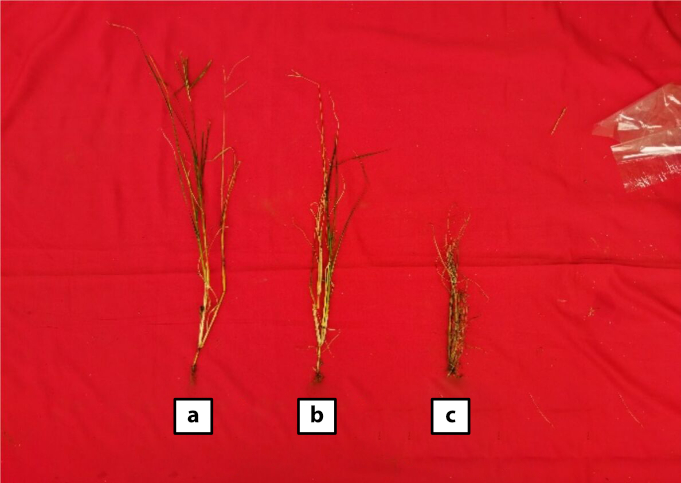
The frequency of spraying 5 and 3 times had a higher AUDPC value, by 17.73 and 10.14%, respectively, compared to the frequency of 1 time (Table 1).
Table 1
Effect on pathosystem component.
. Single effect of weed pathogenic fungi on pathosystem component
Based on Table 1, the single treatment with the weed pathogenic fungi significantly affected the incubation period, disease intensity, and AUDPC of goosegrass. The treatment with the three weed pathogenic fungi (Chaetomium sp., Curvularia sp., and Fusarium sp.) resulted in the fastest incubation period of 3.33 dai or was able to accelerate the incubation period by 85.41%, compared to the control.
Goosegrass infected with Chaetomium sp. showed symptoms of necrosis, which was marked by dry leaves starting from the edge of the leaf to all parts of the leaf; then, the leaves would curl and fall (Figure 2a). The yellowing then spread to all parts of the leaf and the leaves began to dry from the top. The leaves then dried out completely and the leaves were shed. Symptoms due to infection with Curvularia sp. in goosegrass were narrow spots appearing on the elongated leaves that were reddish-brown in color; then, the spots turned black over time (Figure 2b). Goosegrass infected with Fusarium sp. showed yellowing leaves, brownish rootstock, and wilted plants. Symptoms of wilting started from the leaves located below and then developed upwards as the base of the stem began to rot (Figure 2c).
Figure 2
Symptoms caused by pathogenic fungi on goosegrass. Description: (a) necrosis due to Chaetomium sp. infection, (b) leaf spot due to Curvularia sp. infection, (c) Fusarium wilt due to Fusarium sp. infection.
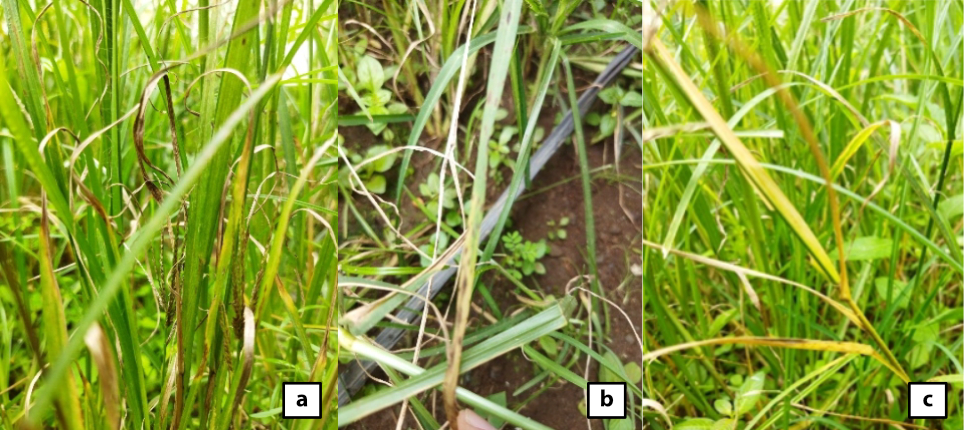
The single treatment with the pathogenic fungi had a significant effect on disease intensity (Table 1). The treatment with the mixture of three pathogenic fungi and the mixtures of two pathogenic fungi had better grass attack ability, compared to the treatment with a single pathogenic fungus (Figure 3). The mixed treatments with two pathogenic fungi (Chaetomium sp. and Curvularia sp., Chaetomium sp. and Fusarium sp., and Curvularia sp. and Fusarium sp.) resulted in disease intensity values of 46.67, 55.00, and 58.33%, respectively, or an increase of 46.43, 54.54, and 57.14%, respectively, compared to the control. The mixed treatment with the three pathogenic fungi (Chaetomium sp., Curvularia sp., and Fusarium sp.) was characterized by a disease intensity value of 80.83% or an increase of 69.07%, compared to the control.
Figure 3
Disease intensity of goosegrass inoculated with weed pathogenic fungi. Description: (a) control, (b) with Chaetomium sp., (c) with Curvularia sp., (d) with Fusarium sp., (e) with Chaetomium sp. and Curvularia sp., (f) with Chaetomium sp. and Fusarium sp., (g) with Curvularia sp. and Fusarium sp., (h) with Chaetomium sp., Curvularia sp., and Fusarium sp.
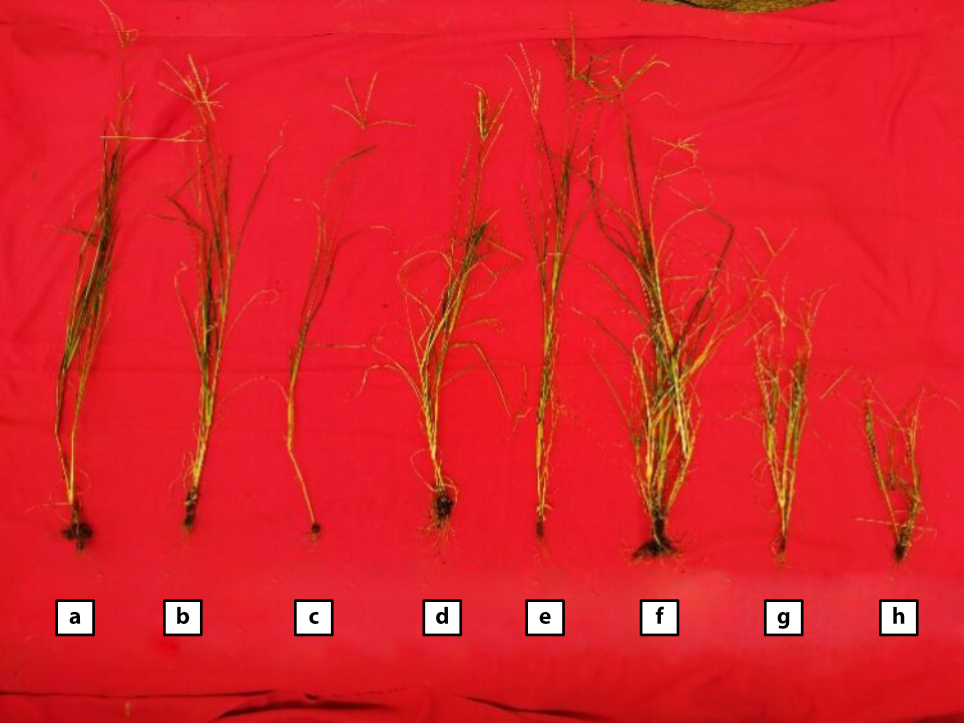
The combined treatment with the three pathogenic fungi (Chaetomium sp., Curvularia sp., and Fusarium sp.) exhibited the highest AUDPC value, compared to the other treatments, namely 1335.83% per week or an increase of 80.35%, compared to the control (Table 1).
. Combined effect of frequency and weed pathogenic fungi
Based on the results of the analysis, it was shown that the combination of treatment frequency and weed pathogenic fungi had a significant effect on AUDPC (Table 1). The combination of spraying frequency 5 times and the mixture of three pathogenic fungi (Chaetomium sp., Curvularia sp., and Fusarium sp.) showed the highest AUDPC value, compared to the other treatments, as evidenced by AUDPC, which was 1443.75% per week or increased by 81.82%, compared to the control. The combined treatment had no statistical effect on the incubation period and disease intensity, although the data showed a markedly different trend (Table 1).
. Single frequency effect on growth component
Based on the results of the analysis of variance, it was shown that the single treatment frequency had a significant effect on the fresh and dry weight of goosegrass (Table 2). The treatment with spraying frequency 5 times and 3 times resulted in lower goosegrass fresh weight and dry weight, compared to the 1-time spraying frequency, which was indicated by weed fresh weight values of 62.18 and 38.04%, respectively, and weed dry weight of 39.89 and 17.17%, respectively, compared to the frequency of spraying 1 time. The low wet weight and dry weight of goosegrass in the 5 and 3 times spraying treatments were closely related to the fast incubation period and high disease intensity and AUDPC (Table 1).
. Single pathogenic fungi on growth component
The single treatment with weed pathogenic fungi significantly affected the fresh and dry weight of goosegrass (Table 2). The combined treatment of three weed pathogenic fungi had the lowest fresh and dry goosegrass weights, compared to the other treatments, namely 4.62 and 1.46 g respectively or a decrease of 76.44 and 64.90% respectively, compared to the control.
Table 2
Effect on growth component.
. Combination of frequency and weed pathogenic fungi on growth component
The combination of frequency and weed pathogenic fungi did not significantly affect goosegrass fresh and dry weight, although the data showed differences (Table 2). The combination of the three weed pathogenic fungi tended to show a better reduction in growth components when compared to the effect of a single weed pathogen. Although Table 1 and 2 show different numbers, the combined treatment tends to affect the variables, which can be proven by the goosegrass growth in Figure 3.
. Discussion
. Single frequency effect on pathosystem component
Increasing the frequency of spraying can accelerate the appearance of disease symptoms in goosegrass. Although Fusarium sp. is a pathogenic fungus to cultivated plants, based on the results of tests on pakcoy plants, Fusarium sp. from weeds did not cause symptoms in cultivated plants (Dewi et al., 2022). The more inoculated pathogenic fungi, the more interactions between the virulent pathogens and the grass. This is in accordance with Longdon et al. (2015), who stated that the more inoculums that come into contact with plants, the shorter the time needed for pathogens to infect, so disease symptoms can appear earlier. It is possible to increase the spraying frequency of weed pathogenic fungi to reduce the failure of weed pathogenic fungal conidia to come into contact and infect goosegrass. Conidia of pathogenic fungi applied at an early stage, which have not been able to infect the host plant, need to be replaced by conidia that are applied at a later stage (Sharma & Gautam, 2019). The faster the incubation period, the greater the disease appearance. The more pathogenic fungi inoculated on goosegrass, the more conidia interact with the grass, so the intensity of the disease will be high. This is supported by Uysal & Kurt (20172017) and Jain et al. (2019), who reported that in conditions where fungal spores interact a lot with plant tissue, the number of symptoms will also increase. The intensity of spraying with weed pathogenic fungi more frequently causes the presence of more weed pathogenic fungi to interact in causing disease symptoms. Plant pathogenic fungi need time to adapt to new environments and plant surfaces for infection (van der Does & Rep, 2017). Every living organism will need an adaptation period if applied to a new place with different environmental conditions (Nnadi & Carter, 2021). The more often weed pathogenic fungi are applied, the more likely they are to adapt and infect the plant surface. The AUDPC is consistent with data on the incubation period and disease intensity, where the faster the incubation period, and the greater the disease intensity, and the higher the AUDPC value. This is because the AUDPC calculation is carried out to determine the relationship between disease intensity and time. This is in accordance with the results of Nainwal et al. (2020), who reported that AUDPC data aligned with disease intensity data. The results of calculating the AUDPC data show that the higher the frequency of spraying with weed pathogenic fungi, the higher the AUDPC value. According to Jeger & Viljanen (2001), the higher the number of inoculums, the greater the AUDPC. The same finding was also expressed by Chawla et al. (2012), who reported that the number of Fusarium and Meloidogyne inoculums directly affects the severity and area under the disease development curve.
. Single effect of weed pathogenic fungi on pathosystem component
A combination of three weed pathogenic fungi was found to show synergism and cause symptoms on bone grass. A combination of two or more pathogens showed coexistence and, more importantly, the formation of microbial consortia and synergistic interactions between species (Barman et al., 2020). The fast incubation period is thought to be due to several factors, such as the aggressiveness of weed pathogenic fungi in causing disease and the high suitability of weed pathogenic fungi with bone grass. The onset of symptoms depends on the interaction between the pathogen and the host plant (Sen et al., 2016). In addition, the emergence of a disease or the success of the interaction between the pathogen and the host must be supported by environmental factors. The symptoms caused by infection with Chaetomium sp. in rubber (Hevea brasiliensis) leaves include their yellowing starting from the edge of the leaf (Jiang et al., 2018). According to Garcia-Aroca et al. (2018), the initial symptoms of the disease caused by Curvularia sp. involved the appearance of narrow spots on the leaves in the form of elongated reddish brown, parallel to the midrib, with a length of ± 8 mm and a width of 1–3.5 mm. The number of spots increased when the plant formed new leaf. Typical external symptoms due to infection with Fusarium sp. were yellowing leaves, unilateral or overall wilting, and rootstock turning blackish brown or yellowish in color (Okungbowa & Shittu, 2014). A single application of weed pathogenic fungi causes less disease appearance than treatment with combined fungi. This shows that the enzymes and secondary metabolites produced by each of the pathogenic fungi are able to work synergistically, thereby increasing the effectiveness of their control. According to Soesanto et al. (2020), Chaetomium sp. combined with Fusarium sp. is an appropriate combination to be applied. The application of this inter-fungal combination is proven to improve the performance of the fungus to control goosegrass weed. The application of more than one antagonist originating from various sources is suggested as a reliable way of reducing diversity and increasing the reliability of biological control (Mishra et al., 2011). The ability of weed pathogenic fungi to attack and infect grass is closely related to their ability to produce secondary metabolites that can cause damage to the grass. According to Elkhateeb et al. (2021), the pathogenic fungus Chaetomium sp. produces lytic enzymes and other secondary metabolites involved in the mechanism of its virulence. Al-Kharousi et al. (2015) reported that Chaetomium sp. produces cellulase enzymes that degrade cellulose biomass. Alawlaqi & Alharbi (2020) explained that Curvularia sp. produces cellulase, glucosidase, and endoglucanase enzymes. The results of Srivastava et al. (2021) reported that Curvularia sp. produces secondary metabolites in the form of phytotoxins, which are toxic to plants. Phytotoxins can interfere with mitochondrial oxygen evolution and inhibit mitosis (Chen et al., 2020). Fusarium sp. can damage plant tissue because it produces enzymes that degrade compounds contained in cells (Michielse & Martijn, 2009). Fusarium sp. can produce glucosidase, amylase, pectinase, silanase, and cellulase enzymes and the presence of these enzymes causes damage to host plant cells. In addition, cellulolysis enzymes degrade cell membranes in plant tissues, which can cause damage and disease in host plants (Kubicek, 2014). The AUDPC data is consistent with the data of the incubation period and disease intensity. The AUDPC is closely related to the development of the disease. The more developed the disease, the greater the AUDPC and vice versa (Jeger & Viljanen, 2001; Paraschivu et al., 2013).
. Combined effect of frequency and weed pathogenic fungi on pathosystem component
The combination of frequency and pathogenic fungi can synergize and be the most effective, resulting in greater disease symptoms, compared to single treatments. A high AUDPC indicates that disease development in this treatment occurs quickly (Paraschivu et al., 2013). AUDPC shows the level of effectiveness of treatment to cause disease symptoms. The higher the AUDPC value, the more effective the treatment is in causing disease symptoms. The height of the incubation period and the intensity of the disease in goosegrass weed are thought to be influenced by several factors, including the virulence of the pathogen, environmental conditions, and susceptibility of host plants. The occurrence of a plant disease is influenced by three important factors, namely susceptibility of host plants, virulence of pathogens, and appropriate environmental conditions (Almeida, 2018).
. Single frequency effect on growth component
Growth component of goosegrass is influenced by some abiotic and biotic factors, especially higher frequency of weed pathogenic fungi. According to Scott & Punja (2021), suppression of plant or weed growth is related to the intensity of the disease and the AUDPC that occurs. High disease intensity will cause reduction of plant biomass (Vega-Álvarez et al., 2021).
. Single pathogenic fungi on growth component
The mixture of the weed pathogenic fungi exhibited the fastest incubation period and the highest disease intensity. The highest intensity of the disease is caused by the great ability of synergistic weed pathogenic fungi to infect (Barman et al., 2020). Infection from a combination of three weed pathogenic fungi accelerates changes in plant physiology and morphology, causing symptoms to appear and resulting in inhibition of goosegrass growth and development, which finally reaches the lowest fresh weight and dry weight. The faster incubation period and the larger area infected with a plant pathogenic fungus causes the greatest weight loss (Leclerc et al., 2014). A decrease in fresh and dry weight of weeds due to infection with pathogenic fungi influences plant physiology. According to Trivedi et al. (2020), plant pathogens can have an impact on plant physiological functions, such as photosynthesis and translocation of water and nutrients in their host tissues. Jibril et al. (2016) explained that plant pathogens that infect plants will take nutrients from the host plant and then damage plant tissue, so that the host plant cannot grow and develop properly.
. Combination of frequency and weed pathogenic fungi on growth component
Weed fresh and dry weight was affected by the application of the combined frequency and the pathogenic fungi. This was aligned with the pathosystem components (Table 1). Insufficient inoculum of plant pathogenic fungi can affect the formation of no obvious symptoms and a large decrease in plant biomass (Doehlemann et al., 2017; Francisco et al., 2019).
. Conclusion
The frequency of spraying three times was the best frequency of application of the weed pathogenic fungi in controlling the goosegrass, indicated by accelerating the incubation period and increasing the intensity of the disease and AUDPC, as well as reducing the fresh and dry weight of weeds by 14.79, 6, 14, 10.14, 38.04, and 17.17%, respectively, compared to the frequency of spraying 1 time. The combination of Chaetomium sp., Curvularia sp., and Fusarium sp. was the best combination of spraying the plants with the weed pathogenic fungi three times to control the goosegrass by accelerating the incubation period, increasing disease intensity and AUDPC, and reducing weed fresh and dry weight by 85.41, 69.07, 80.35, 76.44, and 64.90%, respectively, compared to the control.
Acknowledgement
The author thanks the Directorate of Research and Community Service, Deputy for Research and Development Strengthening, Ministry of Research and Technology, National Research and Innovation Agency for financial support through research fund with contract no. 203/SP2H/LT/DPRM/2021. Thanks go to Umu Azimah for her laboratory and field assistance.