. Introduction
Myxomycetes (plasmodial slime molds) are eukaryotic organisms classified within Amoebozoa (Adl et al., 2019). They are protists with a wide global distribution and are typically associated with terrestrial ecosystems. Myxomycetes live in a variety of habitats but are most common in forest environments, where the abundance of decaying plant matter, such as wood, litter, or tree bark, provides them with a suitable substrate rich in bacteria and other microorganisms on which they feed. The nivicolous group of myxomycetes represents a specialized ecological guild. They are closely associated with mountainous regions, where they appear close to melting snowfields during the spring and early summer (Ronikier & Ronikier, 2009). While the global myxomycete diversity exceeds 1000 species (Schnittler et al., 2025), approximately 100 species belong to the nivicolous group. They have been documented worldwide, with notable studies conducted in various mountain ranges across Europe, North and South America, and Asia (e.g. Lado & Ronikier, 2009; Ronikier & Ronikier, 2009 and literature cited there; Stephenson & Shadwick, 2009; Kuhnt, 2009; Novozhilov et al., 2013; Ronikier & Lado 2015; Schnittler et al., 2015; Erastova et al., 2017; Antonopoulos et al., 2018; Ronikier et al., 2020; López-Villalba et al., 2022; Gmoshinskiy & Kireeva, 2023; Inoue et al., 2024; Azirakhmet et al., 2025; Stephenson, 2025; Hampe et al., 2025). However, they remain an understudied group, particularly in terms of their distribution in unexplored mountain ranges.
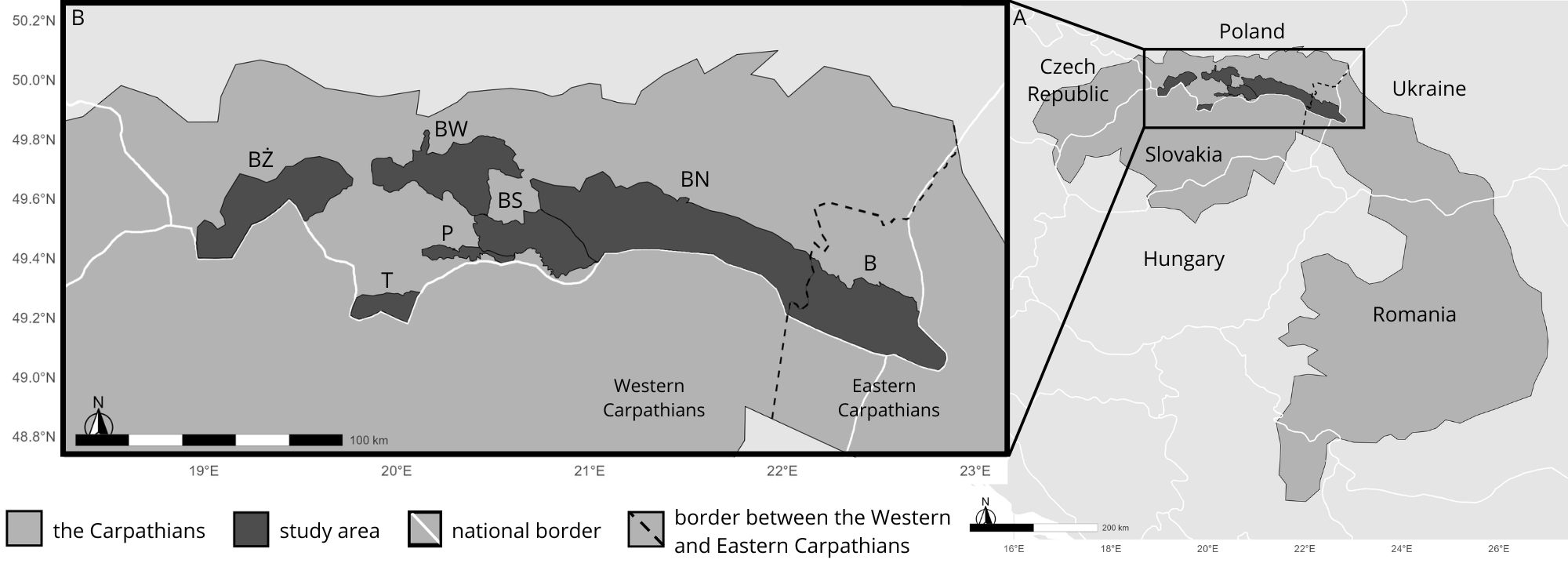
The Carpathians, the second-longest mountain range in Europe after the Alps and a major mountain range in Central Europe, form a natural arc stretching mainly through the Czech Republic, Slovakia, Poland, Hungary, Ukraine, and Romania (Figure 1A). In Poland, the Carpathians include several mountain ranges, such as the Beskids Mts., the Pieniny Mts., and the Tatra Mts., the latter being the highest. These mountains encompass a mosaic of diverse ecosystems, ranging from mixed lower-montane forests to alpine vegetation (Warszyńska, 1995).
The Carpathians have rarely been studied for nivicolous myxomycetes. Some data are available from the Romanian, Slovak, and Ukrainian Carpathians (e.g. Brândza, 1928; Wichanský, 1962; Leontyev et al., 2010, 2021; Krivomaz, 2015; Heluta, 2019; Bauernfeind et al., 2024). In addition, studies on nivicolous myxomycetes in the Polish Carpathians have been conducted sporadically, and their results are scattered in the literature. In this area, only 28 species of nivicolous myxomycetes have been reported (Drozdowicz, 1988; Drozdowicz, 1995; Drozdowicz, 1996; Komorowska & Drozdowicz, 1996; Drozdowicz, 2000; Magiera & Drozdowicz, 2004; Drozdowicz, 2006; Ronikier et al., 2008; Ronikier et al., 2010; Bochynek & Drozdowicz, 2012; Drozdowicz & Bochynek, 2016; Janik & Ronikier, 2016; Ronikier & Janik, 2020; Ronikier et al., 2022), which is a small part of the total Polish myxomycete diversity, which counts 279 species (Ronikier, 2022; Paul et al., 2023). This study aimed to report new localities of nivicolous myxomycete species not previously known from Poland.
Figure 1
Location of the Carpathian Mountains in European countries (A), and study area within the Polish part of the Carpathians (B). The study area includes the following mountain massifs: the Beskid Żywiecki Mts. (BŻ), the Beskid Wyspowy Mts. (BW), the Beskid Niski Mts. (BN), the Bieszczady Mts. (B), the Pieniny Mts. (P), the Beskid Sądecki Mts. (BS) and the Tatra Mts. (T).
. Materials and methods
The Carpathian Mts., approximately 1,300 km long and 100–200 km wide, are divided into three main sections: the Western, Eastern, and Southern Carpathians. The study was conducted in the Polish part of the range, located in the northern Western and northwestern Eastern Carpathians (Figure 1). The Western Carpathians are further divided into the Outer Western Carpathians, which include the Beskids and their foothills, and the Central Western Carpathians, which comprise the Tatra Mts. and the Pieniny Mts. The Outer Eastern Carpathians include the Bieszczady Mts. The Polish Carpathians are characterized by moderate mountain elevations, with some peaks locally exceeding 2,000 m above sea level (Kondracki, 2012). Fieldwork was conducted between 1983 and 2022, between April and June. Specimens were identified using the keys provided by Poulain et al. (2011). The macromorphological characteristics of the sporophores were studied using a stereoscopic microscope (NIKON SMZ1500). Photographs of the macroscopic structures were taken with a Leica M205 C stereomicroscope equipped with FusionOptics and an LED5000 HD illuminator (Leica, Wetzlar, Germany) and processed with Leica LAS X software. Micromorphological characters were observed on permanent slides prepared with Hoyer’s medium (Martin & Alexopoulos, 1969) using a NIKON Eclipse E600 compound microscope. Microphotographs were taken using a Nikon DS-Fi1 digital camera attached to a NIKON Eclipse E400 compound microscope. The specimens are deposited in the Myxomycetes collection of the Herbarium of the W. Szafer Institute of Botany, Polish Academy of Sciences (KRAM), and the Herbarium of the Institute of Botany of the Jagiellonian University (KRA).
. Results
The list of nivicolous myxomycetes new to Poland includes 11 species belonging to four genera: Badhamia, Diderma, Lamproderma, and Polyschismium, represented by 123 specimens. Three species were abundant in numerous localities: Diderma meyerae (41 specimens), D. microcarpum (32 specimens), and Lamproderma album (30 specimens). The latter species, however, was found only in one region of the Tatra Mts. The remaining species were reported from one to several locations. The sites where the species have been recorded are located in seven regions of the Polish Carpathians (Figure 1): the Beskid Żywiecki Mts. (BŻ), the Beskid Wyspowy Mts. (BW), the Beskid Niski Mts. (BN), the Pieniny Mts. (P), the Beskid Sądecki Mts. (BS), the Tatra (T) in the Western Carpathians, and the Bieszczady Mts. (B) in the Eastern Carpathians. The sampling sites ranged from an elevation of approximately 680 to 1730 m a.s.l. Many of these locations are situated within protected areas, such as the Tatra National Park, the Pieniny National Park, and the Bieszczady National Park. With our new findings, the list of nivicolous myxomycetes known from the Polish Carpathians now includes 39 species, and the diversity of myxomycetes in Poland has increased to 290 species. The list of species below is provided in alphabetical order and includes all sites for the given species.
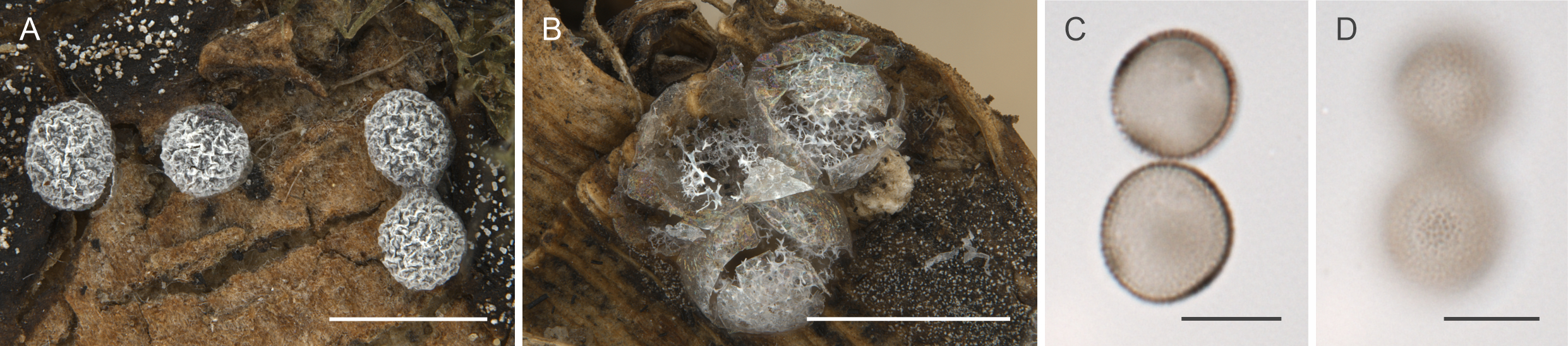
Badhamia alpina G. Lister (Figure 2)
Specimens examined: Beskid Żywiecki Mts., Jałowiec Mt., E ridge of the Jałowiec Mt., towards Zawoja-Wełcza, 49°39'23''N, 19°30'16''E, shrubs in mixed forest with Sorbus, 850 m, on bark of a twig, 02.05.2006, leg. A. Ronikier, M. Ronikier, Ron379 (KRAM M-3088); Tatra Mts., High Tatra Mts., above Morskie Oko Lake, by path towards Szpiglasowa Przełęcz Pass, wide gully, at a stream, 1520 m, on fallen plant stem (Umbelliferae), 23.06.1984, leg. A. Drozdowicz (UJ-KRA-S-2001, duplicate in KRAM M-2890).
Diderma meyerae H. Singer, G. Moreno, Illana & A. Sánchez (Figure 3A–C)
Specimens examined: Beskid Wyspowy Mts., N ridge of Mogielica, towards Chyszówka pass, 49°39'50''N, 20°17'00''E, edge of a forest, at a stream, 880 m, on plant remnants and mosses, 17.04.2005, leg. A. Ronikier, M. Ronikier, Ron234 (KRAM M-2898); Beskid Wyspowy Mts., N ridge of Mogielica, towards Chyszówka pass, 49°39'42''N, 20°16'40''E, beech forest with spruce, 990–1030 m, on plant remnants, 17.04.2005, leg. A. Ronikier, M. Ronikier, Ron237 (KRAM M-2899); Beskid Wyspowy Mts., vicinity of Półrzeczki village (S from Jurków), Kobylica Mt., summit area, S-W slopes, 49°38'05''N, 20°12'18''E, meadows, 900 m, on plant remnants, 09-04-2006, leg. A. Ronikier, M. Ronikier, Ron307b (KRAM M-2900); Pieniny Mts., at hiking trail, between Polana Majerz meadow and Przełęcz Szopka pass, 700–800 m, on grass culms, 10.04.2007, leg. A. Drozdowicz (UJ-KRA-S-2002; UJ-KRA-S-2003); Pieniny Mts., at yellow hiking trail from Krościekno nad Dunajcem to Trzy Korony, meadow at Pieniński Potok stream, 680 m, on plant shoots, 27.04.2007, leg. A. Drozdowicz (UJ-KRA-S-2004); on grass culms, 27.04.2007, leg. A. Drozdowicz (UJ-KRA-S-2005); on plant shoots (?Centaurea sp.), 27.04.2007, leg. A. Drozdowicz (UJ-KRA-S-2006); Tatra Mts., Western Tatra Mts., Dolina Bystrej valley – Dolina Kondratowa valley, area from Polana Kalatówki meadow to Hala Kondratowa, 1150–1450 m, on grass culms, 1983, leg. A. Drozdowicz (UJ-KRA-S-2053); on pressed plant remnants, 1983, leg. A. Drozdowicz (UJ-KRA-S-2054); on pressed grass culms, 1983, leg. A. Drozdowicz (UJ-KRA-S-2055); on pressed grass culms, 1983, leg. A. Drozdowicz (UJ-KRA-S-2056); on pressed grass culms, 1983, leg. A. Drozdowicz (UJ-KRA-S-2057); on plant shoots, 1983, leg. A. Drozdowicz (UJ-KRA-S-2058); on plant remnants, 1983, leg. A. Drozdowicz (UJ-KRA-S-2059); on plant remnants, 1983, leg. A. Drozdowicz (UJ-KRA-S-2060); on plant remnants, 1983, leg. A. Drozdowicz (UJ-KRA-S-2061); on plant remnants, 1983, leg. A. Drozdowicz (UJ-KRA-S-2062); on plant remnants, 1983, leg. A. Drozdowicz (UJ-KRA-S-2063); on plant remnants, 1983, leg. A. Drozdowicz (UJ-KRA-S-2064); Tatra Mts., Western Tatra Mts., Hala Kondratowa mountain pasture, near patch of melting snow, close to the mountain hostel, at the path to Giewont Mt., 1480 m, on cone of Picea abies, 05.05.1984, leg. A. Drozdowicz (UJ-KRA-S-2007); on plant shoots, 05.05.1984, leg. A. Drozdowicz (UJ-KRA-S-2008); Tatra Mts., Western Tatra Mts., Hala Kondratowa mountain pasture, near patch of melting snow, below a hut, 1440–1460 m, on plant remnants, 05.05.1984, leg. A. Drozdowicz (UJ-KRA-S-2009); Tatra Mts., Western Tatra Mts., Polana Kalatówki meadow, at hiking trail to Hala Kondratowa mountain pasture, at melting snow patch, 1000 m, on plant remnants, 07.05.1984, leg. A. Drozdowicz (UJ-KRA-S-2010; UJ-KRA-S-2011); on plant remnants, 12.05.1984, leg. A. Drozdowicz (UJ-KRA-S-2012); on grass culms, 12.05.1984, leg. A. Drozdowicz (UJ-KRA-S-2013); at a melting snow patch, on plant remnants, 1000 m, 14.05.1984, leg. A. Drozdowicz (UJ-KRA-S-2019); Tatra Mts., Western Tatra Mts., Hala Kondratowa mountain pasture, near patch of melting snow, close to the mountain hostel, 1480 m, on pressed plant remnants, 13.05.1984, leg. A. Drozdowicz (UJ-KRA-S-2014; UJ-KRA-S-2015); Tatra Mts., Western Tatra Mts., Hala Kondratowa mountain pasture, 1200 m, on pressed plant remnants, 13.05.1984, leg. A. Drozdowicz (UJ-KRA-S-2016; UJ-KRA-S-2017; UJ-KRA-S-2018); Tatra Mts., Western Tatra Mts., at hiking trail to Hala Gąsienicowa mountain pasture, vicinity of Boczań Mt., at melting snow patches, on plant remnants, 1260 m, 10.06.1984, leg. A. Drozdowicz (UJ-KRA-S-2020; UJ-KRA-S-2021); Tatra Mts., Western Tatra Mts., Hala Kondratowa mountain pasture, near patch of melting snow, close to the mountain hostel, on grass culms, 1460 m, 20.05.1985, leg. A. Drozdowicz (UJ-KRA-S-2022); on pressed plant remnants, 20.05.1985, leg. A. Drozdowicz (UJ-KRA-S-2023); Tatra Mts., Western Tatra Mts., Hala Kondratowa mountain pasture, close to the mountain hostel, toward path to Polana Kalatówki meadow, among spruces, 1280 m, on plant remnants, 20.05.1985, leg. A. Drozdowicz (UJ-KRA-S-2024; UJ-KRA-S-2025; UJ-KRA-S-2026); Tatra Mts., Western Tatra Mts., Czerwone Wierchy massif, at hiking trail from Ciemniak Mt. to Dolina Kościeliska valley, W slope of Upłazińska Kopka Mt., subalpine meadow, at melting snow, 49°15'49''N, 19°53'18''E, 1400 m, on plant remnants, dead grasses and living plants and mosses, 03.05.2000, leg. A. Ronikier, M. Ronikier, Ron7a (KRAM M-2888).
Figure 3
Morphological features of the Diderma species. (A–C) D. meyerae; (A) group of sporocarps (KRAM M-2899); (B–C) spores observed under a light microscope (KRAM M-2900); (D–F) D. microcarpum; (D) group of sporocarps (KRAM M-2902); (F–F) spores observed under a light microscope (KRAM M-2906). Scale bars: (A, D) = 1 mm; (B–C, E–F) = 10 μm.
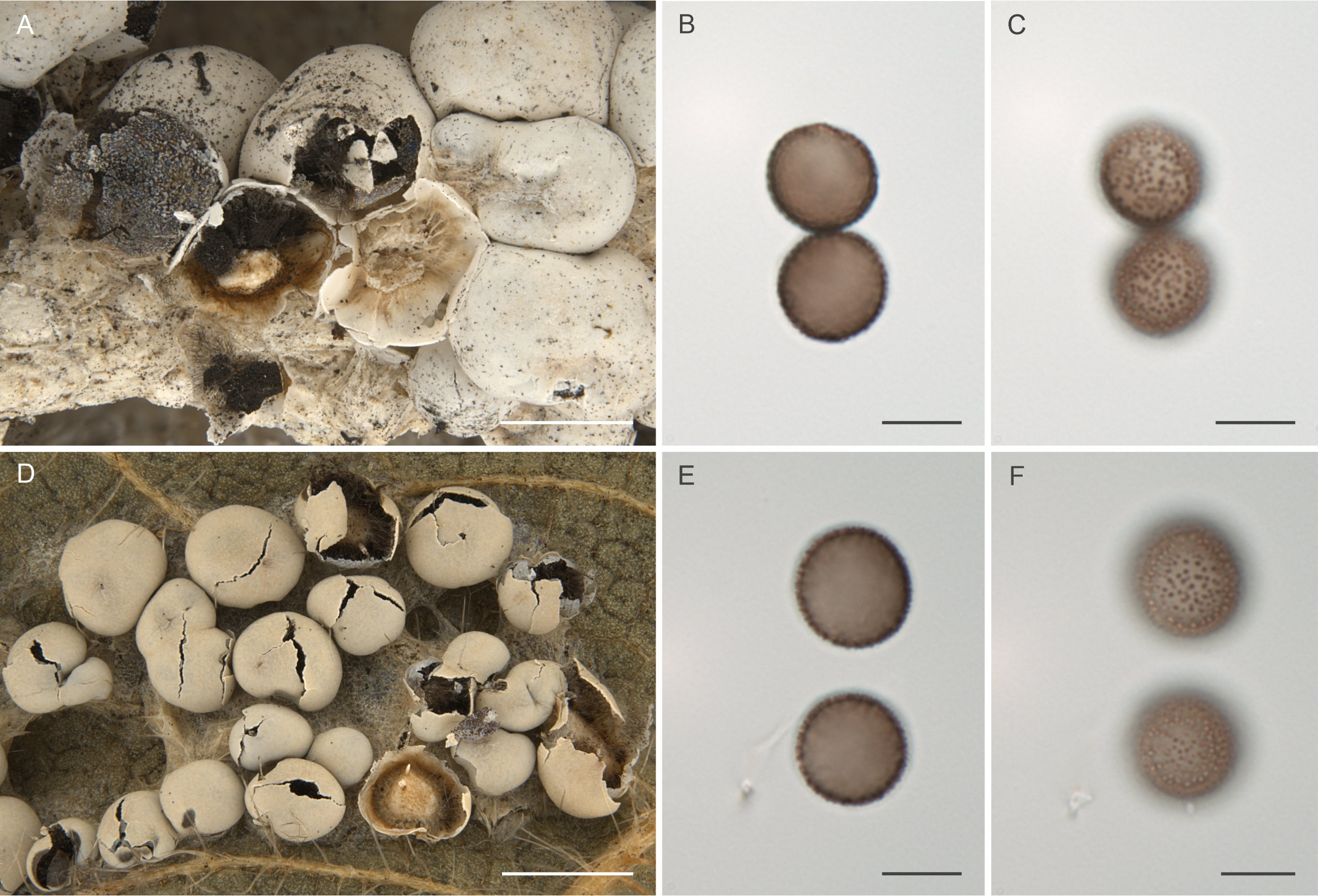
Diderma microcarpum Meyl. (Figure 3D–F)
Specimens examined: Beskid Niski Mts., Magurski National Park, Polana Świerzowska meadow, forest edge, 49°34'30"N, 21°23'41"E, 715 m, on shoots of Fagus sylvatica, 14.04.2015, leg. A. Drozdowicz (UJ-KRA-S-2030); meadow, on leaf of Rubus sp., 14.04.2015, leg. A. Drozdowicz (UJ-KRA-S-2031); on bark of fallen twig, 14.04.2015, leg. A. Drozdowicz (UJ-KRA-S-2032); on fronds of Athyrium distentifolium 14.04.2015, leg. A. Drozdowicz (UJ-KRA-S-2033); Beskid Sądecki Mts., Radziejowa range, Mała Prehyba, 49°27'48''N, 20°33'32''E, 1156 m, edge of a spruce forest, at the road, at snow patch, and meadow near forest, on plant shoots, 03.05.2009, leg. A. Ronikier, M. Ronikier, Ron664 (KRAM M-2907); Beskid Wyspowy Mts., N ridge of Mogielica, towards Chyszówka pass, 990–1030 m, 49°39'42'' N, 20°16'40'' E, beech forest with spruce, on fallen leaves, 17.04.2005, leg. A. Ronikier, M. Ronikier, Ron238 (KRAM M-2901); Beskid Wyspowy Mts., Lubomir and Łysina massif, ridge between Kudłacze mountain hostel and summit of Łysina, 850–980 m, 49°46'48''N, 20°02'45''E, mixed forest, on leaves and shoots of Rubus sp., 24.04.2005, leg. A. Ronikier, M. Ronikier, Ron263b (KRAM M-2902); on plant remnants, 24.04.2005, leg. A. Ronikier, M. Ronikier, Ron265b (KRAM M-2903); Beskid Wyspowy Mts., vicinity of Jurków town, Ćwilin massif, 49°41'17''N, 20°11'26''E, 100 m, on fallen leaf, 08.04.2006, leg. A. Ronikier, M. Ronikier, Ron287b (KRAM M-2904); on plant shoots, 08.04.2006, leg. A. Ronikier, M. Ronikier, Ron292b (KRAM M-2905); Beskid Żywiecki Mts., Pilsko Mt., at hiking trail to Hala Miziowa meadow, on shoots of Vaccinium myrtillus, 10.05.1995, leg. A. Drozdowicz (UJ-KRA-S-2037); Beskid Żywiecki Mts., Pilsko Mt., on shoots of Vaccinium myrtillus, 10.05.1995, leg. A. Drozdowicz (UJ-KRA-S-2038); Beskid Żywiecki Mts., at hiking trail between Przełęcz Przegibek pass and Wielka Rycerzowa Mt., 1000–1200 m, on shoots of Vaccinium myrtillus, 04.05.2013, leg. A. Drozdowicz (UJ-KRA-S-2039; UJ-KRA-S-2040); Beskid Żywiecki Mts., vicinity of the Schronisko Rysianka mountain hotel, 49°32'10"N, 19°14'03"E, 1290 m, meadow with Vaccinium myrtillus, on shoots of V. myrtillus, 09.05.1995, leg. A. Drozdowicz (UJ-KRA-S-2041); Beskid Żywiecki Mts., range of Polica, above the village Sidzina Wielka Polana, Hala Kucałowa meadow, on the ridge, 49°37'35''N, 19°38'37''E, 1150 m, on shoots of Vaccinium myrtillus, 23.04.2006, leg. A. Ronikier, M. Ronikier, Ron331b (KRAM M-2906); Bieszczady Mts., Mała Rawka Mt., vicinity of Bacówka pod Małą Rawką mountain hut, 49°07'04,49''N, 22°34'48,18''E, 930 m, on shoots of Vaccinium myrtillus, 16.04.2015, leg. A. Bochynek (UJ-KRA-S-2027); on grass culms, 16.04.2015, leg. A. Bochynek (UJ-KRA-S-2028); Bieszczady Mts., Połonina Caryńska, above forest, 49°07'22,4''N, 22°38'16,3''E, 1033 m, on shoots of Rubus sp.18.04.2015, leg. A. Bochynek (UJ-KRA-S-2029); Pieniny Mts., at blue-marked hiking trail, between Polana Majerz meadow and Przełęcz Szopka pass, 700–800 m, on grass culms, 10.04.2007, leg. A. Drozdowicz (UJ-KRA-S-2034); on grass culms and mosses, 10.04.2007, leg. A. Drozdowicz (UJ-KRA-S-2035); Pieniny Mts., at blue-marked hiking trail, between Bajków Groń Mt. and Trzy Korony Mt., 700–900 m, on shoots of Vaccinium myrtillus and Abies alba, 10.05.1992, leg. A. Drozdowicz (UJ-KRA-S-2036); Tatra Mts., Western Tatra Mts., Hala Kondratowa mountain pasture, near patch of melting snow, close to the mountain hostel, 1460 m, on leaves of Geum sp., 20.05.1985, leg. A. Drozdowicz (UJ-KRA-S-2042); on grass culm, 20.05.1985, leg. A. Drozdowicz (UJ-KRA-S-2043); Tatra Mts., Western Tatra Mts., Dolina Bystrej valley – Dolina Kondratowa valley, area from Polana Kalatówki meadow to Hala Kondratowa, 1150–1450 m, on plant remnants and spruce cone, 1983, leg. A. Drozdowicz (UJ-KRA-S-2065); on plant shoots, 1983, leg. A. Drozdowicz (UJ-KRA-S-2066); on fronds of Athyrium distentifolium, 1983, leg. A. Drozdowicz (UJ-KRA-S-2067); on grass culm, 1983, leg. A. Drozdowicz (UJ-KRA-S-2068); on shoots of Vaccinium myrtillus, 1983, leg. A. Drozdowicz (UJ-KRA-S-2069); on plant remnants, 1983, leg. A. Drozdowicz (UJ-KRA-S-2070); on plant shoots, 1987, leg. A. Drozdowicz (UJ-KRA-S-2071); on grass leaves, 1987, leg. A. Drozdowicz (UJ-KRA-S-2072); on frond of Athyrium distentifolium, 1987, leg. A. Drozdowicz (UJ-KRA-S-2073); Tatra Mts., High Tatra Mts., mouth of a gully descending from Koszysta Mt. to the Waksmundzka Polana, 49°15'17''N, 20°03'31''E, 1430 m, spruce forest, on plant shoots, 01.06.2008, leg. A. Ronikier, M. Ronikier, Ron627 (KRAM M-2863).
Lamproderma album H. Neubert, Nowotny & K. Baumann (Figure 4A–B)
Specimens examined: Tatra Mts., Western Tatra Mts., Czerwone Wierchy massif, N slopes of Upłazińska Kopa Mt. (Gładkie Upłazińskie), by a source, 1730 m, on tall herb shoots, 26.05.1984, leg. A. Drozdowicz (UJ-KRA-S-2044); Tatra Mts., Western Tatra Mts., at hiking trail to Hala Gąsienicowa mountain pasture, vicinity of Boczań Mt., at melting snow patches, 1260 m, on plant remnants, 10.06.1984, leg. A. Drozdowicz (UJ-KRA-S-2045); leg. A. Drozdowicz (UJ-KRA-S-2046); leg. A. Drozdowicz (UJ-KRA-S-2047); Tatra Mts., Western Tatra Mts., Czerwone Wierchy massif, Polana Upłaz meadow, N-W part of the meadow, 49°15'04.1''N, 19°52'47.8''E, 1303 m, on plant shoot, 19.05.2022, leg. J. Fijoł, P. Janik, A. Ronikier, Ron1255b (KRAM M-2650); on plant shoots, 19.05.2022, leg. J. Fijoł, P. Janik, A. Ronikier, Ron1257 (KRAM M-2652); Ron1265 (KRAM M-2660); on shoots of Rubus sp., 19.05.2022, leg. J. Fijoł, P. Janik, A. Ronikier, Ron1264 (KRAM M-2659); Ron1267 (KRAM M-2662); Ron1272 (KRAM M-2668); Ron1275 (KRAM M-2671); Ron1278 (KRAM M-2674); Ron1281 (KRAM M-2677); Tatra Mts., Western Tatra Mts., Czerwone Wierchy massif, at red-marked hiking trail to the Ciemniak Mt., S from the Piec Mt., 49°14'45.2''N, 19°53'11.3''E, 1553 m, 19.05.2022, on shoots of Rubus sp., leg. J. Fijoł, P. Janik, A. Ronikier, Ron1334 (KRAM M-2730); on plant shoots, leg. J. Fijoł, P. Janik, A. Ronikier, Ron1345 (KRAM M-2742); on leaf of Luzula sp., leg. J. Fijoł, P. Janik, A. Ronikier, Ron1347 (KRAM M-2744); on plant shoot, leg. J. Fijoł, P. Janik, A. Ronikier, Ron1361b (KRAM M-2758); on shoots of Vaccinium myrtillus, leg. J. Fijoł, P. Janik, A. Ronikier, Ron1363 (KRAM M-2760); on plant shoots, leg. J. Fijoł, P. Janik, A. Ronikier, Ron1386 (KRAM M-2782); Ron1391 (KRAM M-2787); Tatra mts., Western Tatra mts., the Dolina Kondratowa valley, near “Herbik” place, 49°15'07''N, 19°57'40''E, 1300 m, at a hiking trail, at melting snow, on plant remnants, leaves, mosses, 13.05.2002, leg. A. Ronikier, M. Ronikier, Ron49 (KRAM M-1015); Tatra Mts., High Tatra Mts., mouth of a gully descending from Koszysta Mt. to the Waksmundzka Polana, 49°15'17''N, 20°03'31''E, 1450 m, spruce forest, on shoot of Rubus sp., 25.05.2008, leg. A. Ronikier, M. Ronikier, Ron615b (KRAM M-2850); Tatra Mts., High Tatra Mts., forest to the east from Waksmundzka Rówień, by the tourist trail to the Dolina Waksmundzka, 49°15'20''N, 20°04'30''E, 1320 m, spruce forest, on shoots of Rubus sp., 25.05.2008, leg. A. Ronikier, M. Ronikier, Ron616 (KRAM M-2851); Ron618a (KRAM M-2852); Tatra Mts., High Tatra Mts., mouth of a gully descending from Koszysta Mt. to the Waksmundzka Polana meadow, spruce forest, 49°15'17''N, 20°03'31''E, 1430 m, on plant remnants, fallen leaf, 01.06.2008, leg. A. Ronikier, M. Ronikier, Ron620 (KRAM M-2855); on plant shoots, 01.06.2008, leg. A. Ronikier, M. Ronikier, Ron623 (KRAM M-2858); Ron628 (KRAM M-2864); on shoots of Vaccinium myrtillus, 01.06.2008, leg. A. Ronikier, M. Ronikier, Ron626a (KRAM M-2861); Tatra Mts., High Tatra Mts., a gully descending from Koszysta Mt. to the Waksmundzka Polana meadow, 49°15'10''N, 20°03'32''E, 1505 m, scrub of Salix silesiaca, on plant shoots, 01.06.2008, leg. A. Ronikier, M. Ronikier, Ron630 (KRAM M-2866); on plant shoot, 01.06.2008, leg. A. Ronikier, M. Ronikier, Ron632 (KRAM M-2868); on shoots of S. silesiaca, 01.06.2008, leg. A. Ronikier, M. Ronikier, Ron633 (KRAM M-2869); Tatra Mts., High Tatra Mts., a gully descending from Koszysta Mt. to the Waksmundzka Polana meadow, 49°15'03''N, 20°03'28''E, 1630 m, scrub of Salix silesiaca, on shoots of (?) S. silesiaca, 01.06.2008, leg. A. Ronikier, M. Ronikier, Ron640 (KRAM M-2874).
Figure 4
Morphological features of Lamproderma species. (A–C) Lamproderma album; (A) sporocarps with visible white capillitium (KRAM M-2668); (B) capillithal threads observed under a light microscope (KRAM M-2668); (C–E) L. cristatum; (C) sporocarps (KRAM M-2328); (D–E) spores observed under a light microscope (KRAM M-2328); (F–G) L. cucumer; (F) sporocarps (KRAM M-2895); (G) elongated sporocyst observed under a light microscope (KRAM M-2895). Scale bars: (A, C, F) = 1 mm; (B, D–E) = 10 μm; (G) = 100 μm.
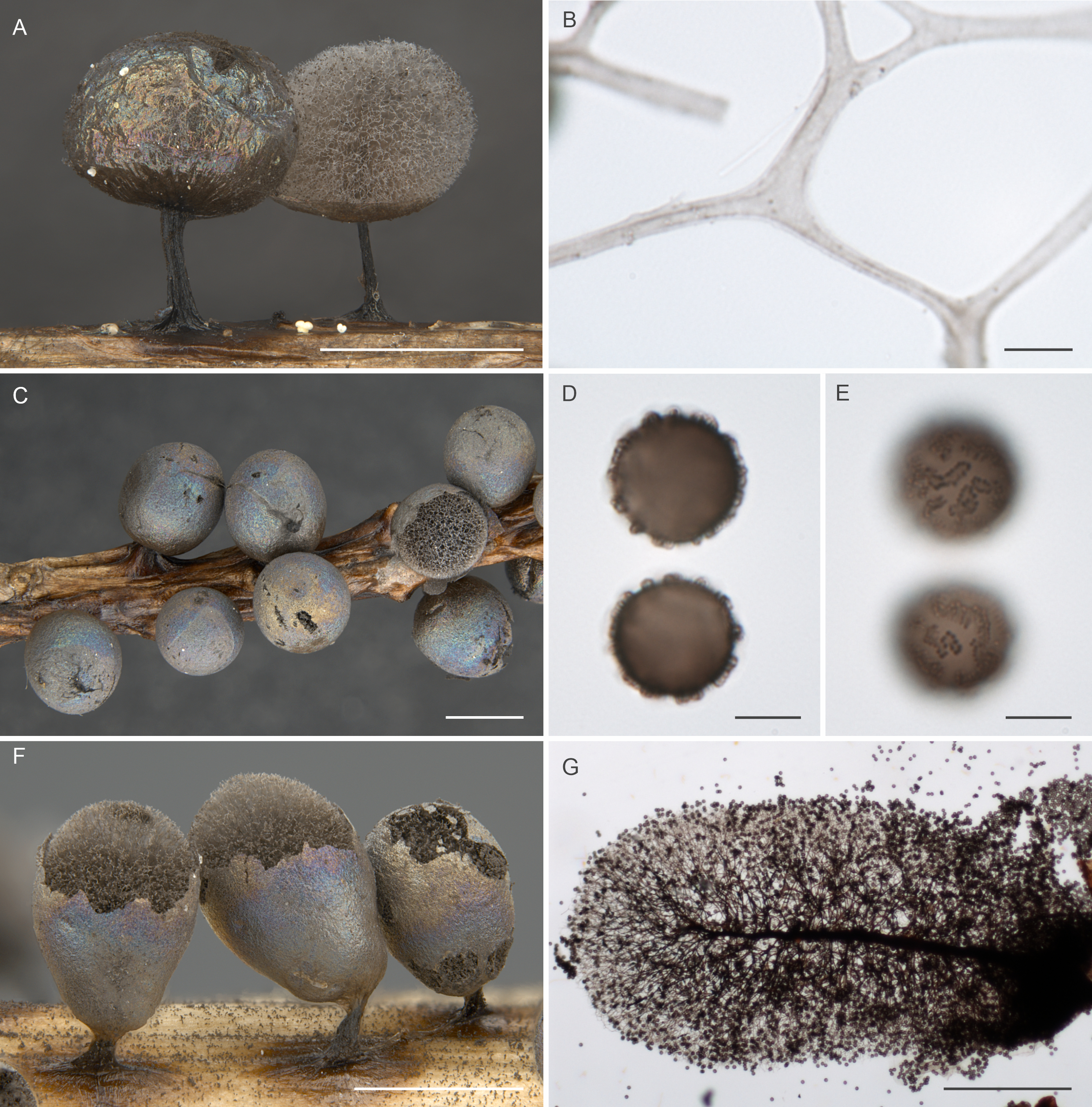
Lamproderma cristatum Meyl. (Figure 4C–E)
Specimens examined: Beskid Żywiecki Mts., Jałowiec Mt., E ridge of the Jałowiec Mt., towards Zawoja-Wełcza, 49°39'23''N, 19°30'16''E, 850 m, shrubs in mixed forest with Sorbus, on shoots of Rubus sp., 02.05.2006, leg. A. Ronikier, M. Ronikier, Ron383 (KRAM M-2891); Tatra Mts., Western Tatra Mts., Czerwone Wierchy massif, vicinity of N-W part of the Polana Upłaz meadow, edge of spruce forest, 49°15'05.0''N, 19°52'46.4''E, 1299 m, on spruce shoots, plant remnants and mosses, 28.04.2020, leg. A. Ronikier, Ron920 (KRAM M-2328); on plant shoots, 28.04.2020, leg. A. Ronikier, Ron922a (KRAM M-2330); on mosses, 28.04.2020, leg. A. Ronikier, Ron938 (KRAM M-2348); on plant remnants, 28.04.2020, leg. A. Ronikier, Ron958 (KRAM M-2368); on shoots of Picea abies, 09.05.2020, leg. P. Janik, A. Ronikier, Ron1032 (KRAM M-2444).
Lamproderma cucumer (Meyl.) Nowotny & H. Neubert (Figure 4F–G)
Specimens examined: Beskid Niski Mts., Magurski National Park, Ciechania, Dolina Ciechani valley, 500–600 m, meadow, on plant shoots, 13.04.2015, leg. A. Drozdowicz (UJ-KRA-S-2048, duplicate in KRAM M-2895); on plant remnants, 14.04.2015, leg. A. Drozdowicz (UJ-KRA-S-2049, duplicate in KRAM M-2894).
Lamproderma piriforme (Meyl.) Mar.Mey. & Poulain (Figure 5A–C)
Specimens examined: Tatra Mts., Western Tatra Mts., at hiking trail to Hala Gąsienicowa mountain pasture, vicinity of Boczań Mt., at melting snow patches, 1260 m, 10.06.1984, on shoots of Aconitum sp., leg. A. Drozdowicz (UJ-KRA-S-2050, duplicate in KRAM M-2896); Beskid Żywiecki Mts., Babiogórski Park Narodowy, Babia Góra Mt., at red-marked hiking trail from Markowe Szczawiny mountain hostel to the summit of Babia Góra, above 1200 m, 1983, shoots of Vaccinium myrtillus, leg. A. Drozdowicz (UJ-KRA-S-2051).
Figure 5
Morphological features of Lamproderma species. (A–C) Lamproderma piriforme; (A) sporocarps (KRAM M-2896); (B–C) spores observed under a light microscope (KRAM M-2896); (D–E) L. pseudomaculatum; (D) sporocarps (KRAM M-2771); (E) peridium with visible dark patches observed under a light microscope (KRAM M-2771); (F–G) L. pulchellum; (F) sporocarps (KRAM M-2892); (G) capillitium observed under a light microscope (KRAM M-2892). Scale bars: (A, D, F) = 1mm; (B–C) = 10 μm; (E) = 50 μm; (G) = 100 μm.
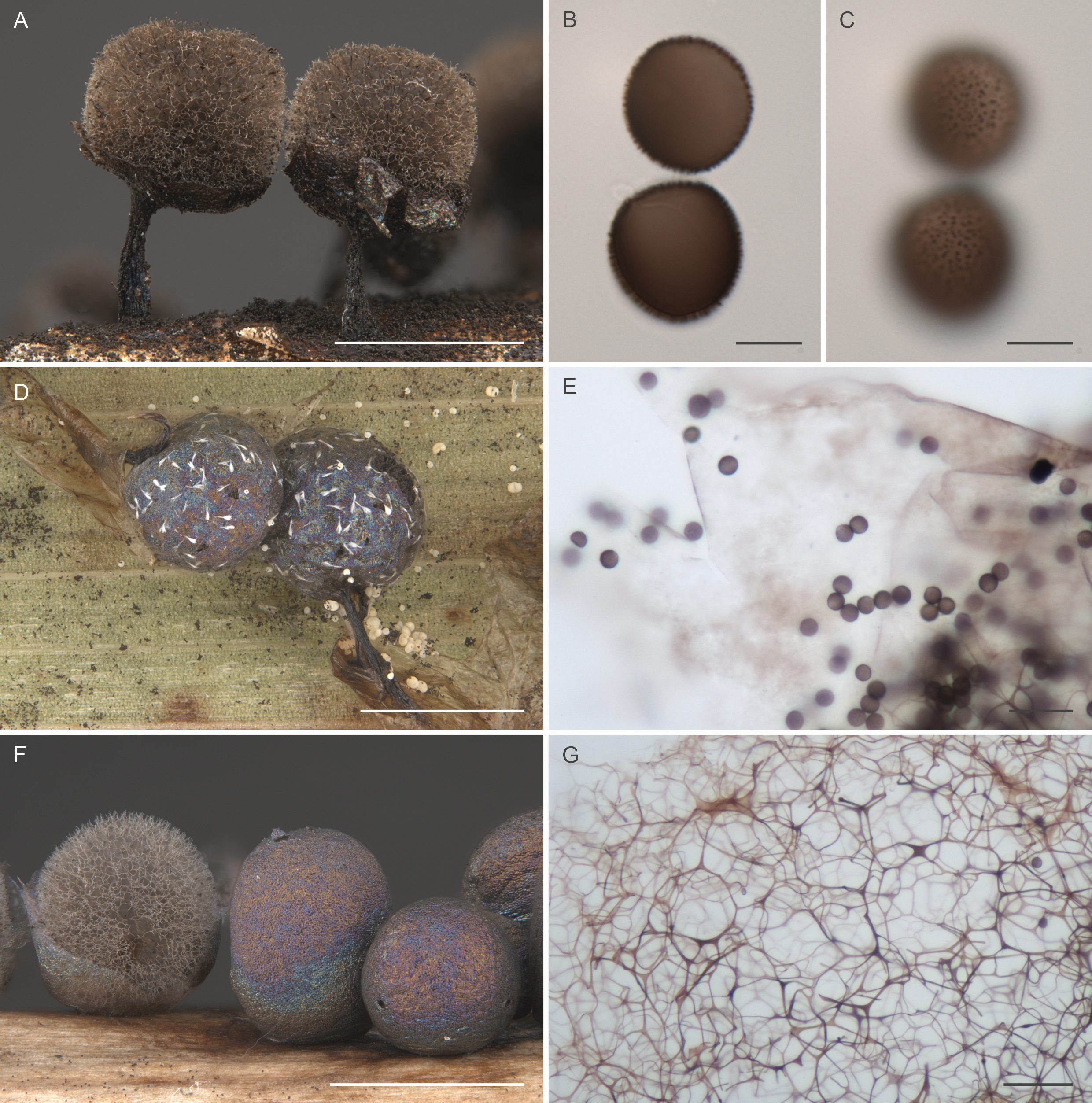
Lamproderma pseudomaculatum Mar.Mey. & Poulain (Figure 5D–E)
Specimens examined: Tatra Mts., Western Tatra Mts., Czerwone Wierchy massif, at red-marked hiking trail to the Ciemniak Mt., S from the Piec Mt., 49°14'45,2''N, 19°53'11,3''E, 1553 m, on leaves of Luzula sp.,19.05.2022, leg. J. Fijoł, P. Janik, A. Ronikier, Ron1374 (KRAM M-2771).
Lamproderma pulchellum Meyl. (Figure 5F–G)
Specimens examined: Beskid Żywiecki Mts., range of Polica, above the village Sidzina Wielka Polana, the Dolina Zakulwaki (Psia Dolina) valley, SW slopes of the mount Okrąglica, 49°37'12''N, 19°39'19''E, 1050 m, on shoots of Rubus sp. and leaves of Luzula sp., 23.04.2006, leg. A. Ronikier, M. Ronikier, Ron320a (KRAM M-2892); Beskid Sądecki Mts., the Radziejowa range, Mała Prehyba, edge of a spruce forest, at the road, at snow patch, and meadow near forest, 49°27'48''N, 20°33'32''E, 1156 m, on shoots of Vaccinium myrtillus, 03.05.2009, leg. A. Ronikier, M. Ronikier, Ron661 (KRAM M-2893).
Polyschismium alpestroides (Mar.Mey. & Poulain) A. Ronikier, J. M. García-Martín, A. Kuhnt, J. C. Zamora, M. de Haan, Janik & Lado (Figure 6A–C)
Specimens examined: Tatra Mts., High Tatra Mts., mouth of a gully descending from Koszysta Mt. to the Waksmundzka Polana, 49°15'17''N, 20°03'31''E, 1430 m, spruce forest, 01.06.2008, on shoots of Vaccinium myrtillus, leg. A. Ronikier, M. Ronikier, Ron622b (KRAM M-2857).
Figure 6
Morphological features of the Polyschismium species. (A–C) P. alpestroides; (A) open plasmodiocarp (KRAM M-2857); (B–C) spores observed under a light microscope (KRAM M-2857); (D–E) P. granuliferum; (D) closed plasmodiocarp (KRAM M-UJ-KRA-S-2052); (E) stellate capillitium with lime nodules observed under a light microscope (UJ-KRA-S-2052). Scale bars: (A, D) = 1 mm; (B–C) = 10 μm; (E) = 100 μm.
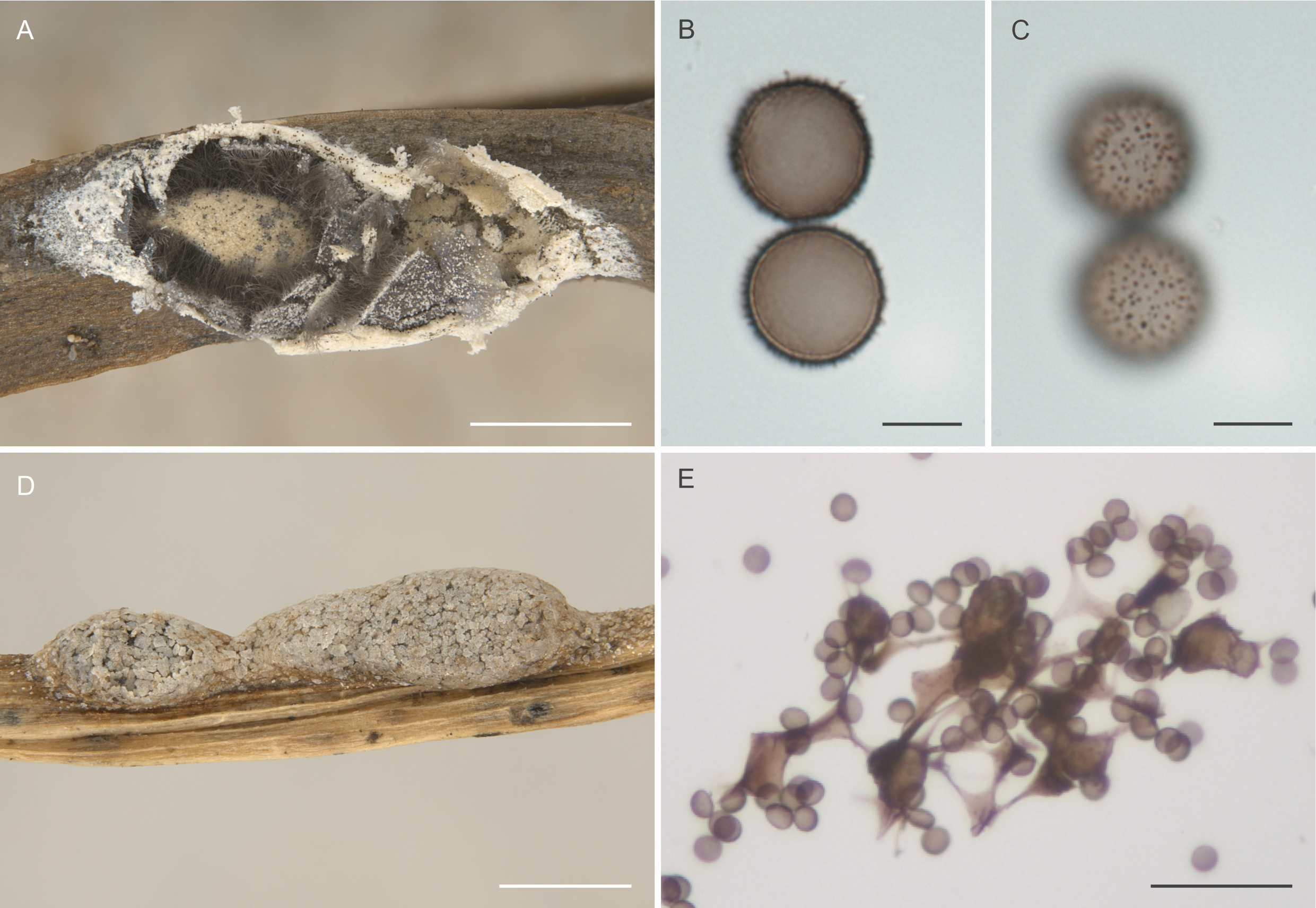
Polyschismium granuliferum (W. Phillips.) A. Ronikier, J. M. García-Martín, A. Kuhnt, J. C. Zamora, M. de Haan, Janik & Lado (Figure 6D–E)
Specimens examined: Beskid Żywiecki Mts., Babiogórski Park Narodowy, Babia Góra Mt., at red-marked hiking trail from Markowe Szczawiny mountain hostel to the summit of Babia Góra Mt., above 1200 m, 1983, on grass culm, leg. A. Drozdowicz (UJ-KRA-S-2052).
. Discussion
The list of nivicolous myxomycetes new to Poland comprises 11 species. Among them are species considered very rare or globally scarce, such as Badhamia alpina, Lamproderma album, L. cristatum, L. cucumer, L. piriforme, L. pulchellum, L. pseudomaculatum, Polyshismium alpestroides, and P. granuliferum. In contrast, two other species, Diderma meyerae and D. microcarpum, are widespread in Europe and are locally very common, especially in the alpine and subalpine habitats of the Alps (Kuhnt, 2009; Shchepin et al., 2024; Inoue et al., 2024). They have also been found at the largest number of sites in the Polish Carpathians since the 1980s (see dates of collection above). However, because taxonomic status of Diderma microcarpum was unclear and D. meyerae has been described relatively recently, the two species have not been distinguished from the D. alpinum-niveum group until the morphological differences between all nivicolus Diderma species were correctly identified by Poulain et al. (2011). Some of the newly recorded species are known from only a few localities worldwide. Badhamia alpina has been described from the Swiss Alps, the Swiss Jura, and the Scandinavian mountains in Sweden (Lister, 1914) and has recently been reported from the French and Italian Alps (Meyer, 2010; Gallinari & Ferrari, 2013) and Japan (Yajima et al., 2018). Polyschismium alpestroides has been described from the French and Austrian Alps and the mountains of Japan (Poulain et al., 2002) and has recently been reported from the Ukrainian Carpathians (Leontyev et al., 2010), German Alps (Kuhnt, 2014; Ronikier et al., 2022), the Scandinavian mountains in Norway (Johannesen & Vetlesen, 2020), and the Khibiny Mts. in Russia (Erastova et al., 2017), whereas P. granuliferum is more widespread (see Ronikier & Ronikier, 2009 and literature cited there; Sánchez & Moreno, 2016; Moreno et al., 2018; Dussaussois et al., 2019).
To the best of our knowledge, six species, Badhamia alpina, Lamproderma cristatum, L. cucumer, L. piriforme, L. pseudomaculatum, and Polyshismium granuliferum, are reported here for the first time from the Carpathians. The other five species have been already found in the Ukrainian Carpathians: Polyschismium alpestroides in the Synevyr National Park (Leontyev et al., 2010), Diderma microcarpum and Lamproderma album in the Carpathian National Nature Park (Heluta, 2019; Leontyev et al., 2021), and L. pulchellum and Diderma meyerae with no exact location (Krivomaz, 2015).
The new species were collected during incidental field surveys initiated by Anna Drozdowicz and undertaken over nearly 40 years in various regions of the Polish Carpathians. Systematic and continuous field surveys are essential for obtaining reliable data on the diversity and distribution of nivicolous myxomycetes. Most newly recorded species have been found at a limited number of sites and over an extended period, highlighting that short-term or spatially limited surveys can overlook much of the true diversity. This underscores the importance of repeated surveys and consideration of diverse sites to achieve a more comprehensive understanding of the distribution and occurrence of these organisms in the Carpathian region. Moreover, systematic field surveys provide valuable long-term data, allowing the analysis of potential environmental factors affecting the occurrence of nivicolous myxomycetes. The finding of 11 species of nivicolous myxomycetes new to Poland in the Carpathians confirms that the region is characterized by a high diversity of this group of organisms. The presence of several rare species, hitherto known from a limited number of sites in other mountain ranges worldwide, indicates the importance of conducting studies in each mountain massif to reveal the complete distribution patterns of nivicolous myxomycetes.