
. Introduction
The Ujście Warty National Park is the youngest national park in Poland. It was established in 2001, mainly for the protection of wetland birds and their habitats. It is located within the Gorzów Basin mesoregion, in the north-western part of the Lubuskie Voivodeship, at the confluence of three rivers: Odra, Warta and Postomia. A characteristic feature of the park’s landscape are vast open areas – reed beds, wet meadows, and pastures, which together cover an area of almost 8,000 hectares. In contrast, forest communities are sparse and scattered, constituting only 1% of the park’s area.
While information about birds nesting or flying here is very extensive, data on the occurrence of organisms from other taxonomic groups is far from complete and requires much supplementation. This is particularly true for spore-bearing organisms, including lichens.
The current area of the national park so far has not been studied in detail from a lichenological perspective. Data on the occurrence of lichens can be found in some German publications (Hillmann, 1923, 1925, 1936, 1939; Hillmann & Grummann, 1957; Schultz-Korth, 1931), as well as in the phytosociological study by Filipek (1974); more extensive mentions were included in the articles by Lipnicki (1992) and Grochowski (2005). The list compiled from literature sources contains several dozen species, mainly common or frequent. Most of them, however, were recorded not within the park, but in its buffer zone and adjacent areas. The only information directly relating to the area of the national park is included in the draft of the current conservation plan (Grochowski, 2013), according to which 94 species of lichens occur in the park; however, only a dozen or so protected and otherwise interesting ones were listed.
Open areas covered with grasses and reeds are generally not particularly rich in lichens, which can be confirmed, for example, by the small number of these organisms found in another Polish national park of a similar nature: the Narwiański National Park (153 species; Matwiejuk, 2015). However, even in such areas there are potential habitats suitable for lichen vegetation, e.g. single trees, stumps, and logs, as well as various hydrotechnical structures made of concrete. The aim of the research conducted between 2022 and 2024 was to supplement the knowledge on the various systematic groups of organisms inhabiting the Ujście Warty National Park and adjacent areas, as well as to determine the species composition and distribution of lichen biota in relation to the substrate they occupy.
. Material and methods
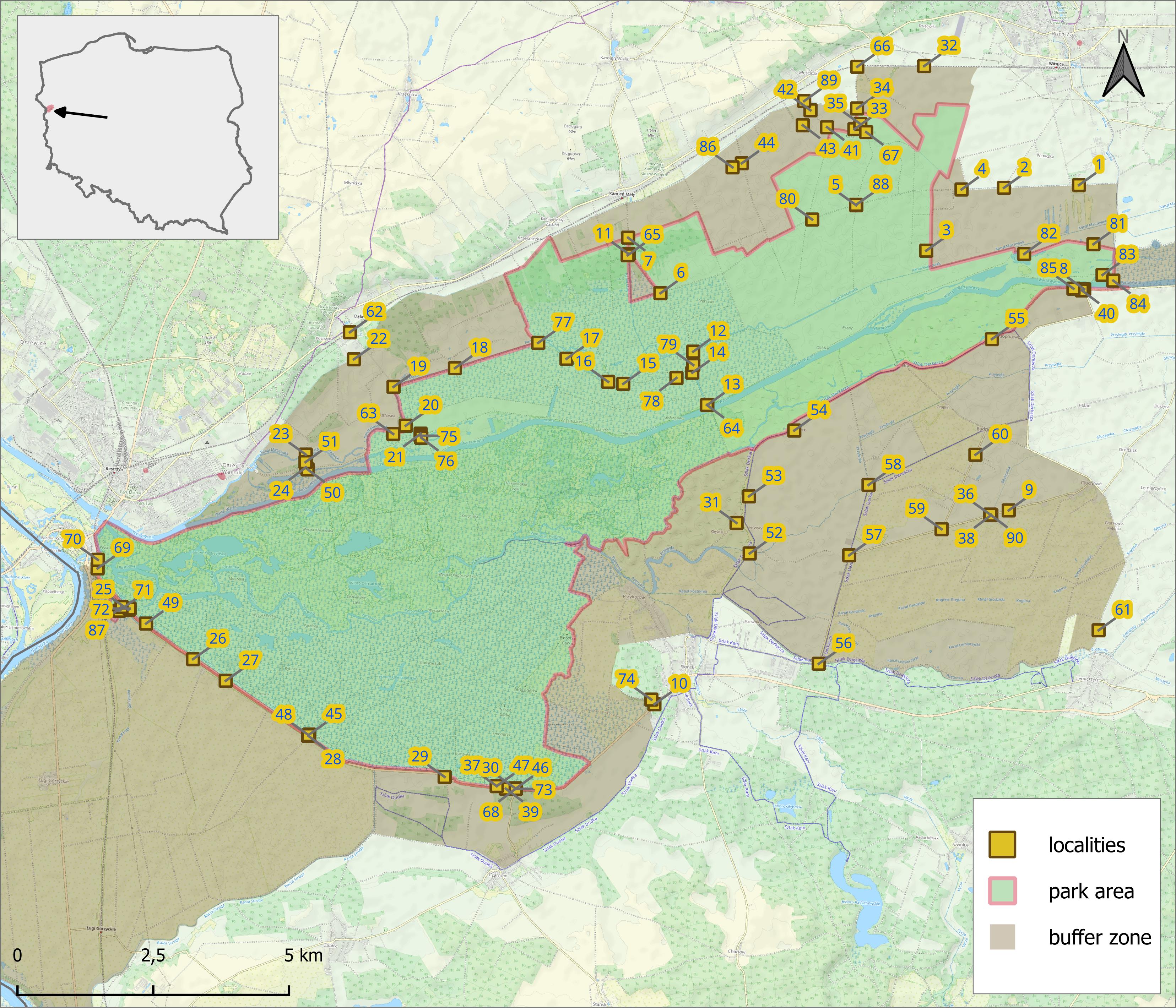
The research was conducted at 90 research sites, including 58 within the park and 32 in its buffer zone (Figure 1). The sites were not evenly distributed due to the specificity of the Ujście Warty National Park, the central part of which is occupied by difficult-to-access, but also unfavourable for lichen vegetation, reed beds and other wetland habitats. At each site, all potential habitats and substrates were examined, in particular: tree trunks and branches, dead wood, and various concrete structures. The collection of lichens was limited to only those specimens that could not be identified in the field; in such cases, small fragments of thalli were collected for identification under laboratory conditions. A permit for collection in the protected area was obtained from the Ministry of Climate and Environment (DOP-WOPPN.61.167.2024.MŚP). The herbarium materials were deposited in the herbaria of the University of Gdańsk (UGDA-L) and the University of Wrocław (WRSL).
The lichens were identified in the laboratory by classical methods, using a light microscope and standard reagents: 10% potassium hydroxide (K), sodium hypochlorite (C), p-phenylenediamine in ethanol (Pd) and Lugol’s iodine (I). In the case of sterile crustose lichens, the content of secondary metabolites was determined by thin-layer chromatography in solvents A and C (Kubiak & Kukwa, 2011). Lichen nomenclature follows Fałtynowicz et al. (2024).
(1) Żółta Droga road, south of the village of Witnica, 52.64822° N, 14.90405° E; (2) Żółta Droga road, south of the village of Witnica, 52.64706° N, 14.88374° E; (3) Żółta Droga road, south of the village of Witnica, 52.63594° N, 14.86360° E; (4) Żółta Droga road, southwest of the village of Witnica, 52.64639° N, 14.87224° E; (5) intersection of Żółta Droga and Mościczkowa Droga roads, south of the village of Mościczki, 52.64278° N, 14.84391° E; (6) “Olszynki” parking lot, south of the village of Kamień Mały, 52.62638° N, 14.79216° E; (7) road from the village of Kamień Mały to the “Olszynki” parking lot, 52.63523° N, 14.78251° E; (8) road between the villages of Oksza and Kłopotowo, 52.63108° N, 14.90708° E; (9) road between the villages of Jamno and Głuchowo, 52.59383° N, 14.89003° E; (10) near the museum building in the village of Słońsk, 52.55844° N, 14.79703° E; (11) the Kamieńska Grobla dike, 52.63255° N, 14.78294° E; (12) the Kamieńska Grobla dike, 52.61704° N, 14.80197° E; (13) “Niwka” rest area on the northern embankment of the Warta River, 52.60837° N, 14.80665° E; (14) intersection of Bobrowa Droga road and the Kamieńska Grobla dike, 52.61355° N, 14.80206° E; (15) Bobrowa Droga road, 52.61105° N, 14.78351° E; (16) Bobrowa Droga road, 52.61123° N, 14.77940° E; (17) near the observation tower at Bobrowa Droga road, 52.61463° N, 14.76772° E; (18) intersection of Bobrowa Droga and Poprzeczna Wschodnia roads, 52.61200° N, 14.73762° E; (19) tourist shelter at the “Dąbroszyn” rest area, western end of the Bobrowa Droga road, 52.60831° N, 14.72126° E; (20) concrete bridge on Dąbroszyńska Droga road, 52.60202° N, 14.72520° E; (21) near the “Śluza” rest area, end of the Dąbroszyńska Droga road, 52.60085° N, 14.72937° E; (22) southern end of the village of Dąbroszyn, 52.61248° N, 14.71007° E; (23) road east of the town of Kostrzyn, 52.59626° N, 14.69856° E; (24) northern embankment of the Warta River, 52.59416° N, 14.69880° E; (25) Nature Path “Mokradła” near the village of Chyrzyno, 52.56886° N, 14.65303° E; (26) main road between the villages of Chyrzyno and Słońsk, 52.56137° N, 14.67134° E; (27) village of Żabczyn, 52.558119° N, 14.680534° E; (28) “Strefa” viewpoint by the main road between the villages of Chyrzyno and Słońsk, 52.54985° N, 14.70379° E; (29) main road between the villages of Chyrzyno and Słońsk, 52.54439° N, 14.74138° E; (30) the Czarnowska Górka hill, north of the village of Czarnów, 52.54320° N, 14.76069° E; (31) Szeroka Droga road, northeast of the village of Przyborów, 52.58916° N, 14.81644° E; (32) railway tracks between the villages of Mościczki and Witnica, 52.66642° N, 14.86017° E; (33) meadow south of the village of Mościczki, 52.65533° N, 14.84222° E; (34) Mościczkowa Droga road, 52.65878° N, 14.84261° E; (35) inland dune, southeast of the village of Mościczki, 52.65625° N, 14.84374° E; (36) road between the villages of Jamno and Głuchowo, 52.59295° N, 14.88511° E; (37) inland dune by the Czarnowska Górka hill, 52.54338° N, 14.75563° E; (38) concrete culvert near the village of Jamno, 52.59291° N, 14.88538° E; (39) inland dune by the Czarnowska Górka hill, 52.54305° N, 14.75813° E; (40) alder forest by the Wał Wschodni dike, 52.63085° N, 14.90648° E; (41) road south of the village of Mościczki, 52.65539° N, 14.83475° E; (42) road south of the village of Mościczki, 52.65803° N, 14.82999° E; (43) railway tracks at the village of Mościczki, 52.65549° N, 14.82813° E; (44) meadow south of the village of Mościczki, 52.64862° N, 14.81219° E; (45) main road between the town of Kostrzyn town and the village of Słońsk, 52.55007° N, 14.70403° E; (46) observation tower by the Czarnowska Górka hill, 52.54316° N, 14.76082° E; (47) grassland on the slope of the Czarnowska Górka hill, 52.54340° N, 14.75564° E; (48) concrete platform by the “Strefa” viewpoint, 52.54997° N, 14.70385° E; (49) concrete viewpoint near the village of Chyrzyno, 52.56678° N, 14.65804° E; (50) northern embankment of the Warta River, 52.59383° N, 14.69933° E; (51) near the pumping station, western end of the northern embankment of the Warta River, 52.59502° N, 14.69861° E; (52) pumping station on the Przyległa River, 52.58426° N, 14.82047° E; (53) pasture by the Wał Wschodni dike, 52.59368° N, 14.81939° E; (54) ruins of the farm “Budachówek”, 52.60498° N, 14.83063° E; (55) sand pit, west of the village of Kłopotowo, 52.62196° N, 14.88282° E; (56) concrete bridge over the Postomia River near the village of Słońsk, 52.56669° N, 14.84092° E; (57) concrete bridge on the road between the villages of Słońsk and Głuchowo, 52.58490° N, 14.84747° E; (58) concrete bridge over the Przyległa River, 52.59670° N, 14.85162° E; (59) concrete bridge in the village of Jamno, 52.59009° N, 14.87211° E; (60) power poles in the village of Jamno, 52.60270° N, 14.88014° E; (61) road north of the village of Lemierzyce, 52.57487° N, 14.91625° E; (62) railway tracks at the village of Dąbroszyn, 52.61690° N, 14.70855° E; (63) wooden shelter at the “Śluza” rest area, 52.60052° N, 14.72194° E; (64) wooden shelter at the “Niwka” rest area, 52.60836° N, 14.80655° E; (65) alder forest by the Kamieńska Grobla dike, 52.63233° N, 14.78266° E; (66) railway tracks near the village of Mościczki, 52.66566° N, 14.84201° E; (67) grassland by Mościczkowa Droga road, 52.65496° N, 14.84545° E; (68) rest area by the Czarnowska Górka hill, 52.54316° N, 14.76082° E; (69) southern end of the town of Kostrzyn, 52.57541° N, 14.64400° E; (70) southern end of the town of Kostrzyn, 52.57682° N, 14.64394° E; (71) educational garden next to the park management building in the village of Chyrzyno, 52.56862° N, 14.65056° E; (72) main road in the village of Chyrzyno, 52.56909° N, 14.65334° E; (73) main road between the villages of Chyrzyno and Słońsk, 52.54311° N, 14.76080° E; (74) concrete road at the museum building in the village of Słońsk, 52.55917° N, 14.79614° E; (75) northern embankment of the Warta River, 52.60051° N, 14.72939° E; (76) Stara Warta oxbow lake near the northern embankment of the Warta River, 52.60017° N, 14.72960° E; (77) meadow by the Marszówek canal, 52.61699° N, 14.75979° E; (78) Bobrowa Droga road, 52.61253° N, 14.79785° E; (79) Bobrowa Droga road, 52.61483° N, 14.80221° E; (80) Żółta Droga road, 52.64000° N, 14.83218° E; (81) embankment, west of the pumping station on the Witna River, 52.63859° N, 14.90890° E; (82) northern shore of the Sierżant lake, 52.63632° N, 14.89024° E; (83) thickets near the bridge over the Warta River, 52.63360° N, 14.91184° E; (84) bridge over the Warta River, 52.63276° N, 14.91484° E; (85) embankment of the Warta River near the village of Kłopotowo, 52.63106° N, 14.90416° E; (86) meadow, east of the village of Kamień Mały, 52.64786° N, 14.80973° E; (87) parking lot in front of the park management building in the village of Chyrzyno, 52.56928° N, 14.65112° E; (88) intersection of Żółta Droga and Mościczkowa Droga roads, 52.64285° N, 14.84384° E; (89) road south of the village of Mościczki, 52.65949° N, 14.82813° E; (90) road between the villages of Jamno and Głuchowo, 52.59295° N, 14.88511° E.
. Results
. List of lichen species found in the “Ujście Warty” National Park and its buffer zone
The list includes all lichen species recorded during the research, as well as the currently unconfirmed taxa listed in the draft conservation plan (Grochowski, 2013). The species are arranged in alphabetical order. Information on habitat and substrate is provided for each taxon, followed by the number and list of sites in the park (NP) and buffer zone (BF). The number of sites is given in square brackets. Unconfirmed species are written in without bolded font.
Acarospora fuscata (Nyl.) Arnold – Grochowski (2013), not confirmed.
Acarospora moenium (Vain.) Räsänen – on concrete and dust-impregnated stones. NP: Grochowski (2013), not confirmed. BZ [3]: 52, 62, 66.
Amandinea punctata (Hoffm.) Coppins & Scheid. – on bark of deciduous trees and shrubs (Betula spp., Quercus robur, Fraxinus excelsior, Alnus glutinosa, Salix spp., Populus nigra, Rhamnus cathartica, Robinia pseudacacia, Sambucus nigra, Ulmus scabra) and on wood. NP [18]: 8, 13, 26, 27, 33, 40, 45, 46, 68, 71, 73, 74, 76, 81, 82, 83, 84, 86. :BZ [12]: 10, 24, 32, 41, 42, 44, 50, 53, 62, 66, 75, 90.
Anisomeridium polypori (Ellis & Everh.) M.E. Barr – on bark of Populus nigra and Salix spp. NP [2]: 69, 78. BZ [1]: 9.
Arthonia radiata (Pers.) Ach. – on bark of Alnus glutinosa. NP [1]: 65.
Athallia cerinella (Nyl.) Arup, Frödén & Søchting – on bark of Populus nigra, Sambucus nigra and Salix spp., and on wood. NP [11]: 14, 55, 69, 71, 72, 74, 75, 78, 81, 84, 86. BZ [6]: 24, 34, 42, 61, 89, 90.
Athallia pyracea (Ach.) Arup, Frödén & Søchting – on bark of Fraxinus excelsior, Populus nigra, P. tremula, Salix spp. Sambucus nigra and on wood. NP [9]: 3, 4, 14, 25, 26, 46, 68, 71, 72. BZ [8]: 24, 32, 35, 41, 53, 57, 61, 90.
Buellia aethalea (Ach.) Th. Fr. – Grochowski (2013), not confirmed.
Buellia griseovirens (Turner & Borrer ex Sm.) Almb. – on wood. NP [2]: 47, 86.
Caeruleum heppii (Arnold) K. Knudsen & Arcadia – Grochowski (2013), not confirmed.
Calogaya decipiens (Hoffm.) Arup, Frödén & Søchting – on concrete. NP [1]: 18. BZ [3]: 51, 52, 60.
Calogaya pusilla (A. Massal.) Arup, Frödén & Søchting – on concrete and on dust-impregnated stone. NP [6]: 8, 12, 18, 70, 71, 77. BZ [5]: 10, 22, 52, 57, 60.
Calogaya saxicola (Hoffm.) Vondrák – Grochowski (2013), not confirmed; probably confused with C. pusilla.
Candelaria pacifica M. Westb. & Arup – on bark of Rhamnus cathartica. NP [1]: 35.
Candelariella aurella (Hoffm.) Zahlbr. – on concrete, wood, metal and dust-impregnated stones. NP [18]: 5, 6, 19, 33, 36, 35, 48, 49, 54, 63, 67, 70, 71, 76, 77, 84, 85. BZ [14]: 2, 7, 10, 22, 32, 51, 52, 56, 57, 58, 59, 60, 62, 66.
Candelariella coralliza (Nyl.) H. Magn. – Grochowski (2013), not confirmed.
Candelariella efflorescens agg. – mainly on wood, occasionally also on bark of Populus nigra, Fraxinus excelsior, Salix spp. and Quercus robur. NP [9]: 13, 35, 47, 64, 73, 74, 81, 83, 85. BZ [2]: 42, 75.
Candelariella vitellina (Hoffm.) Müll. Arg. – on wood, concrete, siliceous stones and metal, exceptionaly on a piece of old fabric. NP [9]: 8, 17, 28, 45, 63, 64, 71, 73, 74. BZ [2]: 23, 62.
Candelariella xanthostigma (Pers. ex Ach.) Lettau – on bark of Populus nigra and on wood. NP [2]: 26, 73.
Cetraria aculeata (Schreb.) Fr. – on the soil. NP [4]: 30, 37, 41, 47.
Chaenotheca brachypoda (Ach.) Tibell – on bark of Quercus robur and Salix sp. NP [1]: 83.
Chaenotheca chrysocephala (Ach.) Th. Fr. – on bark of Alnus glutinosa. NP [1]: 83.
Chaenotheca ferruginea (Turner ex Sm.) Mig. – on bark of Alnus glutinosa. NP [1]: 83.
Chaenotheca trichialis (Ach.) Th.Fr. – on bark of Quercus robur. NP [1]: 83.
Circinaria calcarea (L.) A. Nordin, S. Savić & Tibell – Grochowski (2013), not confirmed; probably confused with C. contorta.
Circinaria contorta (Hoffm.) A. Nordin, S. Savić & Tibell – on concrete, exceptionally on dust-impregnated stones. NP [7]: 8, 18, 19, 34, 37, 38, 63. BZ [10]: 2, 7, 32, 35, 52, 56, 57, 58, 62, 66.
Cladonia arbuscula (Wallr.) Flot. em. Ruoss – on the soil. NP [5]: 30, 37, 41, 45, 47. Both subspecies: subsp. arbuscula i subsp. mitis (Sandst.) Ruoss. were found.
Cladonia cariosa (Ach.) Spreng. – on the soil. NP [1]: 55.
Cladonia cenotea (Ach.) Schaer. – on the soil. NP [1]: 30.
Cladonia cervicornis (Ach.) Flot. subsp. verticillata (Hoffm.) Ahti – on the soil. NP [1]: 47.
Cladonia chlorophaea s.str. (Flörke ex Sommerf.) Spreng. – on the soil. NP [4]: 22, 30, 41, 47.
Cladonia coniocraea (Flörke) Spreng. – on bark of Alnus glutinosa, Populus nigra, on wood and soil. NP [8]: 11, 16, 33, 40, 63, 64, 74, 83. BZ [3]: 22, 55, 66.
Cladonia cornuta (L.) Hoffm. – on wood and soil. NP [4]: 30, 46, 67, 68.
Cladonia deformis (L.) Hoffm. – Grochowski (2013), not confirmed.
Cladonia digitata (L.) Hoffm. – Grochowski (2013), not confirmed.
Cladonia diversa Asperges ex S. Stenroos – on the soil. NP [2]: 30, 47.
Cladonia fimbriata (L.) Fr. – on bark of Alnus glutinosa, wood, and soil. NP [5]: 11, 16, 63, 67, 85. BZ [2]: 22, 66.
Cladonia floerkeana (Fr.) Flörke – on the soil. NP [2]: 30, 47.
Cladonia foliacea (Huds.) Willd. – on the soil. NP [4]: 30, 35, 37, 47.
Cladonia furcata (Huds.) Schrad. – on the soil. NP [7]: 30, 35, 41, 46, 47, 55, 68.
Cladonia glauca Flörke – on the soil. NP [1]: 30.
Cladonia gracilis (L.) Willd. – on the soil. NP [2]: 30, 47.
Cladonia macilenta Hoffm. – on the soil and wood. NP [2]: 8, 30. BZ [1]: 22.
Cladonia merochlorophaea Asahina – on the soil. NP [1]: 8.
Cladonia novochlorophaea (Sipman) Brodo & Ahti – on the soil. NP [1]: 30.
Cladonia phyllophora Hoffm. – on the soil. NP [1]: 47.
Cladonia pleurota (Flörke) Schaer. – on the soil. NP [1]: 47.
Cladonia pocillum (Ach.) O.J. Rich. – on the soil. NP [1]: 53.
Cladonia pyxidata (L.) Hoffm. – Grochowski (2013), not confirmed.
Cladonia rangiferina (L.) Weber ex F.H. Wigg. – on the soil. NP [1]: 47.
Cladonia rangiformis Hoffm. – on the soil. NP [1]: 37.
Cladonia rei Schaer. – on wood and soil. NP [4]: 8, 30, 41, 85.
Cladonia squamosa (Scop.) Hoffm. – Grochowski (2013), not confirmed.
Cladonia subulata (L.) F.H. Wigg. – on the soil. NP [2]: 41, 47.
Cladonia uncialis (L.) F.H. Wigg. – on the soil. NP [2]: 30, 47.
Coenogonium pineti (Ach.) Lücking & Lumbsch – on bark of Alnus glutinosa. NP [3]: 40, 65, 83.
Diarthonis spadicea (Leight.) Frisch, Ertz, Coppins & P.F. Cannon – on bark of Alnus glutinosa. NP [2]: 65, 83.
Diploschistes muscorum (Scop.) R. Sant. – on the soil. NP [1]: 55.
Evernia prunastri (L.) Ach. – on bark of Betula pendula, Populus spp. and Quercus robur, occasionally also on wood. NP [5]: 35, 47, 63, 71, 74. BZ [2]: 10, 75.
Flavoparmelia caperata (L.) Hale – on bark of Quercus robur and on wood. NP [1]: 63. BZ [1]: 75.
Flavoplaca citrina (Scop.) Hoffm. – Grochowski (2013), not confirmed; records probably concerned F. flavocitrina.
Flavoplaca flavocitrina (Nyl.) Arup, Frödén & Søchting – on concrete and dust-impregnated stones. NP [11]: 5, 8, 12, 13, 28, 48, 54, 55, 63, 64, 84, 88. BZ [10]: 2, 10, 23, 37, 51, 52, 56, 58, 60, 62.
Flavoplaca oasis (A. Massal.) Arup, Frödén & Søchting – on concrete, metal, and dust-impregnated stones. NP [17]: 3, 5, 8, 12, 18, 21, 33, 56, 70, 74, 85, 88. BZ [14]: 2, 7, 32, 35, 48, 51, 52, 57, 58, 59, 60, 62, 63, 66.
cf. Gallowayella fulva (Hoffm.) S.Y. Kondr., Fedorenko, S. Stenroos, Kärnefelt, Elix & A. Thell – on wood. NP [1]: 64.
Hypocenomyce scalaris (Ach.) M. Choisy – on bark of Alnus glutinosa and Pinus sylvestris, also on wood. NP [3]: 11, 64, 67. BZ [1]: 75.
Hypogymnia physodes (L.) Nyl. – on bark of Betula spp., Salix spp. and Rhamnus cathartica, occasionally on wood and metal. NP [12]: 30, 35, 47, 48, 64, 63, 64, 71, 75, 80. BZ [1]: 22.
Hypogymnia tubulosa (Schaer.) Hav. – on wood. NP [1]: 47.
Imshaugia aleurites (Ach.) S.L.F. Meyer – Grochowski (2013), not confirmed.
Kuettlingeria atroflava (Turner) I.V. Frolov, Vondrák & Arup – on siliceous stones. BZ [2]: 62, 66.
Kuettlingeria erythrocarpa (Pers.) I.V. Frolov, Vondrák & Arup – Grochowski (2013), not confirmed; probably a misidentification.
Kuettlingeria soralifera (Vondrák & Hrouzek) I.V. Frolov, Vondrák & Arup – on concrete and dust-impregnated stones. NP [1]: 54. BZ [3]: 52, 58, 62.
Kuettlingeria teicholyta (Ach.) Trevis – on concrete. BZ [6]: 52, 56, 59, 60, 62, 63.
Lecania cyrtella (Ach.) Th. Fr. – on bark of Fraxinus excelsior, Sambucus nigra, Salix spp., Populis nigra, Acer platanoides and on wood. NP [12]: 4, 14, 46, 63, 68, 69, 71, 72, 74, 75, 76, 78, 80, 81, 83. BZ [8]: 24, 32, 34, 52, 53, 61, 89, 90.
Lecania erysibe (Ach.) Mudd – Grochowski (2013), not confirmed.
Lecania naegelii (Hepp) Diederich & van den Boom – on bark of Sambucus nigra, Salix spp., Populis nigra and Acer platanoides. NP [8]: 63, 71, 72, 76, 78, 80, 81, 83. BZ [4]: 24, 34, 89, 90.
Lecanora argentata (Ach.) Malme – Grochowski (2013), not confirmed.
Lecanora carpinea (L.) Vain. – on bark of Salix spp., Populus nigra, Robinia pseudacacia, and Acer platanoides. NP [6]: 35, 71, 73, 80, 83, 84. BZ [1]: 42.
Lecanora chlarotera Nyl. – on bark of Salix spp., Fraxinus excelsior, Populus nigra, Robinia pseudacacia and Acer platanoides. NP [5]: 47, 73, 80, 83, 84. BZ [4]: 4, 24, 42, 61.
Lecanora compallens Herk & Aptroot – on bark of Salix sp. BZ [1]: 42.
Lecanora conizaeoides Nyl. – bark of Alnus glutinosa, Quercus robur and Pinus sylvestris. NP [2]: 16, 35. BZ [1]: 10.
Lecanora expallens Ach. – bark of Salix spp., Acer platanoides, Alnus glutinosa, Populus nigra, Quercus robur and Ulmus spp. NP [10]: 11, 33, 40, 47, 69, 76, 79, 81, 82, 83. BZ [2]: 24, 50.
Lecanora polytropa (Ehrh. ex Hoffm.) Rabenh. – on siliceous stones, metal and on wood. NP [1]: 74. BZ [3]: 7, 62, 66.
Lecanora populicola (DC.) Duby – on bark of Populus nigra. BZ [1]: 61.
Lecanora pulicaris (Pers.) Ach. – on bark of Betula pendula, Fraxinus excelsior, Salix spp. and on wood. NP [3]: 35, 81, 86. BZ [1]: 32.
Lecanora quercicola Coppins & P. James – on wood. NP [1]: 47.
Lecanora saligna (Schrad.) Zahlbr. – on bark of Betula pendula, Populus nigra, P. tremula, Rhamnus cathartica and on wood. NP [7]: 36, 46, 68, 71, 86, 71, 72. BZ [4]: 24, 33, 41, 44.
Lecidea fuscoatra (L.) Ach. – on siliceous stones. NP: Grochowski (2013), not confirmed. BZ [2]: 62, 66.
Lecidella carpathica Körb. – on siliceous stones. BZ [1]: 62.
Lecidella elaeochroma (Ach.) M. Choisy – on bark of Salix spp., Populus nigra and Acer platanoides. NP [7]: 4, 35, 71, 78, 79, 80, 81.
Lecidella euphorea (Flörke) Hertel – on bark of Alnus glutinosa. NP [1]: 41.
Lecidella stigmatea (Ach.) Hertel & Leuckert – on concrete. NP [6]: 8, 21, 54, 55, 63, 84. BZ [8]: 22, 51, 52, 56, 58, 59, 60, 62.
Lepraria membranacea (Dicks.) Vain. – Grochowski, (2013), not confirmed.
Lepraria incana (L.) Ach. – on bark of Betula spp., Quercus robur, Fraxinus excelsior, Alnus glutinosa, Populus spp., Salix spp. and Pinus sylvestris. NP [15]: 8, 11, 16, 27, 35, 40, 46, 68, 69, 71, 76, 79, 81, 82, 83. BZ [4]: 10, 24, 33, 75.
Lepraria vouauxii (Hue) R.C. Harris – on concrete and bark of Salix spp. NP [2]: 64, 81.
Melanelixia glabratula (Lamy) Sandler & Arup – on bark of Betula spp., Quercus robur and Rhamnus cathartica, also on wood. NP [2]: 64, 71. BZ [4]: 10, 24, 35, 75.
Melanelixia subaurifera (Nyl.) O. Blanco, A. Crespo, Divacar, Essl., D. Hawksw. & Lumbsch – on bark of Betula pendula and Quercus robur, also on wood. NP [2]: 71, 83. BZ [1]: 75.
Melanohalea elegantula (Zahlbr.) O. Blanco, A. Crespo, Divacar, Essl., D. Hawksw. & Lumbsch – on bark of Quercus robur and on wood. NP [2]: 35, 63. BZ [1]: 75.
Melanohalea exasperatula (Nyl.) O. Blanco, A. Crespo, Divacar, Essl., D. Hawksw. & Lumbsch – on bark of Quercus robur and on wood. NP [2]: 71, 83. BZ [2]: 24, 75.
Micarea denigrata (Fr.) Hedl. – on wood. NP [3]: 47, 74, 86. BZ [1]: 22.
Micarea prasina Fr. s. lat. – on bark of Alnus glutinosa. NP [1]: 65.
Myriolecis albescens (Hoffm.) Śliwa, Zhao Xin & Lumbsch – mainly on concrete, occasionally also on dust-impregnated stones. NP [10]: 5, 8, 12, 13, 18, 21, 28, 33, 54, 55, 63, 64, 70, 71, 76, 77, 85, 88. BZ [8]: 10, 22, 32, 51, 56, 57, 60, 62.
Myriolecis crenulata (Hook.) Śliwa, Zhao Xin & Lumbsch – on concrete and stone. NP [1]: 71. BZ [1]: 62.
Myriolecis dispersa (Pers.) Śliwa, Zhao Xin & Lumbsch – mainly on concrete, rare on dust-impregnated stones, wood, and metal, exceptionally also on bark of Populus spp. and Fraxinus excelsior. NP [15]: 5, 8, 13, 17, 18, 19, 21, 25, 28, 33, 45, 48, 54, 55, 63, 64, 67, 70, 71, 74, 76, 77, 84, 85, 88. BZ [13]: 10, 22, 32, 38, 51, 52, 56, 57, 58, 59, 60, 62, 66.
Myriolecis hagenii (Ach.) Śliwa, Zhao Xin & Lumbsch – on bark of Salix spp., Populus nigra and Sambucus nigra, also on wood. NP [8]: 4, 14, 69, 71, 72, 78, 81, 83. BZ [5]: 24, 34, 50, 52, 90.
Myriolecis persimilis Śliwa, Zhao Xin & Lumbsch – on bark of Sambucus nigra and Salix spp., also on wood. NP [7]: 8, 13, 14, 69, 73, 78, 84. BZ [1]: 42.
Myriolecis semipallida (H. Magn.) Śliwa, Zhao Xin & Lumbsch – on concrete. BZ [2]: 51, 62.
Myriospora rufescens (Ach.) Hepp ex Uloth – on siliceous stones. BZ [1]: 62.
Parmelia saxatilis (L.) Ach. – on metal. NP [1]: 49.
Parmelia serrana A. Crespo, M.C. Molina & D. Hawksw. – on bark of Quercus robur. BZ [1]: 75.
Parmelia sulcata Taylor – on bark of various trees and shrubs (Quercus robur, Betula spp., Frangula alnus, Salix spp., Alnus glutinosa, Pinus sylvestris, Rhamnus cathartica, Populus spp.), on wood and metal. NP [18]: 8, 11, 13, 16, 17, 30, 33, 35, 47, 49, 63, 64, 67, 71, 74, 80, 83, 85. BZ [8]: 4, 10, 22, 24, 50, 52, 61, 75.
Parmeliopsis ambigua (Wulfen) Nyl. – on wood. BZ [1]: 22.
Peltigera didactyla (With.) J.R. Laundon – on the soil, NP [1]: 55.
Peltigera rufescens (Weiss) Humb. – on the soil. NP [2]: 39, 47.
Phaeophyscia nigricans (Flörke) Moberg – mainly on bark of Salix spp., rare on Sambucus nigra, Acer platanoides and Fraxinus excelsior, exceptionally on concrete, dust-impregnated stones, wood and metal. NP [7]: 12, 40, 47, 48, 72, 78, 85. BZ [5]: 2, 52, 57, 62, 66.
Phaeophyscia orbicularis (Neck.) Moberg – on bark of various trees (Salix spp., Fraxinus excelsior, Populus spp., Acer platanoides, Quercus robur, Robinia pseudacacia, Sambucus nigra, Ulmus spp.), also on concrete, stones, wood and metal. NP [25]: 6, 7, 8, 12, 13, 14, 15, 28, 29, 33, 36, 40, 46, 47, 48, 49, 54, 64, 67, 68, 69, 70, 71, 72, 73, 76, 77, 78, 79, 80, 81, 82, 83, 84, 85, 88, 93. BZ [13]: 1, 2, 10, 23, 24, 32, 41, 52, 53, 57, 61, 62, 75.
Phlyctis argena (Ach.) Flot. – on bark of Populus nigra, Quercus robur, Alnus glutinosa, Salix spp. and Sambucus nigra. NP [7]: 3, 8, 11, 40, 65, 72, 83. BZ [3]: 9, 32, 53.
Physcia adscendens (Fr.) H. Olivier – on bark of various trees and shrubs (Salix spp., Betula pendula, Fraxinus excelsior, Acer platanoides, Populus spp., Pinus sylvestris, Prunus spp., Quercus robur, Sambucus nigra, Rhamnus cathartica, Ulmus spp.), also on concrete, wood and metal. NP [18]: 4, 6, 8, 12, 13, 14, 21, 28, 29, 30, 40, 46, 47, 48, 49, 54, 55, 63, 64, 67, 68, 69, 71, 72, 73, 74, 76, 77, 78, 79, 80, 81, 82, 83, 84, 86, 88. BZ [18]: 1, 2, 10, 23, 24, 32, 34, 35, 41, 42, 43, 44, 50, 51, 56, 61, 75, 89.
Physcia caesia (Hoffm.) Fürnrohr – on concrete, rare on bark of Salix sp., wood and metal. NP [37]: 8, 20, 27, 28, 48, 49, 54, 71, 77, 85. BZ [5]: 52, 56, 57, 60, 62.
Physcia dubia (Hoffm.) Lettau – on bark of various trees and shrubs (Salix spp., Fraxinus excelsior, Populus spp., Acer platanoides, Sambucus nigra, Pinus sylvestris, Alnus glutinosa, Quercus robur, Prunus spp., Ulmus spp.), also on concrete, wood and metal. NP [37]: 8, 12, 14, 15, 21, 26, 29, 35, 36, 40, 46, 49, 54, 67, 68, 83, 85. BZ [12]: 4, 9, 10, 31, 42, 43, 50, 52, 53, 56, 57, 61.
Physcia tenella (Scop.) DC. – on bark of deciduous trees and shrubs (Salix spp., Betula pendula, Sambucus nigra, Quercus robur, Fraxinus excelsior, Acer platanoides, Frangula alnus, Alnus glutinosa, Populus spp., Robinia pseudacacia, Prunus spp., Rhamnus cathartica, Ulmus spp.), occasionally on wood, metal, concrete and dust-impregnated stones. NP [10]: 4, 6, 8, 11, 13, 14, 15, 16, 17, 28, 30, 35, 40, 46, 47, 48, 54, 55, 63, 64, 68, 69, 71, 72, 73, 74, 75, 76, 77, 78, 79, 80, 81, 82, 83, 84, 85, 86. BZ [17]: 1, 2, 10, 24, 31, 32, 33, 34, 41, 42, 51, 52, 53, 60, 66, 89, 90.
Physciella chloantha (Ach) Essl. – Grochowski (2013), not confirmed.
Physconia enteroxantha (Nyl.) Poelt – on bark of Fraxinus excelsior and Populus nigra, rare on concrete, moss tufts, wood and stones. NP [2]: 54, 64. BZ [5]: 4, 50, 52, 56, 62.
Physconia grisea (Lam.) Poelt – on bark of Quercus robur, Fraxinus excelsior, Populus nigra and Salix spp. NP [17]: 8, 16, 29, 40, 54, 59, 63, 79, 82, 88. BZ [9]: 1, 4, 26, 31, 38, 52, 56, 60, 75.
Placynthiella dasaea (Stirt.) Tønsberg – mainly on wood, occasionally also on bark of Betula pendula. NP [6]: 8, 33, 35, 71, 73, 85.
Placynthiella icmalea (Ach.) Coppins & P. James – on wood. NP [2]: 8, 74. BZ [1]: 66.
Placynthiella uliginosa (Schrad.) Coppins & P. James – on wood and soil. NP [5]: 30, 41, 47, 55, 63.
Platismatia glauca (L.) W.L. Culb. & C.F. Culb. – on wood. NP [1]: 63.
Pleurosticta acetabulum (Neck.) Elix & Lumbsch – Grochowski (2013), not confirmed.
Polycauliona candelaria (L.) Frödén, Arup & Søchting – on bark of Alnus glutinosa, Fraxinus excelsior, Quercus robur, Betula pendula and Ulmus spp., also on wood and metal. NP [6]: 13, 16, 33, 73, 83, 86. BZ [5]: 2, 24, 52, 56, 75.
Polycauliona polycarpa (Hoffm.) Frödén, Arup & Søchting – on bark of various deciduous trees and shrubs (Salix spp., Quercus robur, Betula pendula, Alnus glutinosa, Populus spp., Rhamnus cathartica, Sambucus nigra, Prunus spp., Ulmus spp.), also on wood, concrete and metal. NP [38]: 6, 8, 13, 15, 16, 28, 30, 40, 46, 48, 49, 64, 68, 69, 71, 80, 81, 82, 84, 85, 86, 88. BZ [8]: 24, 35, 41, 42, 44, 52, 56, 75.
Porina aenea (Wallr.) Zahlbr. – on bark of Ulmus scabra. NP [1]: 11.
Porpidia crustulata (Ach.) Hertel & Knoph – Grochowski (2013), not confirmed.
Porpidia soredizodes (Lamy) J.R. Laundon – on siliceous stones. BZ [1]: 62.
Protoparmeliopsis muralis (Schreb.) M. Choisy – on concrete, rare on wood, metal and dust-impregnated stones. NP [10]: 8, 12, 13, 18, 19, 20, 21, 28, 28, 33, 34, 45, 48, 49, 54, 55, 63, 71, 73, 74, 85, 88. BZ [12]: 2, 7, 23, 32, 38, 52, 56, 57, 58, 59, 62, 66.
Pseudevernia furfuracea (L.) Zopf – on wood. NP [2]: 63, 74.
Pseudoschismatomma rufescens (Pers.) Ertz & Tehler – on bark of Salix spp. and Populus nigra. NP [2]: 26, 78. BZ [1]: 9.
Punctelia subrudecta (Nyl.) Krog – on bark of Quercus robur. BZ [1]: 75.
Ramalina farinacea (L.) Ach. – on bark of Betula pendula, Quercus robur and on wood. NP [1]: 71. BZ [1]: 74.
Ramalina fraxinea (L.) Ach. – Grochowski (2013), not confirmed.
Ramalina pollinaria (Westr.) Ach. – Grochowski (2013), not confirmed.
Rinodina calcarea (Arnold) Arnold – Grochowski (2013), not confirmed.
Rinodina oleae Bagl. – on wood and metal. NP [2]: 49, 68.
Rinodina pityrea Ropin & Mayrhofer – on poplar wood. BZ [1]: 52.
Rinodina pyrina (Ach.) Arnold – on bark of Salix spp. and Sambucus nigra, also on wood. NP [6]: 4, 17, 46, 68, 71, 81. BZ [2]: 24, 42.
Rufoplaca arenaria (Pers.) Arup, Søchting & Frödén – on concrete. NP [1]: 28.
Rusavskia elegans (Link) S.Y. Kondr. & Kärnefelt – on concrete. NP [3]: 8, 54, 55. BZ [3]: 10, 51, 57.
Sarcogyne regularis Körb. – on concrete and dust-impregnated stones. NP [2]: 55, 63. BZ [3]: 52, 59, 62.
Scoliciosporum chlorococcum (Graeve ex Stenh.) Vězda – Grochowski (2013), not confirmed.
Scoliciosporum umbrinum (Ach.) Arnold – on metal. BZ [1]: 7.
Scythioria phlogina (Ach.) S.Y. Kondr., Kärnefelt, Elix, A. Thell & Hur – on poplar wood. BZ [1]: 52.
Stereocaulon condensatum Hoffm. – on the soil. NP [1]: 30.
Stereocaulon tomentosum Fr. – Grochowski (2013), not confirmed.
Strangospora pinicola (A. Massal.) Körb. – on bark of Alnus glutinosa and on wood. NP [2]: 8, 86.
Thelocarpon laureri (Flot.) Nyl. – on wood. NP [5]: 6, 17, 46, 63, 68.
Trapelia placodioides Coppins & P. James – on stones. BZ [1]: 62.
Trapeliopsis flexuosa (Fr.) Coppins & P. James – on wood. NP [7]: 6, 36, 63, 64, 71, 73, 74. BZ [1]: 24.
Trapeliopsis granulosa (Hoffm.) Lumbsch – on wood and moss tufts, and on a piece of old fabric. NP [2]: 54, 64. BZ [1]: 62.
Usnea hirta (L.) Weber ex F.H.Wigg. – Grochowski (2013), not confirmed.
Verrucaria nigrescens Pers. – on concrete and stones. NP [22]: 12, 13, 19, 36, 48, 54, 63, 64, 67, 71, 74, 84. BZ [9]: 32, 52, 55, 56, 57, 58, 59, 62, 66.
Xanthocarpia crenulatella (Nyl.) Frödén, Arup & Søchting – on dust-impregnated stone. NP [1]: 54.
Xanthoparmelia loxodes (Nyl.) O. Blanco, A. Crespo, Divakar, Essl., D. Hawksw. & Lumbsch – on granite stone. NP [1]: 85.
Xanthoria parietina (L.) Th. Fr. – on bark of various trees and shrubs (Salix spp., Quercus robur, Betula pendula, Fraxinus excelsior, Acer platanoides, Alnus glutinosa, Populus spp., Robinia pseudacacia, Prunus spp., Frangula alnus, Sambucus nigra, Rhamnus cathartica and Ulmus spp.), also on wood, concrete, metal and stones. NP [22]: 3, 4, 5, 6, 8, 11, 12, 13, 14, 15, 16, 17, 20, 21, 25, 28, 29, 30, 33, 35, 36, 40, 44, 47, 48, 49, 54, 55, 63, 64, 67, 68, 69, 70, 71, 72, 73, 74, 76, 77, 78, 79, 80, 81, 82, 83, 84, 85, 86, 88. BZ [24]: 1, 2, 9, 10, 22, 23, 24, 31, 32, 34, 38, 41, 42, 43, 50, 51, 52, 53, 56, 57, 60, 61, 75, 89.
. Characteristics of the lichen biota
A total of 138 lichen taxa were recorded in the study area, including 122 within the boundaries of the national park and 81 in its buffer zone. 25 previously reported species were not confirmed, but the list was enriched with 45 new taxa. The analysed biota consists mainly of species that are common or frequent in Poland and is dominated by taxa typical of highly eutrophic habitats (Table 1). The most frequently recorded species was Xanthoria parietina, found at 74 sites (82% of all analysed locations) and on almost all investigated substrates, with the only exception of soil. Some other nitrophilous lichens, e.g. Physcia adscendens, Ph. tenella and Phaeophyscia orbicularis, were found almost as often.
Table 1
The most frequently recorded species. Lichens typical of eutrophic habitats (indicator values for parameter N at the level of 8–9; Wirth, 2010) are marked in bold.
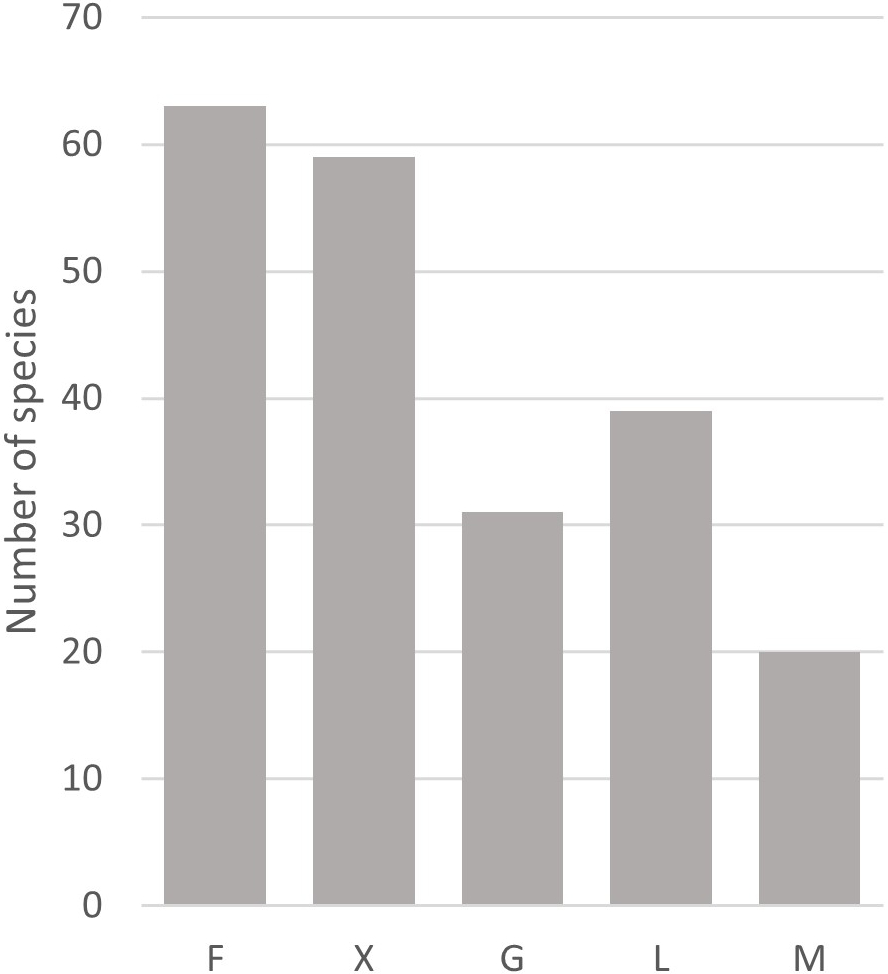
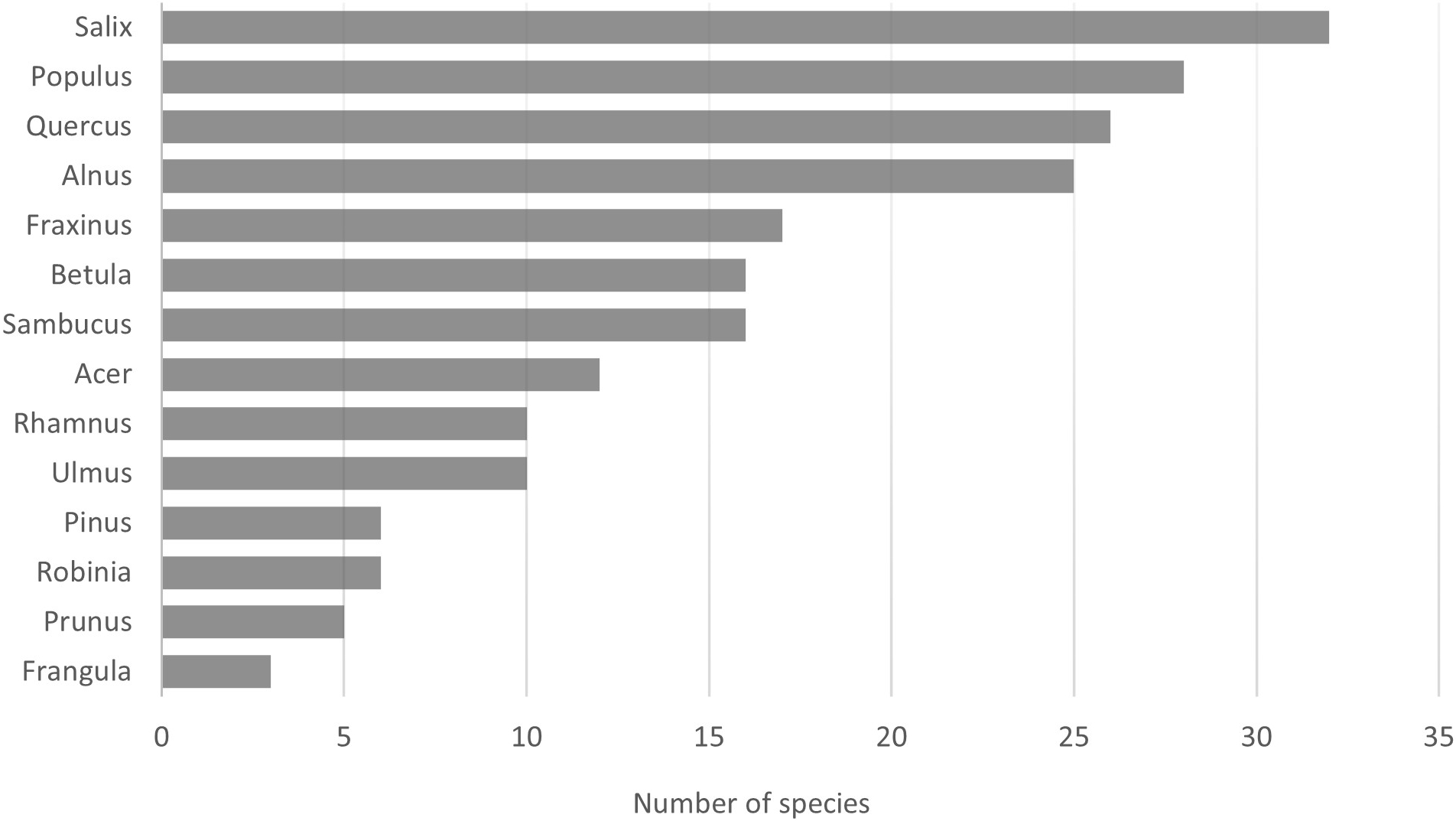
Despite the small share of forest communities in the park area, the dominant habitat groups in the lichen biota are epiphytic and epixylic species (Figure 2). Epiphytic lichens are primarily associated with single trees and shrubs growing along roads and in open areas, as well as with riverside willow thickets and fragments of forests on the outskirts of the park. The phorophytes with the richest lichen vegetation are willows Salix spp., on which 32 species were recorded, poplars Populus nigra and P. tremula (28 species), pedunculate oak Quercus robur (26 species), and adler Alnus glutinosa (25 species) (Figure 3). Oak trees particularly stand out here – there are only a few old specimens of them in the park, but they are the basic habitat for such interesting taxa as Chaenotheca brachypoda, Ch. trichialis, Flavoparmelia caperata, Melanohalea elegantula, Punctelia subrudecta, and Ramalina farinacea. Other phorophytes were inhabited mainly, if not exclusively, by more or less nitrophilous lichens, regardless of the natural chemical composition of their bark.
Figure 2
Habitat groups in the lichen biota of the Ujście Warty National Park and its buffer zone. F – epiphytic species, X – epixylic species, G – epigeic species, L – epilithic species, M – species found on metal.
The substrate inhabited by lichens almost as often as tree bark was dead wood, mainly in the form of various wooden structures (fences, platforms, shelters, etc.), on which a total of 59 species were recorded. These included both true epixyles and species typical for other substrates, especially bark and soil. Some of usually corticolous taxa, e.g., Hypogymnia tubulosa, Parmeliopsis ambigua, Platismatia glauca and Pseudevernia furfuracea, in the study area occurred exclusively on wood.
The occurrence of terricolous lichens in the park and its buffer zone is mainly limited to small areas with a mineral substrate (sandy dunes covered with dry grasslands); several species were also found on flood embankments and in a small sandpit. A total of 31 species of terricolous lichens were recorded, of which 25 belonged to the genus Cladonia. Noteworthy are Diploschistes muscorum and Stereocaulon condensatum, which are not very common in Poland.
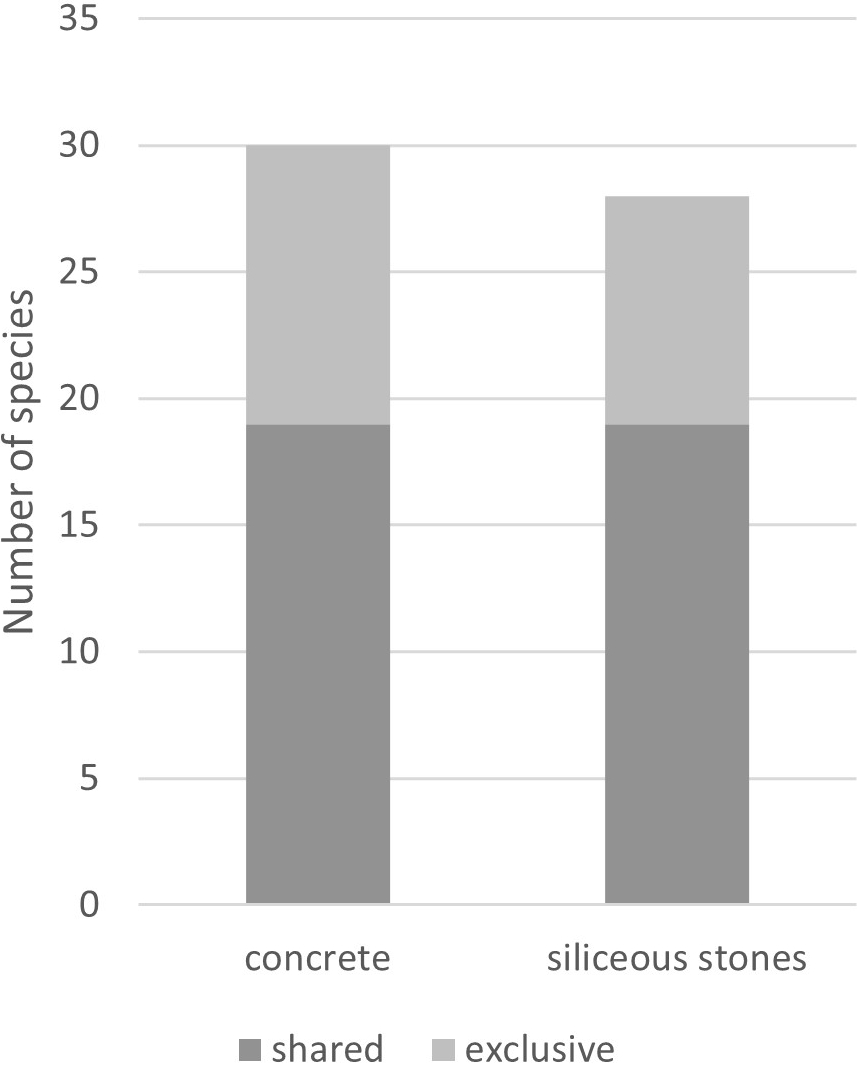
Epilithic lichens in the study area occurred mainly on anthropogenic substrates, such as concrete and mortar. This is due to the abundance of various hydrotechnical structures (e.g., sluices, culverts, bridges), as well as concrete electric poles and remains of buildings, which are scattered throughout the park. Such substrates, characterised by the content of calcium carbonate, were inhabited by calci- and basiphilous lichens, mainly from the genera Myriolecis, Calogaya, Athallia, Candelariella, Flavoplaca and Kuettlingeria. Natural, non-calcareous rock substrates (granite, gneiss, melaphyre, sandstone, etc.) were present only in the form of boulders bound with mortar in the remains of old buildings, as well as railway track ballast in the park’s buffer zone. In both cases, the essentially non-calcareous rock fragments were covered with either fertile dust or calcium carbonate washed out of the mortar, which is why the species composition of the lichens inhabiting them was very similar to that recorded on the concrete, with 19 shared species (Figure 4). Additionally, due to over-fertilisation of the environment, a significant share of nitrophilous species of the genera Physcia, Phaeophyscia, Physconia, Polycauliona and Xanthoria was found on both types of substrates (calcareous and siliceous). Acidophilic lichens typical of silicate rocks were represented by only a few species. Among them, Kuettlingeria atroflava and Myriospora rufescens deserve special attention, both found on melaphyres constituting the ballast of railway tracks. Kuetlingeria atroflava is a rare species in Poland, reported from the Sudetes and the Baltic coast (Fałtynowicz et al., 2024). Myriospora rufescens was recently recorded in Poland for the first time (Ossowska et al., in prep.) at a single site in the Sudetes.
A distinctive feature of the lichen biota of the Ujście Warty National Park is the frequent occurrence of lichens on metal elements – both on exposed, corroded iron and steel elements and on painted ones. This unusual substrate is mainly inhabited by epiliths and nitrophilous lichens, but several epiphytic species have also been found, such as Hypogymnia physodes and Parmelia sulcata. A total of 20 species of lichens have been recorded on various metal structures.
. Discussion
The lichen biota of the Ujście Warty National Park turned out to be quite poor, even by the standards of the Polish lowlands. Most of the species recorded were common crustose and foliose lichens with a wide range of habitat requirements. More sensitive epiphytic lichens with fruticose thalli were represented by only three species (Evernia prunastri, Pseudevernia furfuracea, Ramalina farinacea), of which only Evernia prunastri was recorded at more than two locations. Filamentous lichens of the genera Usnea and Bryoria were not found at all.
The reason for this poverty seems to be primarily the limited availability of suitable habitats for lichens in the park, which is dominated by reed beds. Another factor influencing the quality and richness of the lichen biota is undoubtedly dust pollution and the associated strong eutrophication (or hypertrophication), eliminating stenotopic acidophilous species. In their place, on all types of substrates, several ubiquitous species appear, the occurrence of which depends exclusively on a large supply of nitrogen compounds. As a result, this leads to a gradual uniformity of the lichen biota. The increasing influence of hypertrophication on lichen vegetation is confirmed, among others, by the lichenological studies conducted recently in the Wielkopolski National Park (Kowalewska et al., 2024); similar observations have also been made in other regions of Europe (e.g. Alstrup, 1992; Oksanen et al., 1990; Ruoss, 1999; Seaward & Coppins, 2004).
Acknowledgments
We would like to thank the staff of the Ujście Warty National Park for their assistance during fieldwork. We would also like to thank Dr. Marek Halama of the University of Wrocław for creating the map included in this article and to the Reviewers for all corrections to the manuscript.