

. Introduction
Zucchini (Cucurbita pepo L.), also known as summer squash, is a high-value horticultural crop widely consumed as a vegetable. It belongs to the Cucurbitaceae family and is the only annual bush-type species suitable for human consumption worldwide. Zucchini is low in calories, free from saturated fats or cholesterol, and its peel is rich in fiber. Fresh fruit provides vitamins such as A, C, E, B6, niacin, and thiamin, along with minerals, flavonoids, and antioxidants (Bhattacharjee, 2021). Despite its potential for sustainable agricultural development, zucchini cultivation faces challenges when grown in peat soils due to the limited physical and chemical properties of these soils, which hinder optimal growth and yield potential.
Peatland agriculture, especially peat soils in the inland region, is very susceptible to changes in the environment, so it required an effective strategy to manage the risk of wetland use (Anggraini et al., 2024). Peatland conversion into agriculture also poses significant soil fertility constraints, such as low pH, organic acid accumulation and reduced availability of macro and micro nutrients (Maftu’ah et al., 2019). Moreover, the high content of organic acid, the low NPK, and the possibility of greenhouse gas emissions are also other complexities to manage the peatland (Maftu’ah & Indrayati, 2013). Enhancing the chemical properties of peat soils, which are closely linked to plant nutrient availability, is essential for overcoming these challenges and improving agricultural productivity (Padang et al., 2023).
NPK fertilizer is the primary source of nutrients that help meet the nutritional requirements of zucchini plants (Bhattacharjee, 2021). NPK fertilizers contain nitrogen, which promotes tissue formation in plants (Sharma et al., 2024); phosphorus, which promotes root development and fruit formation (Oloyede et al., 2013); and potassium, which improves the plant’s resistance to environmental stress. Furthermore, NPK fertilizer use alone significantly increased the Ca, Mn, and Fe content in the fruits (Dunsin et al., 2019). However, the efficacy of NPK fertilizers in peat soil tends to be limited due to the soil’s poor capacity to store and release plant nutrients over the long term. To counteract such challenges, biochar can be used as an ameliorant to enhance peat soil quality. Biochar can enhance nutrient retention, reduce soil acidity, and improve soil structure (Evizal et al., 2023; Murtaza et al., 2023; Pandian et al., 2024; Pratiwi & Nurrahma, 2024). Likewise, a mixture of biochar with NPK fertilizer is likely to improve fertilizer efficiency, ultimately enhancing zucchini growth and yield. Biochar has been found to be a successful solution for increasing soil fertility and biochemical quality, and for addressing environmental issues. With its properties, biochar improves soil structure, increases nutrient cation exchange capacity, and encourages microbial growth, thus facilitating sustainable agriculture. Pratiwi & Nurrahma (2024) state that biochar enhances soil fertility by promoting cation exchange capacity. Apart from that, its function in improving soil quality is to increase soil pH, enhance cation exchange capacity, and increase water retention, thereby decreasing nutrient leaching and improving nitrogen use efficiency (Pratiwi & Nurrahma, 2024; Ramamoorthy et al., 2022). It has been reported that biochar greatly enhances crop yields (Wang et al., 2024). Above all, its application has been observed to alter the characteristics of peat soil, like pH, available phosphorus, exchangeable potassium, nutrient uptake, and dry weight of roots and shoots. In addition, the type of biochar used significantly effects exchangeable potassium content in peat soil and total nutrient uptake (Maftu’ah et al., 2019).
This research is needed because growing zucchini in peat soil is challenging and requires new management strategies. Zucchini needs a rich and stable growing medium, but peat soil is acidic and loses nutrients easily, making cultivation difficult. Previous studies have examined NPK fertilizer or biochar separately, but none have examined how combining NPK fertilizer and coconut shell biochar affects zucchini grown in peat soil. This study examines how their combination influences fertilizer efficiency and peat soil quality. Coconut shell biochar, an organic material, improves the soil and helps retain nutrients, creating a better environment for zucchini growth. This research offers new insights into managing peat soil, supports the diversification of horticultural crops on marginal land, and provides a practical way to boost zucchini yields. The objective of this study was to evaluate the impact of NPK fertilizer and coconut shell biochar on the growth and yield of zucchini grown in peat soil, and determine the optimal combination for maximum zucchini yield.
. Materials and methods
Time and place
Research was conducted in a plastic house in Tanjung Pinang Village, Pahandut District, Palangka Raya City, Central Kalimantan, Indonesia from March to July 2024. The biochar was produced at the Laboratory of Forest Management and Agronomy, Faculty of Agriculture, University of Palangka Raya. Biochar’s chemical analysis was performed in the Laboratory of the Swampland Research Center, Banjarbaru, South Kalimantan, Indonesia.
Materials
The zucchini variety Jacky Z6, produced by PT Agrosid Manunggal Sentosa, was used in this study. Agriculture inputs, including coconut shells, NPK fertilizer (16:16:16), and dolomite, were sourced from local supply markets. Peat soil was collected from a depth of 20 cm in Kalampangan village, 18 km south of Palangka Raya, Central Kalimantan Province. This peatland had not been used for crop production previously. The soil was extremely acidic (pH 3.25) and contained very high organic (56.72%). Total N was relatively high (0.79%) but mostly unavailable. Available P was low (7.85 ppm), and exchangeable K was very low (0.11 cmol(+) kg-1), indicating major nutrient limitations for cultivation. Chicken manure was supplied by local farmers. Plants were cultivated in polybags measuring 30 cm × 35 cm.
Design of the study
In the pot experiment, three replications of two treatment factors were arranged in a factorial completely randomised design. The first factor was the application of coconut shell biochar (B), with three levels: B0 = 0 t ha-1 (control), B1 = 3 t ha-1, and B2 = 6 t ha-1. The second factor was the application of NPK 16:16:16 fertilizer (N), which included four levels: N0 = 0 kg ha-1 (control), N1 = 200 kg ha-1, N2 = 400 kg ha-1, N3 = 600 kg ha-1. The number of experimental units were 36 units.
Biochar production and application
Creating biochar involved inserting dry coconut shells into a sooting furnace and burning them until they reached the top of the hole cover. The furnace was then covered with a stone lid, and combustion continued until smoke emerged from a nearby vent. Once clear smoke was observed, indicating complete pyrolysis, the vent was sealed tightly, and the furnace was left undisturbed until all the coals had been fully extinguished (Suryadi et al., 2022). By evenly spreading coconut shell biochar over the soil surface at the predeterminated dose, then thoroughly mixing to ensure uniform distribution, the biochar was applied directly to the polybag. Biochar was incorporated into the planting media during its preparation and incubated for one week before planting.
Preparation of planting media and dolomite application
The planting media used consisted of peat soil collected from Kalampangan. The soil was first cleaned of debris, including dirt, weeds, and roots, then mounded and sieved using a ½ cm mesh soil sieve until a fine texture was obtained. The air-dried soil was subsequently mixed with dolomite at a rate of 2 t ha-1 (equivalent to 16 g per polybag) and then placed into 36 polybags measuring 30 cm × 35 cm. The planting media were then incubated for one week. Following the incubation period, chicken manure was applied at a rate of 5 t ha-1 (42 g per polybag).
Planting
Seeds were soaked in water for approximately two hours, and only those that sank were selected for planting. Planting was done by creating holes 4–5 cm deep in the planting media and placing two seeds per polybag.
Application of NPK
NPK fertilizer was applied in two stages: once in the first week (7 days after sowing) and again in the second week (14 days after sowing), at the specified dosages. It was evenly distributed around the planting hole and then covered with soil.
Plant thinning
Thinning was carried out when the seedlings began to grow (7–10 days after planting), by retaining only one healthy plant per polybag.
Stake installation
Stakes were used to support plant stems and provide a structure for vine growth. They were installed during the vegetative growth stage. The stakes are made from wooden sticks measuring approximately 10–20 cm in length.
Plant maintenance
Plant maintenance included watering, pest and disease control, and pruning. Watering was conducted once daily, with 500 mL per polybag, to maintain soil moisture at field capacity and prevent plant dehydration. Pest and disease control was performed manually. Pruning was conducted when the plants began to bear fruit, targeting dead or diseased leaves to promote healthier growth and fruit development.
Pollination
Pollination was performed by manually transferring pollen from male to female flowers using intact male flowers.
Harvesting
Zucchini fruit was harvested between 57–60 days after planting, based on specific maturity indicators, including a blackish-green skin color, a cylindrical shape, and a fruit length of approximately 24–27 cm. Harvesting was conducted once at full maturity.
Variables observed
The observed variables for biochar characterization included N-total (Kjeldahl method), P and K (H2SO4 wet digestion method), C-organic (gravimetric method), and pH measured with a pH meter. To evaluate the effects of the treatments on zucchini growth and yield, the following parameters were recorded: plant height, measured from the stem base to the highest growing point; leaves number, counted as fully opened leaves, time to first flowering and fruiting; fruits per plant; fruit weight per plant, measured at harvest; fruit length, measured from the base to the tip at harvest; plant fresh weight, determined by weighing shoots and roots at harvest; plant dry weight, obtained by oven-drying plant material at 60°C for 48 h; and fruit sugar content, measured with a refractometer.
Data analysis
To evaluate the effects of the treatments, the observational data were analyzed using analysis of variance (ANOVA) with the F-test at significance levels of α 5% and α 1%. In cases of significant effects, the Honestly Significant Difference (HSD) test was used at the level of 5% to determine whether there were differences among treatment levels. Additionally, correlation analysis was used to determine the relationships between zucchini growth and yield variables.
. Results
Characteristics of chemical coconut shell biochar
Laboratory analysis confirmed that coconut shell biochar met one of the parameters outlined in the Minister of Agriculture’s Decree No. 261/KPTS/SR.310/M/4/2019, which specifies the minimum requirements for organic fertilizers, biological fertilizers, and soil conditioners. This biochar exhibited a high C-organic content of 44.86%, by the standards established by the regulation. Nevertheless, the pH value of 10.05 exceeds the acceptable range specified in the decree.
Table 1 shows that coconut shell biochar has the lowest nitrogen content, at 0.15%. Phosphorus was found to have a higher concentration than nitrogen, while the potassium content was determined to be 1.19%. There is substantial potential for coconut shell biochar to increase soil carbon levels due to its high organic carbon content (44.86%) relative to the standard threshold. Moreover, the relatively high C/N ratio observed is consistent with the low soil nitrogen availability, influenced by the slow rate of organic matter decomposition. The pH value of coconut shell biochar, measured at 10.05, indicates that it is strongly alkaline. This alkalinity is particularly beneficial for ameliorating acidic soils, such as peat soils, by neutralizing soil acidity and improving soil chemical properties conducive to plant growth.
Table 1
The chemical properties of coconut shell biochar.
| Chemical property | Result | Standard* |
|---|---|---|
| N‑total (%) | 0.15 | – |
| P (%) | 1.12 | – |
| K (%) | 1.19 | – |
| C‑organic (%) | 44.86 | Minimum 15 |
| C/N ratio | 299 | – |
| pH | 10.05 | 4–9 |
[i] * Ministry of Agriculture, Indonesia (2019).
The growth of zucchini
Plant height was significantly affected by coconut shell biochar at 14 DAP and by NPK fertilizer at 14, 28, and 35 DAP. A significant interaction between biochar and NPK was also observed at 14 DAP (P < 0.05). The highest plant height at 14 DAP was achieved with NPK at 600 kg ha-1, without supplementation with coconut shell biochar. At 35 DAP, NPK increased plant height by 17.27% (Table 2).
Table 2
The zucchini plant height (cm) at 14, 28 and 35 DAP.
Analysis of variance showed that the combined application of coconut shell biochar and NPK had no significant effect on the number of leaves in zucchini grown on peat soil. However, when applied individually, NPK significantly influenced leaf number at 28 and 35 DAP, while coconut shell biochar had a significant effect at 35 DAP (P < 0.05). As shown in Table 3, the application of NPK at a dose of 400 kg ha-1 resulted in the highest number of leaves at both time points. The increasing at 35 DAP reached 13.86%.
Table 3
The leaves number of zucchini at 28 and 35 DAP.
Root volume of zucchini was not significantly affected by the interaction between coconut shell biochar and NPK fertilizer (P > 0.05). Each treatment acted independently, and neither biochar nor NPK alone had a significant effect. However, applying biochar at 6 t ha-1 tended to increase root volume, suggesting a potential positive trend (Table 4).
Table 4
The root volume (ml) of zucchini.
Flowering and fruiting time
The analysis of variance revealed no significant interaction between coconut shell biochar and NPK on zucchini flowering time in peat soil. However, NPK application as a single factor significantly influenced this parameter. As shown in Table 5, the application of NPK at 600 kg ha-1 resulted in the earliest flowering, at 28.11 DAP. This finding suggests that high-dose NPK application can effectively accelerate the transition from the vegetative to the generative phase in peat soil. Furthermore, early flowering was positively correlated with early fruit set, as the 600 kg ha-1 NPK treatment also resulted in the earliest fruiting among all treatments.
Table 5
Flowering and fruiting time of zucchini (DAP).
The yield component of zucchini
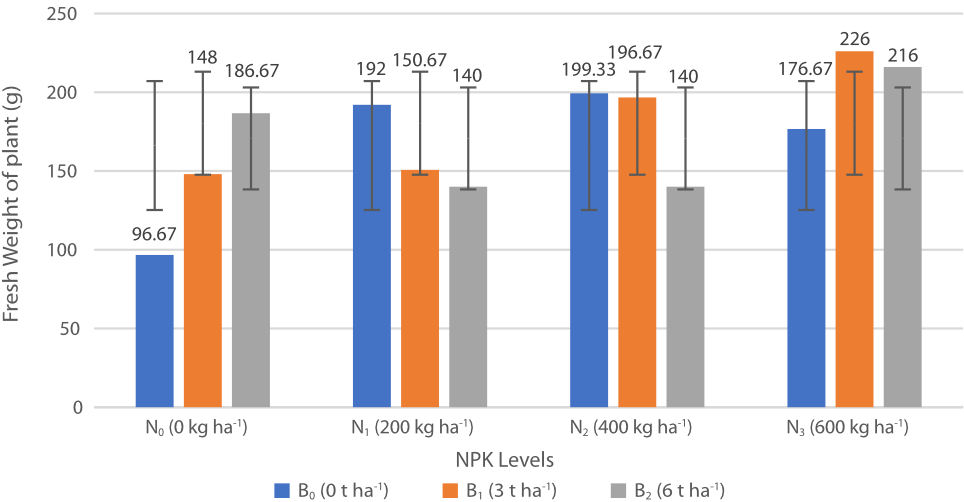
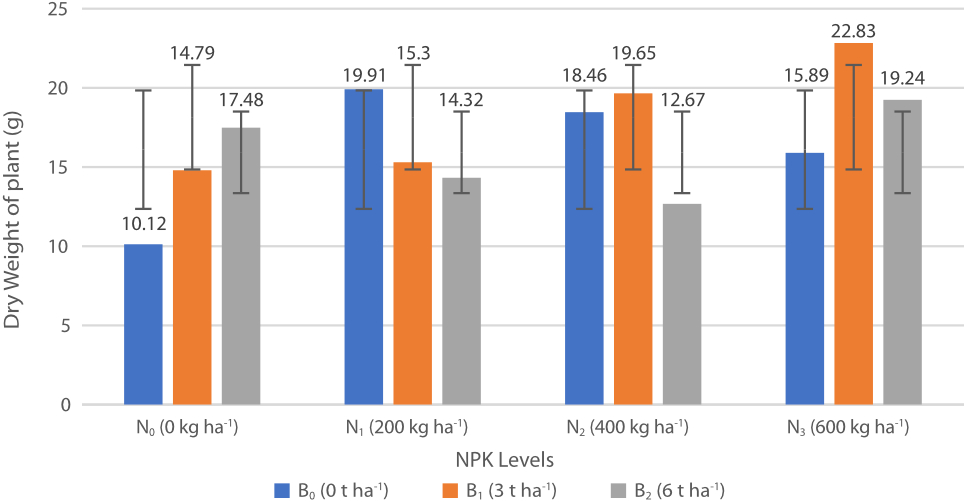
The analysis of variance showed that neither biochar nor NPK fertilizer, alone or combined, had a significant effect on the fresh or dry weight of zucchini grown in peat soil. Nevertheless, there was a notable trend of increased biomass accumulation in certain treatment combinations. As shown in Figure 1 and 2, the combined application of biochar at 3 t ha-1 and NPK at 600 kg ha-1 produced the highest fresh and dry weights, at 226 g and 22.83 g per plant, respectively.
The yield of zucchini
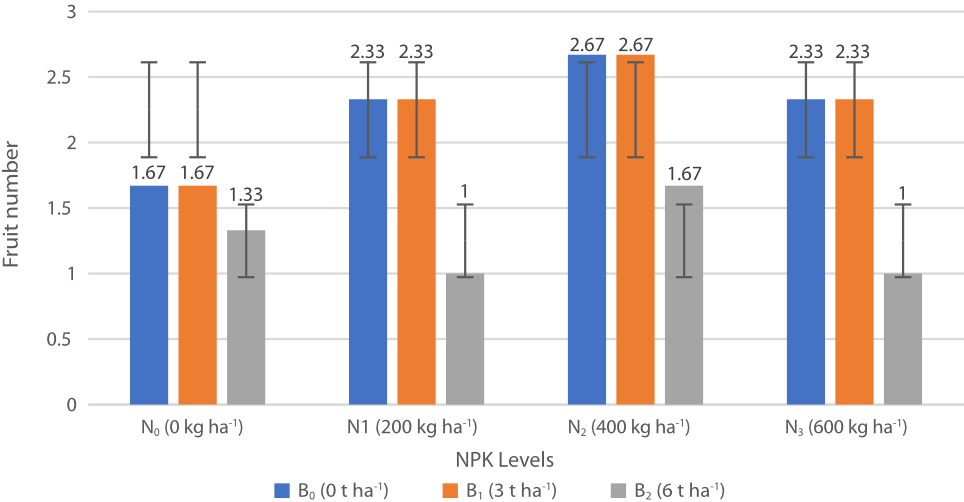
The variance analysis indicated that neither coconut shell biochar nor NPK, whether applied individually or in combination, had a statistically significant effect on the number of zucchini fruits grown in peat soil (P > 0.05). This suggests that, under specific environmental conditions and management practices, the plant response to these inputs was insufficient to consistently influence fruit formation. Nevertheless, a clear trend emerged that NPK fertilization alone tended to increase fruit number, as shown in Figure 3.
Figure 3
Effects of varying NPK (N) fertilizer and Biochar (B) application rates on the fruit number of zucchini.
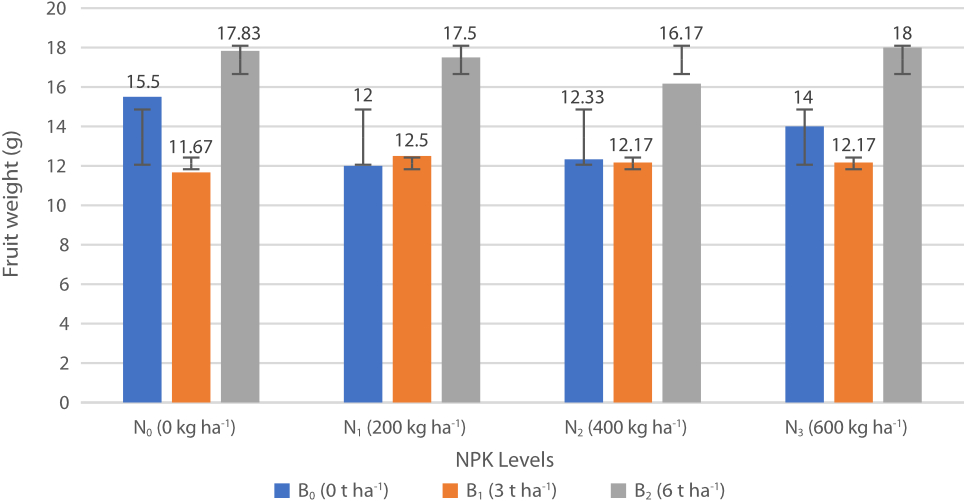
Additionally, coconut shell biochar and NPK fertilizer, whether applied separately or in combination, did not have a statistically significant effect on zucchini fruit weight grown in peat soil (P > 0.05). However, a notable trend emerged: biochar alone appeared to enhance fruit weight, as shown in Figure 4. In contrast, NPK applied independently did not increase fruit weight (P > 0.05); the treatment without NPK yielded the highest average fruit weight at 126.78 g. Interestingly, the highest fruit weight across all combination treatments (175.33 g) was recorded with 6 t ha-1 of biochar and 200 kg ha-1 of NPK. Conversely, the lowest fruit weight (63.67 g) occurred with 3 t ha-1 biochar and 400 kg ha-1 NPK.
Figure 4
Effects of varying NPK (N) fertilizer and Biochar (B) application rates on the fruit weight of zucchini.
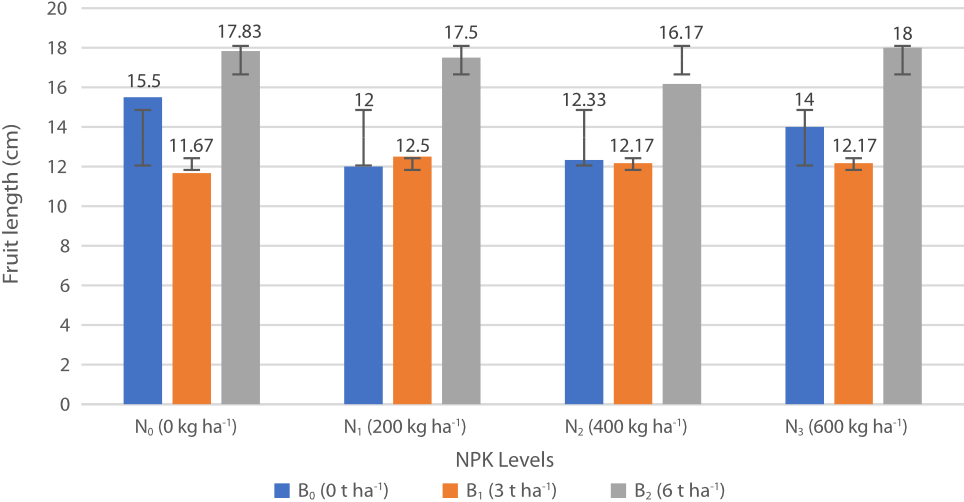
Fruit length is a critical quality attribute for zucchini. This may be closely related to the availability and uptake of key macronutrients, particularly nitrogen and potassium, which influence cellular expansion and division during fruit development. Based on statistical analyses, coconut shell biochar application significantly increased zucchini fruit length in peat soil (P < 0.05), whereas NPK treatment alone did not reach statistical significance (P > 0.05). Biochar tended to increase fruit length compared to the control, though not all differences were statistically significant. Interestingly, the treatment without NPK resulted in the highest average fruit length among the single-factor NPK treatments, suggesting that applying inorganic fertilizer does not inherently enhance this parameter. However, the longest zucchini fruits were achieved with the combined application of 6 t ha-1 biochar and NPK at 600 kg ha-1, highlighting a potential synergistic effect (Figure 5).
Figure 5
Effects of varying NPK (N) fertilizer and Biochar (B) application rates on the fruit length of zucchini.
A significant interaction between coconut shell biochar and NPK fertilizers was observed, enhancing the sugar content of zucchini grown in peat soil. The combination of 3 t ha-1 biochar and 600 kg ha-1 NPK produced the highest sugar level at 4.17 °Brix (Table 6). Although this result was not significantly different from most other treatments, the trend indicates a promising synergistic effect of combining organic and inorganic inputs to improve the organoleptic quality of zucchini fruit.
Table 6
The sugar content of zucchini fruit (°Brix).
Plant height exhibited a significant positive correlation with the number of leaves (r = 0.81; P < 0.01), fruiting time (r = 0.62; P < 0.05), total fresh weight (r = 0.62; P < 0.05), and dry weight per plant (r = 0.53; P < 0.05). These findings suggest that taller plants tend to have more developed vegetative structures and greater biomass accumulation. A similar relationship was observed for the number of leaves, which showed significant positive correlations with both fresh weight (r = 0.63; P < 0.05) and dry weight (r = 0.61; P < 0.05) of the plants. These findings indicate that morphological traits, such as plant height and leaf number, can serve as reliable indirect indicators of biomass accumulation and overall plant performance. Furthermore, the number of leaves exhibited a moderate, though non-significant, positive correlation with fruit length (r = 0.49) and fruit weight (r = 0.43). A significant positive correlation was observed between the number of fruit weight (r = 0.86; P < 0.01), as well as between fruit weight and fruit length (r = 0.93; P < 0.01). These findings indicate that an increase in fruit number is generally accompanied by increases in both fruit weight and length, reflecting the integrated development of yield components. However, the correlation between fruit weight and sugar content was weak and not statistically significant (r = 0.07), suggesting that sugar accumulation in zucchini fruit is not necessarily proportional to fruit size or weight. Total fresh and dry weight exhibited significant positive correlations with fruit sugar content, with correlation coefficients of r = 0.65 and r = 0.69, respectively (P < 0.05), indicating that greater biomass accumulation is associated with increased sugar concentration in zucchini fruits. Additionally, the number of leaves showed a moderate, albeit non-significant, positive correlation with sugar content (r = 0.22).
Table 7
Agronomic correlation results for zucchini plants.
. Discussion
Coconut shell biochar had low nitrogen content (Table 1). The low nitrogen content may be due to nitrogen’s volatility, which is prone to volatilization and leaching. Additionally, coconut shells are inherently rich in carbon-based compounds such as lignin, cellulose, and hemicellulose, but naturally low in nitrogen content (Ajien et al., 2022). Phosphorus was found to be higher than nitrogen (Table 1). According to Iskandar & Rofiatin (2017), this is because phosphorus remains stable and does not volatilize at the high temperatures generated during pyrolysis or charcoal production. This thermal stability allows phosphorus to be retained at higher levels in the resulting biochar. Coconut shells are a source of potassium (Zahrah & Kustiawan, 2024). Furthermore, Bao et al. (2024) reported that potassium tends to be retained in biochar due to its low water solubility, thereby limiting leaching losses (Ewansiha et al., 2012). The high potassium content commonly observed during combustion, particularly in lignin-rich woody materials, supports this observation (Ajien et al., 2022). In addition to stabilizing carbon, biochar persists in the soil for extended periods (Gross et al., 2024; Kumar et al., 2025). Its porous surface structure promotes the adsorption of soil organic carbon (Wang et al., 2024) and facilitates the binding of organic matter, thereby reducing its decomposition by soil microorganisms (Bolan et al., 2024).
Table 2 shows that coconut shell biochar and NPK fertilizer affected zucchini plant height grown in peat soil. The increase in plant height reflects active physiological processes, particularly cell division and elongation, which depend on the availability of macronutrients, especially nitrogen (Singh & Singh, 2024). Although coconut shell biochar has a total nitrogen content of 0.15% (Table 1), this concentration is insufficient to enhance zucchini plant height in peat soil. Consequently, a dose of NPK 600 kg ha-1 was required to support early plant growth. At 28 and 35 DAP, the application of NPK singly continued to significantly increase plant height, indicating its effectiveness in sustaining vegetative development under nutrient-deficient peat soil conditions (Table 2).
Interestingly, zucchini plants that did not receive the coconut shell biochar treatment had the highest number of leaves, indicating that under certain conditions, coconut shell biochar did not provide additional benefits to vegetative growth, particularly in leaf development. One possible explanation lies in the biochar’s inherently high carbon-to-nitrogen ratio (Table 3), reflecting its low nitrogen content. A high C/N ratio (Table 1) can induce nitrogen immobilization by soil microorganisms, especially during the early stages of plant growth. Microbial competition for nitrogen can temporarily reduce the availability of this essential nutrient for plants (Gannett et al., 2024), thereby inhibiting the development of vegetative organs such as leaves.
NPK fertilizer applied at 200 kg ha-1 individually resulted in the highest root volume among all NPK treatments, suggesting that 200 kg ha-1 may represent an optimal threshold for root development in nutrient-poor peat soils, which are often deficient in essential macronutrients such as nitrogen and phosphorus. Under these conditions, roots develop more optimally when biochar is absent and nutrient availability is not limited by such interactions. These results highlight the importance of carefully balancing organic amendments and inorganic fertilizers to optimize root growth and nutrient acquisition in peat-based cultivation systems.
In the term of flowering and fruiting time, a single factor of NPK influenced this parameter (Table 5). Supporting this result, reported that using nano NPK fertilizer (20–20–20) significantly enhanced flowering earliness and maturity in zucchini. Similarly, Sharma et al. (2024) demonstrated that nano urea treatments led to increased vine length and earlier flowering in Cucurbita pepo L.
Figure 1 and 2 shows that using coconut shell biochar at 3 t ha-1 combined NPK at 600 kg ha-1 produced the highest yield component of zucchini. This suggests that biochar and NPK fertilizer may work well together to boost plant growth, as biochar improves soil and NPK provides nutrients. However, the increase was not statistically significant. In contrast, coconut shell biochar at doses exceeding 3 t ha-1 was associated with reduced fruit yield. This outcome may be attributed to biochar’s high nutrient adsorption capacity, which can temporarily bind essential nutrients such as nitrogen and phosphorus, reducing their availability to plants. High biochar levels immobilize nutrients, rendering nitrogen and phosphorus less accessible to crops, a fundamental need for growth and production (Arunkumar & Thippeshappa, 2022). Further, the increase in soil pH (Table 1) resulting from biochar may reduce the availability of certain micronutrients, which are highly available under acidic peat soil conditions. Besides, the extremely high carbon-to-nitrogen (C/N) ratio of the biochar (Table 1) may promote nitrogen immobilization by microbes, further limiting nitrogen availability during the critical reproductive stage. This finding concurs with those reported by Arunkumar & Thippeshappa (2022), who found that the exclusive use of coconut shell biochar did not improve upland rice productivity, primarily due to its high C/N ratio, which limited nutrients availability.
Notably, the no-biochar and NPK application at 400 kg ha-1 resulted in the highest fruit yield. This outcome indicates the promise of moderate-dose NPK as a superior strategy for optimizing fruit productivity in peat soil, provided it is not complicated by high-dose soil amendments. Thus, the use of biochar in such systems must be carefully calibrated in terms of dosage and application method to avoid decreasing nutrient availability through its soil-conditioning activity. These results do highlight the agronomic value of well-balanced NPK fertilization at moderate rates (e.g., 400 kg ha-1) for sustaining reproductive success without risk of over-fertilization or poorly coordinated soil amendment practices.
Coconut shell biochar at a high application rate (6 t ha-1) in association with a dose of NPK (200 kg ha-1) can synergistically enhance fruit weight in zucchini produced on peat soils. Potential mechanisms for these effects include biochar’s ability to enhance the physical, chemical, and biological properties of peat soil such as increased porosity in the soil, buffering, nutrient storage, and microbial activity (Ali et al., 2024; Hu et al., 2024; Hui, 2021). Application of NPK fertilizer alone was prone to reduce fruit weight. This may be due to nutrient imbalances or to potential nutrient toxicity caused by excess unabsorbed fertilizer in acidic peat soils with inherently low buffering capacity. These conditions can limit nutrient uptake and affect physiological processes involved in fruit development. The improved efficacy of NPK fertilizer when combined with biochar suggests that nutrient availability and plant uptake are optimized only after soil conditions are ameliorated. Biochar helps increase cation exchange capacity (Banu et al., 2023), moderates soil pH (Haraz et al., 2020), and reduces nutrient leaching (Kuo et al., 2020), thereby enhancing the retention and gradual release of essential nutrients (Banu et al., 2023). The combination of 3 t ha-1 biochar and 600 kg ha-1 NPK demonstrates potential as a technical recommendation to improve zucchini fruit quality, particularly sugar content. Improved organoleptic characteristics not only enhance market value but also increase consumer. The used biochar in this study, with a higher organic carbon content (44.86%), alkalinity (10.05), and pH (Table 1), has the potential to buffer the natural acidity of peat soil. This pH modification enhances the availability of key macronutrients, including potassium, whose role in translocation of sugar and the biosynthesis of secondary metabolites are crucial. NPK fertilizer directly supplies nutrients critical for carbohydrate formation. NPK application at 600 kg ha-1 tends to enhance sugar deposition in zucchini fruit, possibly due to adequate nitrogen and potassium supply. Nitrogen affects chlorophyll formation and photosynthetic activity (Fathi, 2022), while potassium is responsible for photosynthates transport and the conversion of carbohydrates to simple sugars (Coskun et al., 2017). Collectively, these nutrients are responsible for increased photosynthetic ability and sugar accumulation in fruit tissues.
The strong relationship between plant height and the number of leaves indicates that development in the vertical dimension is accompanied by an increase in canopy, which would enhance the plant’s photosynthetic potential. This increased potential for photosynthesis would be responsible for enhanced biomass production, as evidenced by the significant correlations between fresh and dry weights. Moreover, leaf number showed a moderate, though nonsignificant, positive correlation with fruit length (r = 0.49) and fruit weight (r = 0.43), suggesting an influence on reproductive traits. Such relations highlight the significant role of the leaf number in elevating the photosynthetic potential, which plays a key role in supporting both vegetative growth and generative organ formation in zucchini cultivated on peat soils.
Although root volume was not significantly related to either fruit weight or sugar content, a positive trend with plant dry weight suggests that the root system supports water and nutrients absorption and therefore contributes to vegetative biomass accumulation.
The correlation between the weight of the fruit and its sugar content was non-significant and weak (r = 0.07), meaning that sugar accumulation in the fruit of zucchini is not directly related to fruit weight or size. This implies that different physiological mechanisms may regulate sugar biosynthesis and partitioning independently from structural growth. Additionally, the number of leaves showed a moderate, albeit non-significant, positive correlation with sugar content (r = 0.22). This supports the hypothesis that a larger photosynthetic canopy may enhance the translocation of assimilates, including sugars, to the fruit. Notably, fruit sugar content did not correlate significantly with fruit weight or length, reinforcing that sugar accumulation is more closely linked to the plant’s overall physiological efficiency in photosynthate production and allocation rather than to fruit size. These findings are particularly relevant to zucchini cultivation on peat soils, where strategies that enhance biomass accumulation may play a critical role in improving fruit quality, particularly in sweetness.
Most variables did not show significant effects from the NPK and biochar treatments, not because the treatments were ineffective, but because a major biological factor interfered. During the generative phase, a severe outbreak of the fungus Choanephora cucurbitarum occurred. High humidity made it easy for the fungus to spread and damage flower and fruits, which are important for yield measurement (Kumar et al., 2025). This led to much higher data variability and set a low-yield baseline unrelated to the nutritional treatments, making it hard to detect any statistical differences that NPK and biochar might have produced.
. Conclusions
The study concluded that the combined application of coconut shell biochar and NPK fertilizer positively influences plant height and sugar content of zucchini cultivated in peat soils. Individual treatment of biochar was significantly improving leaves number and fruit length. The application of NPK increased plant height, leaves number, and accelerated flowering and fruiting. Coconut shell biochar at a dose of 6 t ha-1 was the best dose for zucchini fruit length, while NPK application at a dose of 600 kg ha-1 resulted in the highest plant height and the fastest flowering and fruiting times. Future research should focus on optimizing application rates and on the long-term effects to promote sustainable and efficient peatland cultivation practices.