
. Introduction
Wheat (Triticum spp.) is one of the most important agricultural crops worldwide providing a major source of calories and proteins for human consumption. Its productivity and quality directly influence global food security, underscoring the significance of research in this field (Schelepov et al., 2009; Takenaka et al., 2018). Wheat is also one of the most widely genetically studied plants, with genetic maps, karyotypes, and even the genome sequence already available (Edet et al., 2018).
Despite extensive genetic studies of the genus Triticum, the taxonomic positions of its species remain controversial. Specialists in wheat research, known as triticologists, from different countries often disagree on the fundamental principles that should underpin wheat classification (Goncharov, 2009; 2012).
The first wheat taxonomy was developed by Linnaeus (1753), who based his classification on well-differentiated traits, such as spring versus winter growth habit or hulled versus naked grains. Körnicke (1885) later presented a more detailed, morphology-based description of all known wheat taxa, introducing the division of species into varieties (in accordance with botanical nomenclature, not to be confused with cultivars). Until the mid-20th century, before the advent of genetic and cytological research, the taxonomy of Triticum, in its various modifications, was built solely on classical comparative-morphological approaches, as summarized in the monograph by Persival (1921).
Vavilov (1987) proposed an approach to constructing plant taxonomies using “radical traits” present across taxonomic groups. The enormous polymorphism of some Triticum species led Vavilov to investigate principles of species and intraspecific taxonomy, using wheat as a model. After extensive comparison of numerous accessions, he introduced the concept of a species’ radical traits – specific traits inherent to all forms within a species, whose constancy and stability were later confirmed by subsequent studies, providing a basis for their use as reliable taxonomic markers.
Flaksberger (1935) further developed this approach and divided species into three groups according to ploidy levels. Later, Dorofeev et al., (1979) improved and implemented one of the most widely used classifications of the genus Triticum, which remains prevalent in CIS countries and Eastern European scientific institutions.
Observing that some wheat species with the same ploidy are difficult to differentiate and readily hybridize to produce fertile offspring with normal meiotic chromosome separation, Mac (1968; 1975) proposed grouping all wheat species into five categories based on ploidy and genetic relatedness and suggested recording radical genetically controlled traits as genetic formulas. This approach greatly reduced recognized species diversity, demoting many taxa to subspecies or varieties. More recent molecular genetic data have supported aspects of this system, which is widely used in Western Europe, the Americas, and Australia (Goncharov, 2009).
Cytogenetic classification was developed by Bowden (1959) and later revised by Morris and Sears (1967). Their system combined the genus Triticum with several Aegilops species, based on the fact that two of the three genomes of hexaploid wheat originated from Aegilops. This taxonomy recognized 40 species within the unified genus. However, because the two genera are morphologically distinct, the system has had limited practical value and is therefore rarely used by triticologists. Furthermore, since only certain Aegilops species (e.g., Ae. squarrosa/ Ae. tauschii and possibly a variety of Ae. speltoides) contributed to the wheat genome, the rationale for merging the genera remains questionable.
The fourth version of the Angiosperm Phylogeny Group classification (APG 4) is now established, based on sequences of two chloroplast genes and one ribosomal gene (Byng et al., 2016). This approach has fundamentally improved higher-level angiosperm classification, yet its applicability for differentiating closely related wheat species and constructing the taxonomy of Triticum remains uncertain. Molecular genetic and cytological studies have not conclusively identified specific polymorphisms distinguishing species. In fact, inter-cultivar differences in common species, such as T. aestivum L. and T. durum Desf., often overlap interspecies differences, although some distinctions exist between hulled and naked wheats (Edet et al., 2018; Curzon et al., 2019). Genotyping our wheat collection with five ISSR markers revealed no clear species-level genetic grouping, confirming the close relatedness of species (Kyrienko et al., 2018). Difficulties in constructing phylogenies for Triticum can be attributed to its recent evolution (~10,000 years ago), yielding too few nucleotide substitutions in molecular markers to resolve relationships fully (Vavilova et al., 2020).
Given the persistent disagreements and limitations in existing classifications, constructing a harmonized taxonomy of the genus Triticum remains a relevant and challenging task. Previous taxonomies, while valuable, present notable drawbacks that complicate their practical use. For instance, Goncharov’s taxonomy (Goncharov, 2009; 2012) builds upon the investigations of Körnicke (1885), Flaksberger (1935), and Dorofeev et al. (1979), incorporating morphological and molecular genetic data to define 29 species organized into several sections. Despite its improvements, this system introduces a section for man-made amphidiploids and species with unique expression of radical traits, which may lead to subjectivity in assigning species and potential destabilization of the taxonomy.
On the other hand, Mac taxonomy (Mac, 1968; 1975), edited by van Slageren (1994), reduces the number of species by emphasizing genetic formulas and pleiotropic genes, often merging morphologically and ecologically distinct species into a single species group. While this approach reflects genetic relatedness, it overlooks phylogenetic and ecological differentiation and complicates practical usage, especially for maintaining collections of underutilized wheat species (Goncharov, 2009; 2012).
Given these circumstances, we aim to explore the strengths and limitations of both Goncharov (2009; 2012) and Mac (1968; 1975) systems, with the objective of developing a more harmonized and practically useful taxonomy of wheat species that accommodates both morphological and genetic perspectives. Our working hypothesis was that radical traits, traditionally emphasized in the wheat taxonomy established by Dorofeev et al. (1979) and later refined by Goncharov (2009; 2012), while valuable for conventional classification, should be critically reassessed, since they can be recombined through hybridization and therefore cannot be considered fully reliable species-specific markers.
Considering the discrepancies among the most widely used wheat taxonomic systems, we propose a conceptual framework aimed at their harmonization and unification. This framework outlines key principles that could logically integrate existing classifications into a coherent and practically convenient system, suitable for representatives of different scientific schools and accommodating artificially created interspecific wheat hybrids with diverse expressions of taxonomically significant traits.
It should be noted that our conclusions regarding these taxonomically significant traits are based on morphological observations and analysis of their inheritance, without direct molecular or cytogenetic verification.
. Materials and Methods
. Plant materials
Collection specimens of underutilized wheat species as well as spring and winter bread and pasta wheat cultivars registered in Ukraine were taken for the experiments (Table 1). Later, hybrid offspring derived from crossing between species and subspecies were investigated.
When selecting accessions for the study, priority was given to taxa that are carriers of taxonomically significant (“radical” sensu Vavilov) traits. These traits are known to determine species identity within the genus Triticum and, according to both literature and our long-term observations, they generally expressed consistently across environments. Therefore, the presented collection adequately reflects the taxa under study and provides a reliable basis for the analysis of interspecific variation.
Table 1
Passport information on under‑utilized wheat accessions and check cultivars of bread and pasta wheat.
. Characterization of the wheat growing conditions in the experiments
The field experiments were carried out in 2017–2021 in accordance with the requirements of field experimentation (Ermantraut et al., 2004). In 2017–2019, wheat was grown at the All-Ukrainian Scientific Institute of Breeding (AUSIB) located in the Kyivska Oblast (Kaharlytskyi District); in 2019–2021, wheat was grown at the State Biotechnology University (SBU) located in the Kharkivska Oblast (Kharkivskyi District). The SBU’s experimental base is located in the Left-Bank Forest-Steppe of Ukraine; the AUSIB’s experimental base – in the Right-Bank Forest-Steppe, where precipitation is usually more abundant and the climate is milder, favoring plant development. In both locations, the soil is a typical chernozem. Legumes, pea or soybean, were forecrops for spring wheat. Wheat was sown manually, with a density of 400 seeds/m2.
The study years differed in temperature, humidity, disease prevalence, and pest load. The arid conditions in 2017 and 2018 proved to be particularly difficult for wheat development; they affected the expression of major quantitative traits in wheat, including the number of kernels per spike and caryopsis parameters, allowing evaluation of their variability. At the same time, the taxonomically significant traits (e.g., spike morphology, glume length, caryopsis shape), used as the basis of this study, remained sufficiently stable across environments, confirming their value as diagnostic criteria.
Different wheat subspecies and species were crossed with the traditional method using the twirl technique for pollination and applying pollen to stigmata (Chekalin et al., 2008). Hybridological analysis was initiated in 2019. F2 plants with unique expression of morphological traits were selected. The inheritance of these traits was studied in F3 and F4, with the most informative plants retained in each generation. Since the traits under investigation are predominantly monogenically inherited, with only minor modification by small polygenes, they could be stably expressed already in early hybrid generations. Our long-term observations (e.g., T. polonicum covar. × superpolonicum, registered in 2009 and still expressing elongated glumes) confirm that these traits remain stable in subsequent generations as well.
. Measurements and statistical processing of data
The laboratory analyses included assessments of collection specimens and hybrids for expression of major morphological features that determine taxonomic affiliation in the genus Triticum. In particular, in the presented study, we measured spike rachis length (cm) with a ruler; spike density (D) was determined by the following formula:
The thousand-kernel weight was calculated as (weight of kernels per spike / number of kernels) × 1,000; the number of kernels per spike was calculated as (number of kernels / number of spikelets). A caliper was used to measure the glume and awn lengths as well as the caryopsis length, width, and thickness in the first two flowers taken from the most developed part – the upper third of the lower part of the spike.
The analysis of spikelet parts showed significant differences between the first and second flowers in the studied accessions (Rozhkov et al., 2020). Therefore, further analysis of these features was carried out separately for the first and second flowers of the spikelet. To eliminate differences in caryopsis parameters between accessions and species for inter-accession comparisons, averaged parameters for the first and second flowers were used.
When assessing taxonomic differences between the studied species, we used our own caryopsis indices enabling comparisons between wheat species and cultivars based on morphological parameters: large-grained and spherical-grained (Rozhkov, 2018; Rozhkov et al., 2023).
In particular, to determine sphericity, we used the following formula:
where Igr – grain roundness index, Lg – grain length, Wg – grain width, Tg – grain thickness. We assumed that, if Igr was close to 0.5, the caryopsis was almost spherical. The higher this index was, the more elongated the caryopsis was.
To determine the grain size (Igs, grain size index), we multiplied all the linear parameters:
This index approximates caryopsis volume, without considering plumpness, obliqueness, or crease depth, and thus describes its size.
The sample size for each species and cultivar was 10 specimens. This number was sufficient to capture the stable, monogenically inherited traits used in the study, since their expression does not fluctuate significantly across environments or generations.
Statistical processing included calculations of the mean (x¯) standard deviation (S), significance of differences between the means at the 0.05 level, and variation limits by years (Zar, 2010). Calculations were performed in Microsoft Excel.
Thus, the selected plant material and experimental design provide a basis for identifying taxonomically significant traits and patterns of their inheritance, while acknowledging that minor environmental or genetic variations may occur.
. Results
Our research on the inheritance of taxonomically significant traits in interspecific hybrids within the genus Triticum provided the basis for developing a conceptual framework of synthetic taxonomy. The hybridization resulted in numerous new wheat forms with unique combinations of such traits (Figures Figures 1, Figure 2), some of which fall outside the currently recognized taxonomic categories of wheat.
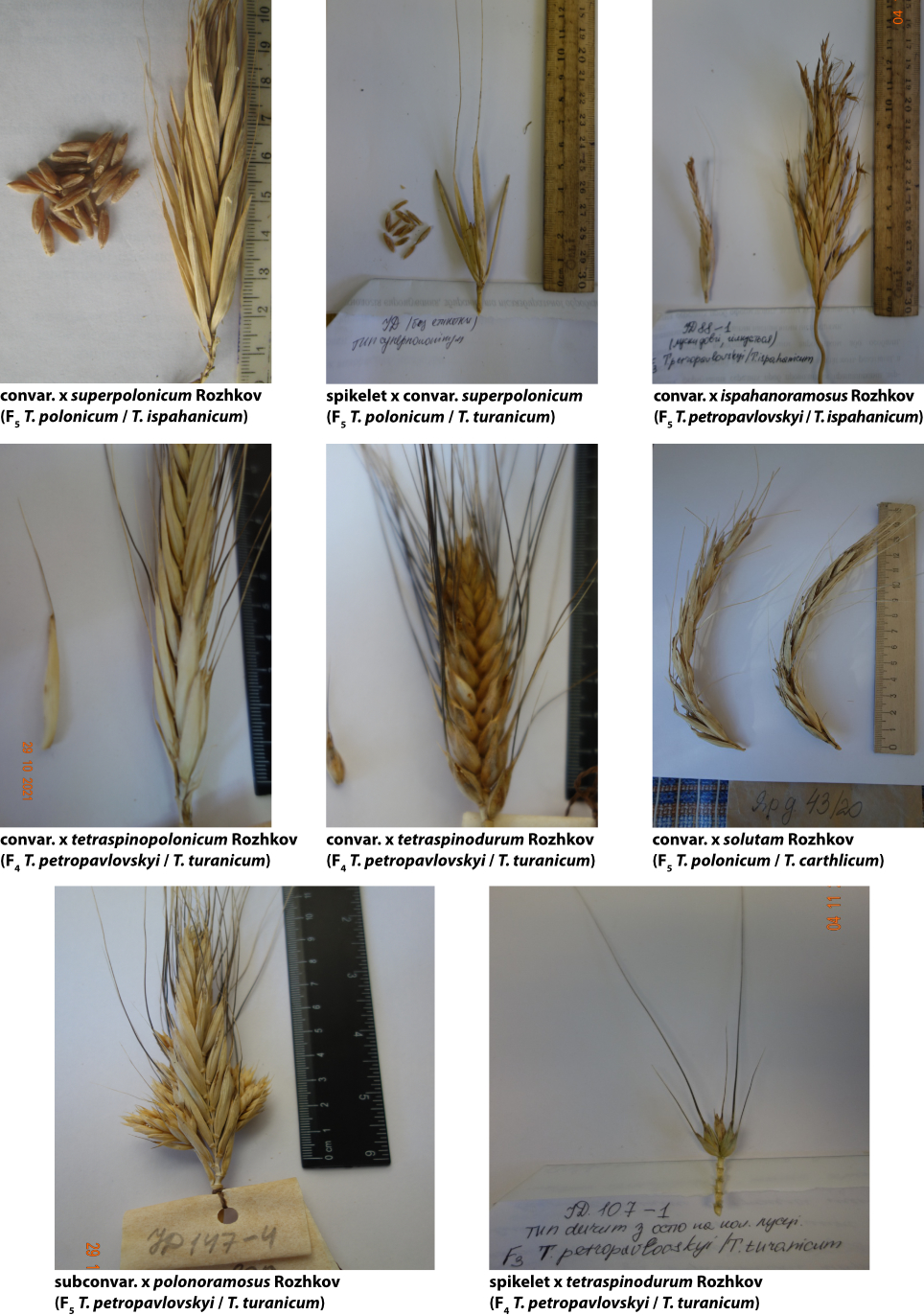
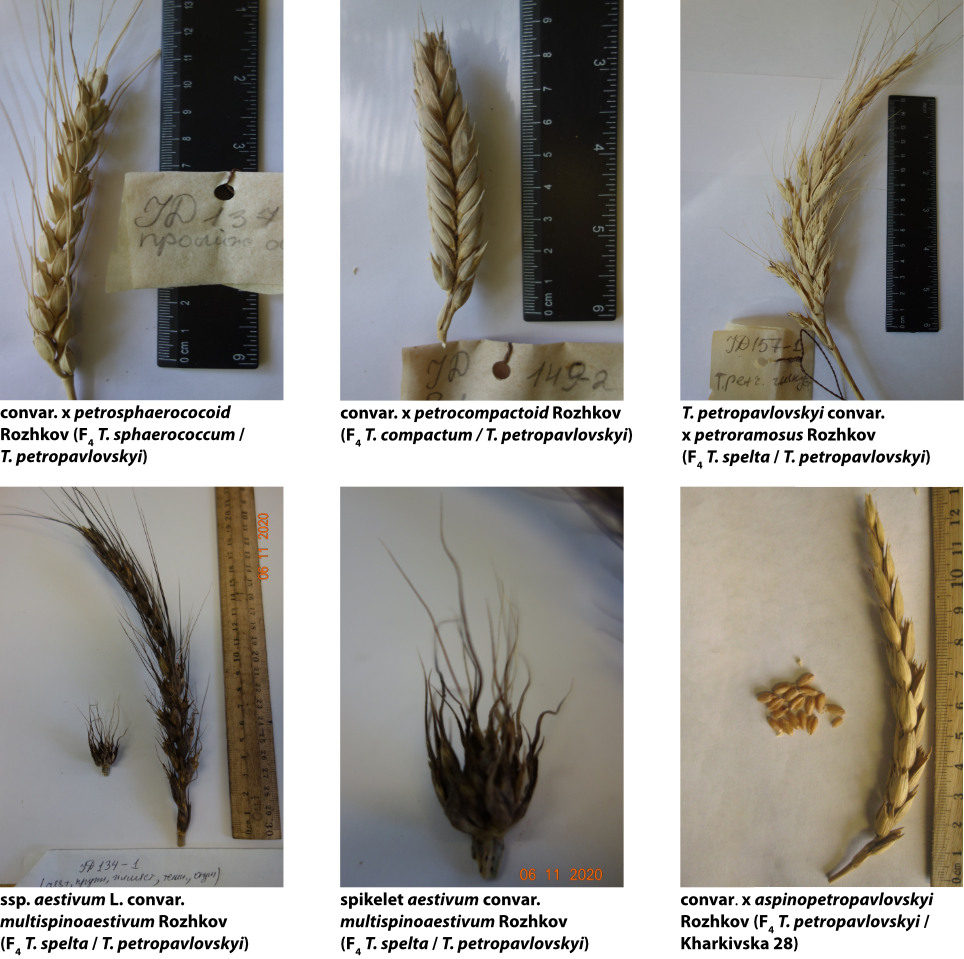
Table 2
Genetic control of radical traits in wheat species and subspecies.
[i] * When studying the “tetra‑awny” trait inheritance in the ‘ssp. carthlicum and ssp. durum’ combination, we elucidated that more than one gene was responsible for the expression of this trait (Rozhkov et al., 2014).
[ii] ** Given the differences in the “tetra‑awny” trait inheritance in combinations derived from ssp. carthlicum and ssp. petropavlovskyi (Rozhkov et al., 2014), we assume that different, non‑allelic genes may be responsible for this trait. Currently, these genes are being tested for allelism.
[iii] *** Most publications reported the dominant inheritance of the p gene; however, according to our data (Rozhkov 2006a; 2006b), when hybridizing T. petropavlovskyi with bread wheat and T. polonicum with durum wheat, a slight dominance of short‑glumed cultivars over polonoid species was observed in all F1 populations; therefore, based on our findings, the p gene, which determines long glumes, is considered recessive.
[iv] **** Elongated glumes are inherent in ssp. T. turanicum Jakubz.; according to our long‑term observations, in a Khorasan wheat accession (UA0300454), the glume was 15.1 cm long. A check for allelism with ssp. T. polonicum (p‑gene carrier) and ssp. T. ispahanicum (Pi gene carrier) showed that the long‑glume gene of ssp. T. turanicum was not allelic to the previously identified genes of polonoid species; therefore, we designated the long‑glume gene in ssp. T. turanicum as pt.
[v] ***** In addition to hexaploid wheat ssp. T. sphaerococcum Persiv., in which the grain sphericity gene is localized on chromosome 3D, subspecies ssp. T. turgidum and ssp. T. aethiopicum with spherical kernels and inflated glumes are distinguished among tetraploid forms. Based on long‑term observations, the mean sphericity index (Igr) in a ssp. T. turgidum accession (UA0300110) was 1.03; in ssp. durum it ranged from 1.15–1.24. The grain sphericity in tetraploid species is attributed to a specific gene similar to the s1 gene in ssp. T. sphaerococcum. We designated this gene in ssp. T. turgidum as st, and in ssp. T. aethiopicum as sat. At present we do not know whether these genes are allelic.
From the cross between the subspecies polonicum and ispahanicum, a distinct line was obtained and designated as × superpolonicum (Figure 1). This form had markedly longer glumes and caryopses compared to the parental accessions (Table 3). However, in appearance, it differed from Polish wheat: its glumes and caryopses were relatively narrower (Rozhkov, 2009). Transgressive forms with similarly altered glume length were also observed in ssp. polonicum × ssp. turanicum and ssp. petropavlovskyi × ssp. ispahanicum combinations.
Table 3
The presence of an additional awn on the glume (tetra-awny) represents another taxonomically significant trait in some hexaploid wheat subspecies (here and below, taxa are presented according to our classification, Table 4). It is most strongly expressed in the tetraploid subspecies T. carthlicum Nevski and is one of the key traits determining its taxonomic affiliation (Rozhkov et al., 2014; Dobrovolskaya et al., 2020). Attempts to obtain tetra-awny tetraploid forms with a phenotype distinct from that of carthlicum through carthlicum × polonicum or carthlicum × durum crosses were unsuccessful. Among the progeny different from Persian wheat, only forms with elongated teeth (0.5 cm) were observed. However, incongruent crosses between hexaploid ssp. petropavlovskyi and tetraploid ssp. polonicum and ssp. durum yielded typical morphotypes of tetraploid subspecies with a well-developed awn on the glume in the F2 generation (Figure 1).
Table 4
Synthetic taxonomy of the genus Triticum built on the wheat domestication stages and genetic kinship.
In addition to the tetra-awny trait, Persian wheat is characterized by a loose spike, which initially led to its misidentification as bread wheat (Vavilov, 1987). As noted above, no stable tetra-awny forms were obtained from carthlicum × polonicum crosses. Nevertheless, stable Polish wheat-like lines with a very loose spike (D = 12–13.5 spikelets per 10 cm) were selected (Table 3), whereas in the parental forms, polonicum (UA0300220) and carthlicum (UA0300068), the spike density (D) was in the range of 17–18.5 and 13.8–19.7, respectively, in the observation years.
Besides tetraploid ssp. polonicum, hexaploid ssp. petropavlovskyi also carries the P gene (Watanabe & Imamura, 2002). In the F2 generation of ssp. petropavlovskyi × ssp. turanicum, plants with a Polish wheat-like phenotype and spike length of 25.1–31.6 mm were selected. Some of these also exhibited spike branching and an additional awn on the glume (tetra-awny). These traits were inherited in the F3 and F4 generations (Figure 1, Table 3).
Segregation of branched ispahanicum-like forms was observed in the F2 generation from ssp. petropavlovskyi × ssp. ispahanicum crosses (Figure 1). Spike branchiness in these forms was also inherited in subsequent generations (F3, F4).
Crossing T. aestivum ssp. sphaerococcum cv. ‘Yeremeyevna’ with an artificially created winter form of ssp. petropavlovskyi (kindly provided by the Gene Bank of Ukraine) resulted in F2 progeny with spherical kernels and elongated glumes (Figure 2). To analyze caryopsis shape and size, previously proposed indices were applied (Rozhkov, 2018): the sphericity index (Igr) and the size index (Igs). The new forms had Igr values of 0.82–0.85, generally corresponding to the parental sphaerococcum type. However, they differed significantly from both parents in glume length: 10.2–10.7 mm versus 6.8–7.5 mm in Indian dwarf wheat and 14.7–15.8 mm in Petropavlovsk wheat. Regarding spike density, the new line showed an intermediate value (D = 20.7–25.7 spikelets per 10 cm) between the parental forms, ssp. sphaerococcum (D = 31.0–32.3) and ssp. petropavlovskyi (D = 14.7–15.1).
In another combination, where a winter ssp. petropavlovskyi form was crossed with winter ssp. compactum, progeny with a unique combination of parental traits were obtained: spike density (27.4–28.4 spikelets per 10 cm) and long glumes (13.4–15.6 mm), similar to ssp. petropavlovskyi (Table 3).
From a cross between a spring ssp. petropavlovskyi accession (UA0300106) and Italian spring spelt (UA0300074), highly productive petropavlovskyi-like plants with branched spikes were obtained (Figure 2).
In addition to the emergence of branched forms, ssp. aestivum-like plants with multiple awns on the glumes were observed in the ssp. petropavlovskyi (UA0300106) × ssp. spelta (UA0300074) combination (Figure 2).
Finally, from the cross between spring ssp. petropavlovskyi (UA0300106) and the spring awnless bread wheat cultivar ‘Kharkivska 28’ (Rozhkov, 2006b), petropavlovskyi-like awnless forms were derived (Figure 2).
. Discussion
A new synthetic taxonomy of wheat should be based on key principles. Before proposing these principles, one must first define the scope and limits of the genus as a structural taxonomic unit. Currently, many intergenus and interspecies hybrids and amphidiploids derived from the genus Triticum exist. These hybrids disrupt the genus structure. We refer to intergeneric hybrids such as × Triticale, × Aegilotricum, × Agropyrotrycum, × Tritordeum, and × Haynatricum. Many researchers (Goncharov, 2012) have tried to include intergeneric amphidiploids in Triticum, causing confusion and mixing representatives of different genera. This raises the question: what are the boundaries of the genus Triticum, and which species and forms should be included?
Since five genomes played key roles in Triticum phylogenesis (Au, Ab, B, G, and D), we propose to classify only carriers of these genomes as members of Triticum. Intergeneric amphidiploids should be assigned to separate genera, indicating their hybrid origin (×). Among these genomes, the presence of at least Au or Ab as a pivotal genome is mandatory for wheat habitus, while the presence or recombination of other genomes is not decisive for inclusion in Triticum.
Having defined the genus boundaries, we return to the key principles for wheat taxonomy: a) species ploidy, b) genetic distance or relatedness between species, and c) wheat domestication stages, which largely reflect phylogenetic relationships.
Replacing Dorofeev et al. (1979) classification, which had two subgenera in Triticum (Triticum and Boeoticum), Goncharov (2009; 2012). proposed five sections. We retain four sections unchanged, but the hexaploid wheat section (BBAuAuDD genome), previously called Triticum, may cause confusion due to its identical name with the genus and some species. We suggest renaming it Eutriticum.
Constructing our taxonomy (Table 4) and considering genetic differences between the Timofeevii and Dicoccoides lineages, we included wheat domestication stages as criteria for feature subordination during phylogenesis. Species may be merged if closely related, have the same ploidy, and share features such as spike rachis brittleness and glume adherence to the caryopsis. These traits are genetically determined, though expression can be influenced by genes in different subgenomes (Kilian et al., 2010; Faris, 2014). This principle preserves all wild Triticum species while logically merging closely related species.
To manage databases of underutilized species, we suggest that all traditional species listed in Dorofeev’s taxonomy be classified as subspecies, and existing subspecies recorded as groups of varieties (convarieties), except for T. spelta L., whose Asian and European subspecies show clear morphological and origin differences.
The section Compositum N includes only artificially created species with genomic formulas or ploidy levels absent in nature. Natural analogs or species that continue natural lineages should be transferred to appropriate sections. Thus, wheats with ploidy exceeding 6n or novel genomic combinations are placed in Compositum N, except for T. × kiharae and T. × migushavae, which are assigned to Timopheevii due to their phylogenetic logic. Man-made genotypes with the GGAuAuDD genome are also assigned to Timopheevii.
Guided by these principles, we included almost all convarieties of Dorofeev’s taxonomy (Identification Guide, 1980), allowing supporters of Dorofeev (1979) to retain variety-level categories, while Mac (1968) supporters can operate at the convariety level, the main category of synthetic taxonomy.
New wheat forms with key gene recombinations may benefit from assignment. We suggest considering assigning them as convarieties within existing subspecies. For example, Polish wheat forms with longer glumes (“× superpolonicum”) are treated as convarieties. Tetraploid morphotypes with additional awns from ssp. petropavlovskyi crosses are assigned as convarieties within their subspecies (e.g., T. turgidum ssp. polonicum convar. × tetraspinapolonicum Rozhkov). Similarly, new tetra-awny durum forms are T. turgidum ssp. durum convar. × tetraspinadurum Rozhkov.
Other unique forms, including polonicum with spike looseness, branched ssp. petropavlovskyi or ispahanicum, and multi-awny ssp. aestivum, are all assigned to convariety or subconvariety ranks according to their phenotypes. This approach maintains taxonomic stability despite the emergence of new recombinants.
The revival of ancient hulled wheats over the last 20–30 years also highlighted the need for taxonomic revision. Hulled species such as T. monococcum, T. dicoccum, and T. spelta, historically abandoned with mechanization, are now reintroduced. Breeding with common bread and pasta wheat has altered their morphology and grain quality. To avoid confusion, artificially created cultivars are labeled as interspecific hybrid convarieties (e.g., ssp. dicoccum convar. × dicoccoid Rozhkov; ssp. spelta convar. × speltoid Rozhkov). This principle should apply to other subspecies, e.g., ssp. carthlicum convar. persicoides (cv. Mulatka).
. Conclusions
Considering the existence of multiple taxonomic systems for the genus Triticum, which often leads to confusion in the identification of its taxa, there is a need for a conceptual framework of synthetic taxonomy. Such a framework could integrate strengths and address limitations of existing systems, be convenient for use by representatives of various scientific schools, and include both artificially created interspecific hybrid forms derived from them.
Our results demonstrated the possibility of recombining genes that control taxonomically significant traits, resulting in wheat morphotypes with unique expressions of these traits. This indicates the limitations of using such traits for species identification and suggests opportunities for refining existing taxonomies.
Accordingly, the proposed synthetic taxonomy was structured around several key principles: a) species ploidy; b) genetic distance or relationship between species; c) stages of wheat domestication.
Following these principles the assignment of taxonomic ranks primarily to wheat forms meeting the specified criteria and helps limit uncontrolled expansion of taxonomy through artificially created forms with recombinant traits.
Meanwhile, key traits determining species affiliation – such as fragility of the spike rachis and complex threshability – largely correspond to phylogenetic stages of speciation and may help prevent confusion when closely related species are grouped into a single taxon.
It should be noted that this represents one perspective on the construction of a synthetic taxonomy. We believe that broad discussion of the approaches and principles of such taxonomy among specialists will contribute to its further refinement and wider recognition.