
. Introduction
Chili (Capsicum spp.), a widely popular spice crop in Bangladesh, is grown across various climates, including tropical, subtropical, and temperate regions worldwide (Pickersgill, 1997). This crop belongs to the Solanaceae family and has its origins in South America. It is valued for its culinary and nutritional benefits, particularly its high content of vitamins, minerals, and antioxidants (Bal S. et al., 2022; Berke & Shieh, 2001).
High CaCO3, Ca+, and pH (7.0 to 8.5) in calcareous soil lead to shortage of micronutrients for crops (Martínez-Ríos et al., 2024). The availability of zinc and boron to plants decreases as the soil pH increases (Barrow et al., 2023). Notably, boron availability sharply declines when the soil pH exceeds 6.5. Additionally, the need for boron in plant growth and yield becomes greater when calcium levels are high (Verma et al., 2021).
The most important cause of lower chili yields in calcareous soil is the deficiency of micronutrients, such as low levels of zinc and boron (Shil et al., 2013). Previous studies have demonstrated that micronutrient deficiencies, particularly zinc and boron, can lead to stunted growth, reduced yield, and poor fruit quality in chili and other crops (Cakmak, 2000; Avila et al., 2024). Proper management of nutrients is crucial for growth and development of crops as well as their yield (Azad et al., 2022; Mondal et al., 2022) As the demand for high-quality chili increases, optimizing its growth conditions through appropriate nutrient management becomes crucial. Micronutrients, such as zinc and boron are essential in enhancing chili’s growth, yield, and quality (Shil et al., 2013).
Improvement of growth characteristics of plants through the application of micronutrients might be due to the enhancement of various physiological and metabolic processes in plants (Hatwar et al., 2003; Azad et al., 2021). For example, zinc is integral to several plant enzymatic activities and influences growth hormones like auxins, which regulate plant development. Boron is essential for maintaining membrane integrity, cell wall formation, and overall plant growth and supports reproductive development, such as pollen tube growth and seed setting (Slaton et al., 2005; Conceicao et al., 2022). Zinc and boron enhanced the photosynthetic activity of plants and synthesis of tryptophan, which is responsible for plant growth (Hamzah et al., 2022).
The methods of application of micronutrients are also very important. The method of foliar application of micronutrients has been proven beneficial for the immediate delivery of nutrients to crop’s tissues and organs (Pavia et al., 2019; Salama et al., 2023; Saavedra et al., 2022). Combined applications of micronutrients (zinc and boron) are more effective compared to single applications (Hasheminasab et al., 2023; Pradhan et al., 2024).
Combined application of zinc and boron enhanced chili production, as reported by previous researchers (Devi et al., 2013; Harris et al., 2018). Broadley et al. (2007) indicated that the combined application of these micronutrients significantly improves fruit length, breadth, and number in chili plants. Similarly, studies by Abd El-wahed et al. (2024) and Verma et al. (2021) have demonstrated that the application of zinc and boron in combination results in higher chili yields.
Thus, the objectives of this study were to determine the optimum level of zinc and boron by examining the application of these micronutrients separately and combinedly in different doses in chili crops. At the end of this study, we investigated the effect of zinc and boron on the growth, yield, and quality of chili.
. Materials and methods
. Details of the experimental site
The experiments were conducted at the Crop Research Center in Rajshahi, located at 24°22'42.5" N latitude and 88°37'57.4" E longitude during two consecutive Robi seasons (2020–2021 & 2021–2022). The experimental area consisted of three distinct seasons: the monsoon (May to October), winter (November to February), and pre-monsoon (March to April) periods. The soil at the site was characterized as a silty loam belonging to the High Ganges River Floodplains Tract under Argo-Ecological Zone 11 (FAO-UNDP, 1988).
The site had medium-high land with good drainage conditions, making it suitable for the experiment. The soil chemical analysis results revealed that the soil was silty clay, with pH 8.12, nitrogen 0.11%, phosphorus 16.60 mg/L, potassium 0.14 mg/L, sulfur 17.05 mg/L and organic carbon 1.59% per 100 g of soil. The zinc and boron content in the soil were found to be low, with the values of zinc of 0.039 mg/Land boron of 0.23 mg/L. During the experimental period, the average maximum temperature was 32.6°C, the minimum temperature was 22.75°C, the average humidity was 74.75%, and the average rainfall was 17.85 mm.
. Soil analysis
Before starting the experiment, soil samples were collected from ten randomly chosen spots at a depth of 0–15 cm across the field. These samples were combined into a composite sample after removing any unwanted materials, followed by air-drying, grinding, and sieving through a 2 mm mesh. The composite sample was then stored for subsequent physical and chemical analysis. The initial soil analysis involved assessing its texture, pH, organic matter content, and total nitrogen.
Additionally, the analysis measured exchangeable potassium, calcium, and magnesium, along with available phosphorus, sulfur, iron, copper, manganese, zinc, and boron levels. The nutrient profile was evaluated at the Soil Resource Development Institute (SRDI), Rajshahi Regional Research Laboratory, Bangladesh (Lab No. 14727). The soil pH was assessed with a glass electrode pH meter, and organic carbon was determined via the wet oxidation method depicted by Page, N.R. (1974).
The organic matter content was calculated by multiplying the percentage of organic carbon by a factor of 1.73 (Piper, 1950). Total nitrogen was assessed using the Kjeldahl method (Page et al., 1982). Phosphorus availability was assessed by extracting the soil using a 0.5 M NaH2CO3 solution with a pH of 8.5 and the concentration was measured spectrophotometrically at 660 nm after reduction of the phosphomolybdate complex with SnCl2 (Olsen et al., 1954). Exchangeable potassium, calcium, and magnesium were extracted utilizing a 1 M N1-L10AC, P117.0 solution, and K was analyzed with a flame photometer, while Ca and Mg were measured using atomic absorption spectrophotometry (Page et al., 1982). CaCl2 at the rate of 0.15% solution and quantified turbidimetrically at 420 nm was used to extract the available sulfur content (Page et al., 1982). The available content of boron, zinc, iron, copper, and manganese was determined by atomic absorption spectrophotometry (Hill & Fisher, 2010).
. Experimental layout and design
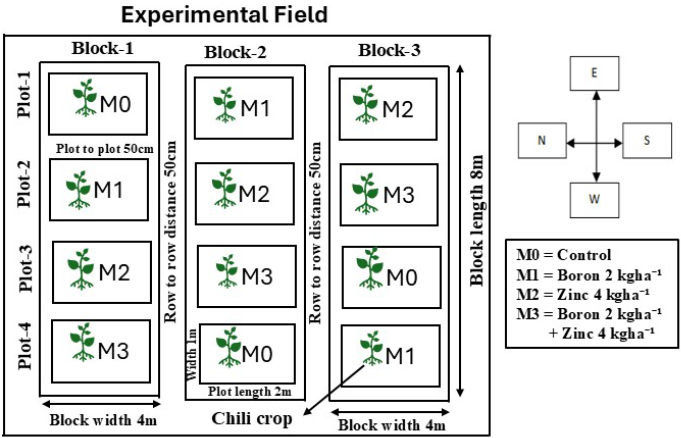
The experiment was conducted in a Randomized Complete Block Design (RCBD) with three replications. This experiment utilized four levels of zinc and boron to examine their effects on different vegetative growth parameters, yield, and yield related characters and quality attributes of chili. The treatments included a control group (M0), 2 kg of boron per hectare (M1), 4 kg of zinc per hectare (M2), and a combined application of 2 kg boron plus 4 kg zinc per hectare (M3). Zinc and boron were used as foliar applications. The experimental field had in total twelve unit plots by dividing the main field into three blocks and further the blocks were divided into unit plots. The block length was 8 m with a width of 4 m, and the plot size was 2 m with a width of 1 m. The distance between the rows was 50 cm, and between the plants was 50 cm. (Figure 1). To avoid the bias, the four different treatments were assigned to the unit plot randomly in such a way that each unit plot had an equal chance to receive the treatments.
Figure 1
Schematic diagram of the experimental field. The field was divided into three blocks, and each was further divides into four-unit plots. All plots were homogeneous, and the treatments were assigned randomly. The row-to-row distance of 50 cm and the plant-to-plant distance of 50 cm were maintained. The block and plot lengths are 8 m & 2 m, wide 4 m, and 1 m, respectively.
. Cultural operation
The experimental plot was prepared by performing multiple rounds of plowing, cross-plowing, and leveling with a power tiller. All weeds and plant debris were cleared from the field, and soil clods were broken down to achieve a fine tilth. The plot was then leveled, and irrigation and drainage channels were established around the perimeter. The field preparation was completed one month before the seedlings were transplanted. Top of FormBottom of FormAbout one-month-old seedlings of chili cultivar PICNIC (Metal) were transplanted at the beginning of November 2020, and the same time in 2021 maintaining spacing between the rows of 50 cm and between the plants of 50 cm. The unit plot size was 2 m × 1 m and accommodated 12 plants in each plot. The planting depth was 5.0 to 8.0 cm from the soil surface. Seedlings were watered just after transplanting. All macro-nutrients: cow dung, urea, triple super phosphate, muriate of potash, and gypsum were applied during the final preparation of the land for the basal dose at the rate of 5 t/ha, 120 kg/ha, 60 kg/ha, 80 kg/ha, and 20 kg/ha, respectively. Boron used as boric acid and zinc used as zinc sulfate were top dressed and sprayed separately and combinedly as per treatment; this was done at additional three time points at 30, 45, and 60 DAP equally as the foliar application. In addition, during the final land preparation, Miral 3G was applied at 6.8 kg per hectare to prevent the plants from soil-borne pests and disease. Weeding, irrigation, gap filling, and plant protection were done as required.
. Data collection
. Growth parameters and yield attributes
Data related to growth and yield contributing characters were collected in 2020–2021 and 2021–2022. For this, 6 plants were selected randomly in each treatment. Plant height was measured at 25, 50, 75, 100, and 125 DAP. The number of branches per plant was recorded thrice at 25, 50, and 75 DAP. The number of leaves was counted four times, starting from 25 DAP at 25-day intervals. At 45, 60, and 75 DAP, the flowers and fruits were counted. Each treatment-damaged fruit per plant was recorded on the day of final harvesting.
Fruit length and diameter measurements were carried out when the fruits matured. Measurements were made using calipers in the middle of the mature selected fruit. After removing mature fruits from the selected plant of a plot, the weight of twelve fruits from six plants was taken. The fruits were selected randomly for measuring the individual fruit weight. Every 100 g of ripened fruits was taken from six randomly selected plants in each experimental unit plot. These 100-g ripened fruits were dried under scorching sunlight and kept in an oven at 65°C for three days. After that, the dry weight of fruits was determined.
Seeds in six (6) mature ripened fruits were selected for each treatment considering as a random method, and then the total number of seeds per fruit was counted. Later, the mean of the six fruits of each treatment was calculated. To measure seed weight, one hundred seeds were counted from each treatment randomly. These seeds were thoroughly dried and weighed using an electronic balance. All mature fruits were also collected from six randomly chosen plants per treatment, weighed, and the average fruit weight per plot was calculated and expressed in grams. Fruit yields were determined by harvesting crops from a two-square-meter area in each plot, and the harvested samples were weighed with a balance, with the results expressed in tons per hectare.
. Chemical analysis
Total chlorophyll, chlorophyll-a, and chlorophyll-b were calculated from a 100-g (fresh weight) sample using the formulae described by Chazaux et al. (2022). The phenol-sulfuric acid method, which was depicted by Chen et al. (2023), was utilized to determine the total amount of soluble carbohydrates. Ash content was determined with the method previously described by Ismail (2017). The pH of fresh ripened chili of three different varieties was determined using a pH meter. β-carotene content in fresh ripened chili was determined using an atomic absorption spectrophotometer following the method of Se Souza et al. (2022). The extraction of β-carotene from the sample was carried out using an acetone-hexane mixture in a 4:6 ratio. The optical densities of the resulting supernatant were simultaneously measured at wavelengths of 663 nm, 645 nm, 505 nm, and 453 nm using a spectrophotometer. These measurements were then used to determine the β-carotene content. Zinc content in fresh ripened chili was determined using an atomic absorption spectrophotometer depicted by previous researchers (Benavides et al., 2021). Calcium content in fresh mature chili was measured using a colorimetric method as described by Alam et al. (2020). The vitamin C content was determined using a rapid and non-destructive determination of vitamin C in intact red chili fruits using visible near-infrared spectroscopy and machine learning tools (Devianti et al., 2023). Total soluble sugar content in ripe chili was analyzed using the Enthrone method (Zhang et al., 2023), while the soluble protein content in ripe chili was determined using the method established by Kong et al. (2015).
. Statistical analysis
Data was analyzed using the JMP statistical package (SAS Institute, Cary, NC, USA). Significant differences among treatments were determined by one-way analysis of variance (ANOVA). Tukey’s multiple range test was used to evaluate treatment effects and conduct comparisons, while the least significance difference (LSD) test at p ≤ 0.05 was used.
. Results
. Plant growth and morphology
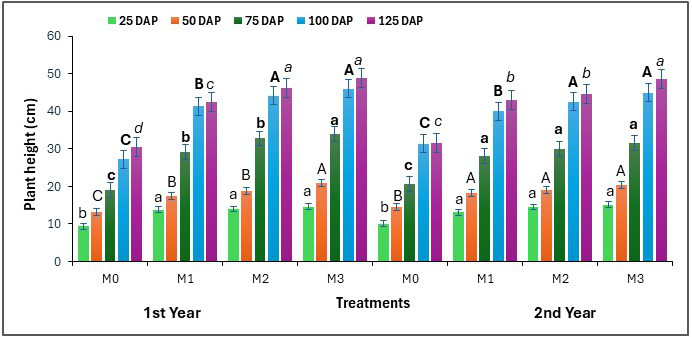
It was observed that the micronutrients had a significant impact on the height of the plants at different DAP (Figure 2). Plant heights increased with the advancements of time from 25 to 125 DAP, with the highest value observed in the M3 treatment combining 2 kg boron and 4 kg zinc per hectare. In contrast, the control (M0) exhibited the lowest plant heights throughout the growth stages. Intermediate values were recorded in the other micronutrient treatments (Figure 2).
Figure 2
Plant height (cm) at twenty-five days interval starting from 25 DAP and Continue at 125 DAP. Different letters indicate significant differences (p < .05; Turkey’s HSD test). Values are the mean ± SD, n = 6. Lowercase, uppercase, bold lowercase, bold uppercase and italic form were used to indicate mean differences at 25, 50, 75, 100 and 125 DAP, respectively. M0 = Control, M1 = 2 kg B ha-1, M2 = 4 kg Zn ha-1, M3 = 2 kg B ha-1 + 4 kg Zn ha-1.
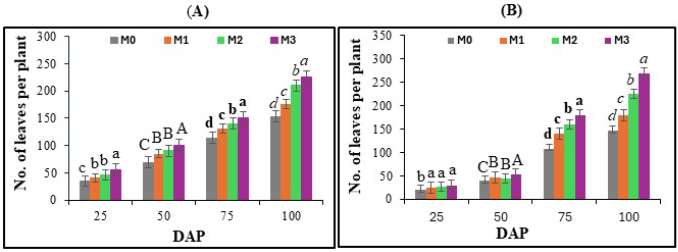
Micronutrients exhibited significant acceleration of the number of branches at different DAP (Figure 3). The number of branches per plant gradually increased from 25, 50, and 75 DAP. At each DAP, the maximum number of branches per plant was produced in the M3 treatment, significantly outperforming the other treatments, while the control yielded the fewest branches (Figure 3). Similarly, the micronutrients exhibited significant variation at different DAP in respect to the leaf number/plant. The number of leaves per plant increased steadily from 25 to 100 DAP, with M3 demonstrating the highest leaf counts and the control showing the lowest number, while the other treatments had intermediate values of this parameter (Figure 4).
Figure 3
Number of branches at 25-days interval in two consecutive years starting from 25 DAP. Different letters indicate significant differences (p < .05; Turkey’s HSD test). Values are the mean ± SD, n = 6. Lowercase, uppercase and bold form were used to indicate mean differences at 25, 50 and 75 DAP, respectively. M0 = Control, M1 = 2 kg B ha-1, M2 = 4 kg Zn ha-1, M3 = 2 kg B ha-1 + 4 kg Zn ha-1.
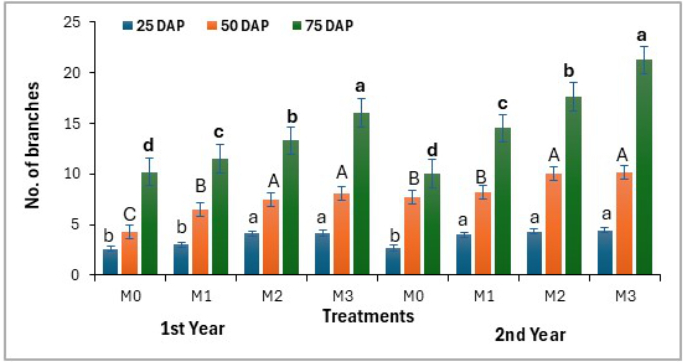
Figure 4
Effect of Zinc and Boron on the number of leaves. Fig. A represents the first-year data and Fig. B represents the second-year data at different days after transplanting. The data collected from 25 DAP at 25 days interval and continued 100 DAP. Different letters indicate significant differences (p < .05; Turkey’s HSD test). Values are the mean ± SD, n = 6. Lowercase, uppercase, bold and italic form were used to indicate mean differences at 25, 50, 75 and 100 DAP, respectively. M0 = Control, M1 = 2 kg B ha-1, M2 = 4 kg Zn ha-1, M3 = 2 kg B ha-1 + 4 kg Zn ha-1.
The micronutrient treatments influenced the time to first flowering and the total number of flowers (Tables 1 & 2). In the first year, the control showed the lowest flowering time (40 DAP), in contrast the M3 variant was characterized by the earliest flowering (39 DAP) compared to the other treatments in the second year (Tables 1 & 2). Flower production also varied significantly among the treatments, with M3 plants producing the highest total number of flowers per plant across all observed time points. The control consistently recorded the lowest flower counts (Figure 5).
Figure 5
Effect of Zinc and Boron on the number of flowers per plant. The flowers collected from 45 DAP at 25 days interval three times. Fig. A represents the first-year data and Fig. B represents the second-year data at different days after transplanting. Different letters indicate significant differences (p < .05; Turkey’s HSD test). Values are the mean ± SD, n = 6. Lowercase, uppercase and bold form were used to indicate mean differences at 45, 60 and 75, respectively. M0 = Control, M1 = 2 kg B ha-1, M2 = 4 kg Zn ha-1, M3 = 2 kg B ha-1 + 4 kg Zn ha-1.
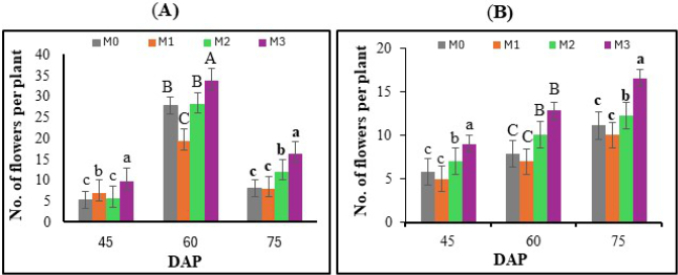
Table 1
Effects of micronutrients on growth and yield of chili. (1st year)
Table 2
Effects of micronutrients on growth and yield of chili. (2nd year)
. Yield and Yield Contributing Parameters
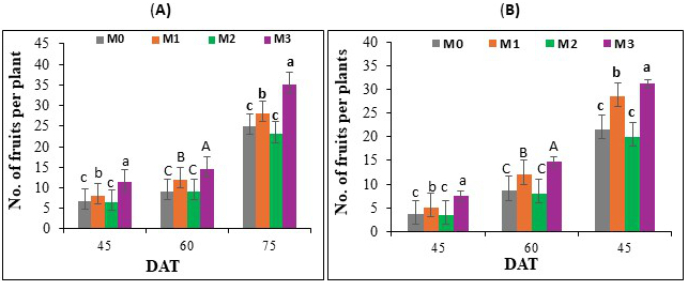
The micronutrients had a significant effect on the number of fruits per plant at different DAP and the total number of fruits in both years (Figure 6). The fruit data were collected in the two consecutive years three times at 45, 60, and 75 DAP. The number of fruits per plant increased consistently across different DAP, with the highest value observed in M3 (2 kg boron + 4 kg zinc per hectare). Compared to the control (M0), M3 produced significantly more fruit, particularly at later stages. Intermediate values were recorded in the M1 and M2 treatments (Figure 6).
Figure 6
Effect of Zinc and Boron on the number of fruits per plant. Fig. A represents the first-year data and Fig. B represents the second-year data at 45, 60 and 75 DAP. The data recorded from 45 DAP. Different letters indicate significant differences (p < .05; Turkey’s HSD test). Values are the mean ± SD, n = 6. Lowercase, uppercase and bold form were used to indicate mean differences at 45, 60 and 75, respectively. M0 = Control, M1 = 2 kg B ha-1, M2 = 4 kg Zn ha-1, M3 = 2 kg B ha-1 + 4 kg Zn ha-1.
The highest fresh fruit weight per plant in both years was found in the M3-treated plants compared to the other treatments, while the control consistently recorded the lowest values (Tables 1 & 2). Among the treatments, there were no significant effects on damaged fruits/plant in either year. Fruit length and diameter were significantly enhanced by the micronutrient treatments, with M3 producing the longest and widest fruits, followed by M2, M1, and M0. The control consistently had the smallest fruits in terms of both length and diameter (Tables 1 & 2). The fresh and dry weight of fruits per plant also showed a trend where M3 outperformed the other treatments, while the control had the lowest values.
However, the differences in the dry weight among the treatments were less pronounced (Tables 1 & 2). The application of the micronutrients had a significant effect on the number of seeds per fruit in both years (Tables 1 & 2). Among the treatments, M3 consistently resulted in the highest number of seeds per fruit and the greatest 100-seed weight. In contrast, the control treatment (M0) consistently exhibited the lowest values of both parameters (Tables 1 & 2). The 100-seed weight varied significantly among the treatments, with the seeds from the M3 plants being the heaviest, indicating better seed development, while the seeds from the M0 plants were the lightest.
Significant differences in the fresh fruit yield per plot and hectare caused by the addition of the micronutrients were obtained in the study. Per hectare yield was expressed in tons. In the 1st year, the fresh fruit yield of chili per hectare was 6.04 tons per hectare in M3, which was highest among all the levels of micronutrients, while the yield in the M0 treatment was 4.75 tons per hectare, which was the lowest value among all the treatments (Table 1). In the 2nd year, M3 and M0 showed the highest and lowest yield, and the value were 6.26 tons per hectare and 4.85 tons per hectare, respectively (Table 2).
Figure 7
Relationship between Yield/plant (g) and Yield (t ha-1). Randomly selected 12 plants yield were measured separately from each treatment after harvest. Fig. A indicated 1st year data and Fig. B indicates 2nd year data. **indicates significance at p < 0.05.
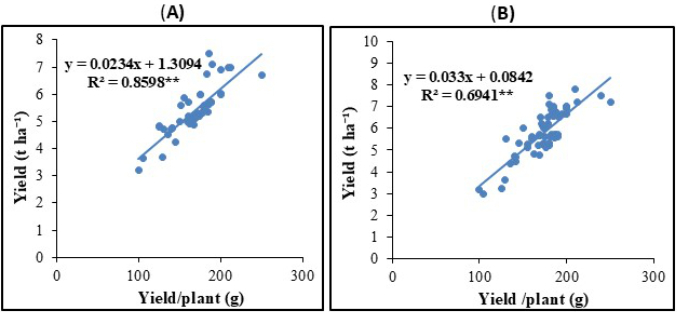
Figure 8
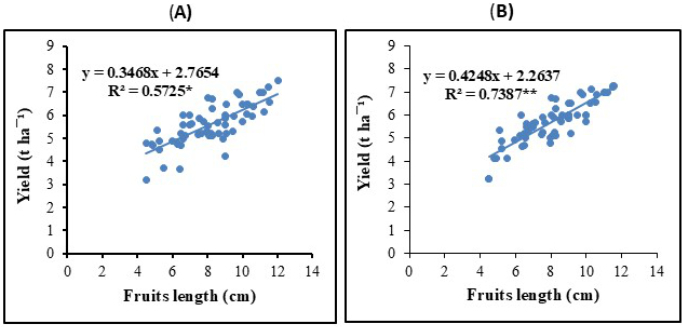
Relationship between Fruits length and Yield. Randomly selected 12 Fruits lengths were measured separately for each treatment and Yield were measured and converted into tons per hectare after harvest. Fig. A indicated 1st year data and Fig. B indicates 2nd year data. **indicates significance at p < 0.05.
. Quality parameters
The chili quality parameters that were measured in this experiment showed significant differences between the treatments, except for pH and ash (Tables 3 & 4). The pH value and ash contained in the fruits were found to exhibit no significant differences. The application of the micronutrients significantly increased vitamin C, sugar, carbohydrate, chlorophyll, calcium, zinc, beta-carotene, and protein content in the chili fruits (Tables 3 & 4). The M3 treatments consistently outperformed all the other treatments, producing the highest levels of these quality parameters. Compared to the control (M0), the M3-treated fruits showed marked increases in vitamin C, sugar accumulation, and chlorophyll content, demonstrating the substantial influence of the combined application of boron and zinc (Tables 3 & 4).
Table 3
Effects of micronutrients on different chemical parameters of chili.
Table 4
Effects of micronutrients on different chemical parameters of chili.
The sugar accumulation in the fruits was greatly influenced by the micronutrient application. The combined application of zinc and boron in the M3 treatment produced 28% more sugar in the first year and 31% more sugar in the second year compared to the control (Tables 3 & 4). The M1- and M2-treated fruits produced more sugar than the control in both years. In the case of carbohydrates, it was observed that the micronutrients induced significant variation among the treatments in both years. The carbohydrate content also varied significantly among the treatments, with M3 yielding the highest percentages, followed by M2 and M1 (Tables 3 & 4). Similarly, the calcium and zinc concentrations were maximized in the M3-treated fruits, indicating a clear benefit of micronutrient supplementation. Beta-carotene levels showed a similar trend, with M3 significantly enhancing its content compared to the control, while M1 and M2 exhibited intermediate values (Tables 3 & 4).
The M3-treated fruit contained 8% and 11% more zinc than M0 (control) in the 1st and 2nd year, respectively (Tables 3 & 4). The carotene content increased by 5%, 11%, and 14% in the 1st year and 6%, 12%, and 20% in the 2nd year in the M1-, M2-, and M3-treated fruits compared to the control (Tables 3 & 4). The protein content was also found to differ significantly with the application of the micronutrients at different doses. The protein content increased by 6%, 12%, and 21% in the 1st year and by 8%, 18%, and 28% in the 2nd year in the M1-, M2-, and M3-treated fruits, respectively, compared to M0 (control) (Tables 3 & 4). These results underscore the critical role of micronutrients in enhancing both nutritional and biochemical qualities of chili fruits, with M3 providing the most significant improvements across all measured parameters.
. Discussion
. The growth and yield of chili were accelerated by the application of zinc and boron
Scientists have demonstrated the advantages of applying micronutrients directly to the leaves of plants, which allows their rapid absorption into plant tissues and organs. The application of different levels of micronutrients had a significant impact on plant growth, morphology, and yield of chili (Cakmak, 2000; Avila et al., 2024). The combined application of zinc and boron as foliar applications increased nutrient levels in plant leaves and increased the rate of photosynthesis. Finally, the overall growth and yield were improved (Hassini et al., 2019; Pradhan et al., 2024; Broadley et al., 2007; Singh et al., 2017; Rafique et al., 2012).
The present results showed that the combination of zinc and boron at the rate of 2 kg ha-1 of boron and 4 kg ha-1 of zinc in M3 consistently resulted in the highest plant height across all observed days after planting (DAP) in both years (Figure 2). The chili crop with the highest plant height produced more flowers, leading to more yield. Therefore, the foliar application of zinc and boron in the M3 treatments caused significant enhancement of plant height as well as the number of leaves (Figure 4). This enhanced growth is likely due to the role of zinc in promoting cell division and elongation and the involvement of boron in cell wall formation and stability. Prior research has shown that insufficient levels of micronutrients, including zinc and boron, can result in inhibited development and decreased crop growth (Harris et al., 2018; Salim et al., 2019; Verma et al., 2021; Noreen et al., 2021). The results underscore the pivotal role of micronutrient management, particularly the combined application of zinc and boron (M3 treatment), in optimizing chili growth, development, and yield.
The increased number of branches and leaves in the M3-treated plants is particularly significant, as these traits enhance the photosynthetic capacity and overall plant vigor, providing a stronger physiological foundation for higher productivity. These findings align with previous studies (e.g., Zhao et al., 2024; Hossain et al., 2025; Harris et al., 2018; Brennan et al., 1996; Singh et al., 2017), emphasizing the importance of micronutrient-driven vegetative growth.
The early flowering observed in the M3-treated plants (Tables 1 & 2) suggests a more efficient transition from vegetative to reproductive stages, likely driven by enhanced hormonal regulation and nutrient availability. Micronutrients like boron and zinc are known to play critical roles in hormonal pathways (e.g., auxin synthesis and distribution), cell division, and carbohydrate transport. This improvement in resource allocation ensures a timely shift to reproductive development, corroborating findings reported by Harris et al. (2018) and Hassan et al. (2018).
The superior performance of the M3-treated plants in yield and yield-related traits, including the number of fruits, fruit weight, size, and seed parameters, reflects the synergistic effects of zinc and boron. Zinc is integral to enzymatic activities and protein synthesis, while boron supports cell wall formation and reproductive processes, including pollen germination and fruit set. The results demonstrate how these nutrients complement each other to optimize reproductive success and fruit development, as supported by Ali et al. (2013), Broadley et al. (2007); in cauliflower Hassan et al. (2018); in Mandarin trees Abd El-wahed et al. (2024); Harris et al. (2018).
The increased seed number and weight in the M3-treated plants suggest improved pollination and nutrient translocation to seeds and fruits. This highlights the role of micronutrients in sustaining metabolic and structural requirements during seed development. Similar findings have been reported by Verma et al. (2021) and Abd El-wahed et al. (2024). Additionally, the enhanced fruit quality parameters, including sugar, carbohydrate, protein, and chlorophyll content, suggest improved photosynthetic efficiency and nutrient assimilation in the M3-treated plants. The higher yield (tons per hectare) achieved under the M3 treatment (Tables 1 & 2) highlights the potential of balanced micronutrient management in sustainable chili production.
This approach not only ensures better crop performance but also contributes to improved nutritional quality, making it a dual benefit for farmers and consumers. The findings resonate with studies in other crops, such as cauliflower (Hassan et al., 2018) and mandarin trees (Abd El-wahed et al., 2024), further supporting the universality of these micronutrient effects.
These results advocate for incorporating micronutrient supplementation, particularly zinc and boron, into standard fertilization practices for chili cultivation. Future research could explore the interaction of these micronutrients with other soil and environmental factors to refine dosage recommendations and maximize their effectiveness across diverse agro-climatic regions. Additionally, long-term studies could assess their residual effects on soil health and subsequent crops, further enhancing the sustainability of micronutrient-based interventions
. The quality of chili was accelerated by the application of zinc and boron
The findings of this study highlight the profound impact of micronutrient applications on enhancing the nutritional and biochemical qualities of horticultural crops, particularly chili (Ahmed et al., 2024). The increased vitamin C content observed in the M3-treated fruits can be attributed to the synergistic effects of boron and zinc in ascorbic acid biosynthesis. Zinc, as an essential cofactor for several enzymes, likely promotes the activity of dehydroascorbate reductase, which is crucial for maintaining higher levels of ascorbic acid. Meanwhile, boron may influence the integrity of cell membranes and carbohydrate metabolism, indirectly supporting the synthesis of antioxidants.
The substantial increases in sugar, carbohydrate, and chlorophyll contents observed in the M3-treated fruits suggest an enhancement in photosynthetic efficiency and carbohydrate metabolism. Zinc plays a pivotal role in the activation of enzymes involved in carbon fixation and carbohydrate synthesis, while boron facilitates the translocation of assimilates, ensuring their effective utilization in fruit development (Saleem et al., 2022). These improvements align with prior studies indicating the benefits of combined boron and zinc applications in crops like broccoli (Sardar et al., 2022).
The higher calcium and zinc levels in the M3-treated fruits further emphasize the importance of these micronutrients in nutrient uptake and assimilation. Boron likely enhances calcium mobility and incorporation into cellular structures, while zinc aids in the synthesis of transport proteins that facilitate mineral uptake (Ahmed et al., 2024). These processes improve not only the structural integrity of the fruits but also their nutritional value. The increased beta-carotene and protein content in the M3-treated fruits underscores the role of micronutrients in secondary metabolite synthesis and nitrogen assimilation.
Zinc-dependent enzymes such as carotenoid isomerase may contribute to enhanced beta-carotene synthesis, while boron influences protein formation by optimizing nitrogen metabolism. These findings are consistent with earlier reports (Bagci et al., 2007; Sardar et al., 2022; in onion, Kumar et al., 2018), reinforcing the critical role of tailored micronutrient applications in horticultural practices.
The results imply that strategic micronutrient management can significantly enhance crop quality, offering practical benefits for both growers and consumers by improving yield, market value, and nutritional composition.
. Conclusion
The foliar application of zinc and boron was found to ensure an outstanding result that compensates for zinc and boron deficiency in calcareous soil and promotes vegetative growth and fruit development. Specifically, the combination of 2 kg boron with 4 kg zinc per hectare was found to be highly effective in enhancing the growth, yield, and quality of chili in calcareous soil. This specific combination of zinc and boron as a foliar application can be used as the optimum nutrient combination for the overall growth, yield, and quality of chili.