
. Introduction
Hawksworth (1991) drew early attention to the fungal dimension of biodiversity, emphasizing both its vast magnitude and its critical ecological significance, while underscoring the need to incorporate fungi into broader conservation frameworks. Microfungi are vital for ecosystem functions, including nutrient cycling, decomposition, and soil structure (Abdel-Azeem, 2010; Vogel et al., 2024). Despite their importance, fungi are poorly represented in many large-scale and national-level biodiversity assessments (Barros & Seena, 2022; Haelewaters et al., 2022a). This lack of representation is even more pronounced for microfungi because the primary method of demonstrating their presence is molecular, such as metabarcoding or metagenomics (Hajji-Hedfi & Abdel-Azeem, 2026). In practice, microorganisms are often treated as “data-poor” instead of being assessed for risk, resulting in a gap between molecular ecology and conservation decision-making (Abdel-Azeem, 2011). As global policy moves toward the Kunming-Montreal Global Biodiversity Framework, it is essential to include microbial components in assessments to protect total biodiversity (Convention on Biological Diversity, 2022).
The IUCN Red List Categories and Criteria (IUCN, 2001), together with the Guidelines for Using the IUCN Red List Categories and Criteria (IUCN Standards and Petitions Committee, 2024), represent the most widely accepted framework for assessing extinction risk. However, several key parameters required for Red List assessments, including population size and area of occupancy, remain difficult to estimate for organisms known primarily from sequence-based data (Abdel-Azeem & Hajji-Hedfi, 2025). Recent studies have nevertheless shown that molecular surveys, when combined with appropriate sampling strategies and modeling approaches, can improve the detection and assessment of threatened fungi (Copoț et al., 2024; Rieker et al., 2024). In response to these challenges, we propose a Microfungal Conservation Framework (MCF) that adapts IUCN principles to microfungi through five standardized components: (C1) molecular occurrence data; (C2) detection-adjusted occupancy, which accounts for false negatives in eDNA-based sampling (Doi et al., 2019; Peixoto et al., 2023); (C3) ecological specialization (Williams et al., 2009); (C4) functional importance weighting; and (C5) a threat exposure matrix. This framework is intended to address persistent knowledge gaps in neglected groups, including Laboulbeniomycetes (Haelewaters et al., 2022b; Cazabonne et al., 2025).
Accordingly, the objective of this study was to develop an MCF that enables the incorporation of microfungi into conservation assessment through a systematic methodology based on these five principal components. Together, they provide a structured basis for evaluating taxa, sites, habitats, and ecosystems beyond simple estimates of microfungal diversity. Each component is informed by the most relevant molecular, ecological, geographic, and conservation-related data, and the resulting scores are integrated in a consistent manner to generate a Microfungal Priority Index (MPI). In this way, the proposed framework provides a practical basis for more transparent, repeatable, and defensible conservation prioritization of microfungi.
. Material and methods
. Development of the Microfungal Conservation Framework (MCF)
Our proposed framework is divided into five main components.
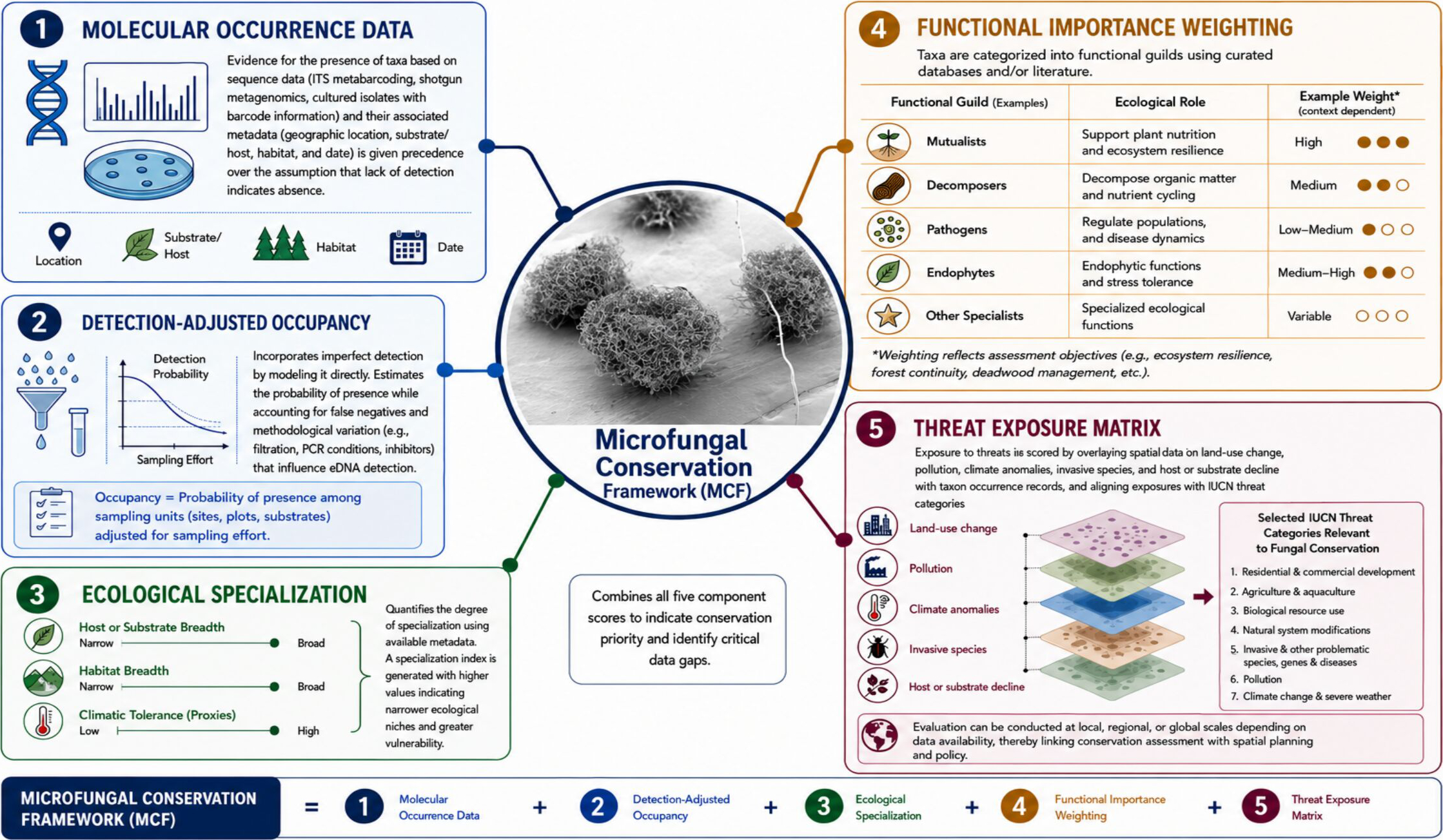
Component 1, molecular occurrence data, uses sequence-based evidence, including ITS metabarcoding, shotgun metagenomics, and cultured isolates with barcode information, together with associated metadata such as geographic location, substrate or host, habitat, and date. This component prioritizes documented evidence of taxon presence rather than non-detection indicating absence.
Component 2, detection-adjusted occupancy, incorporates imperfect detection directly into this framework. Occupancy is estimated as the probability of presence across sampling units, such as sites, plots, or substrates, while accounting for false negatives and variations in methodology, including filtration, PCR conditions, inhibitors, and sampling effort.
Component 3, ecological specialization, addresses the greater vulnerability often associated with taxa that occupy narrow ecological niches. Specialization was quantified using available metadata, including host or substrate breadth, habitat breadth, and climatic tolerance proxies, with higher values indicating narrower ecological requirements.
Component 4, functional importance weighting, considers the ecological or applied significance of taxa according to their functional guilds, such as mutualists, decomposers, pathogens, and endophytes. Where appropriate, different weights may be assigned depending on the context of the assessment and conservation objectives.
Component 5, the threat exposure matrix, evaluates the degree to which taxa are exposed to pressures such as land-use change, pollution, climate anomalies, invasive species, and host or substrate decline. Threat exposure was assessed by linking spatial occurrence data with relevant threat layers and aligning these pressures with the IUCN threat categories. Depending on data availability, this component can be evaluated at the local, regional, or global scale.
. Calculation of the Microfungal Priority Index (MPI)
The Microfungal Priority Index (MPI) was developed as a composite metric to integrate the five components of the Microfungal Conservation Framework (MCF) into a single quantitative measure of conservation priority. For each assessment unit, the MPI was calculated as the weighted sum of five standardized component scores. To ensure comparability, all component values were transformed to a common 0–1 scale prior to integration, with higher values indicating higher conservation priority. Equal weighting was adopted as the default approach, and missing values were addressed by recalculating the index using only the available components.
The MPI for each assessment unit i was calculated as follows:
where Sik is the standardized score of component k for assessment unit i, and wk is the weight assigned to that component, with the sum of all weights being equal to 1.
The five components of the MPI are molecular occurrence data (Mi), detection-adjusted occupancy (Oi), ecological specialization (Ei), functional importance weighting (Fi), and threat exposure matrix (Ti). Accordingly, the MPI can be expressed as:
Each component was evaluated separately using the most relevant evidence available. Molecular occurrence data were used to document confirmed records of taxa based on sequence-based evidence, and associated metadata. Detection-adjusted occupancy was used to estimate the probability of presence while accounting for imperfect detection and differences in the sampling effort. Ecological specialization reflects the degree to which taxa are restricted to hosts, substrates, habitats, or environmental conditions. Functional importance weighting accounts for the ecological or applied significance of taxa based on their functional roles. Threat exposure was used to evaluate the extent to which taxa or sites were affected by pressures, such as land-use change, pollution, climate anomalies, invasive species, and host or substrate decline.
Because these components may be measured on different scales, all raw values were standardized to a common range between 0 and 1 before integration:
where Xik is the raw value of component k for assessment unit i, and Xk,min and Xk,max are the minimum and maximum observed values for that component, respectively, across all assessed units. For components in which higher raw values indicated lower conservation priority (for example, detection-adjusted occupancy, where higher occupancy indicated lower rarity), reverse scoring was applied using:
to ensure that higher standardized values always represented higher conservation priority.
In the proposed framework, equal weighting is used as the default approach. Thus, each component contributed 0.20 to the final score, and Equation (2) became:
When one or more component scores were unavailable, the MPI was recalculated using only the available components and rescaled by the sum of their corresponding weights:
where n is the number of available components for assessment unit i. This step allows the framework to remain applicable, even when the datasets are incomplete.
For interpretation, MPI values may be grouped into broad conservation-priority classes as follows: 0.00–0.20, very low priority; 0.21–0.40, low priority; 0.41–0.60, moderate priority; 0.61–0.80, high priority; and 0.81–1.00, very high priority.
. Results
The Microfungal Conservation Framework (MCF) proposed by the authors shown in Figure 1 is a theoretical model that links together five key elements of microfungal conservation status into a single Microfungal Priority Index (MPI). The MPI supports the integrated analysis of multiple dimensions of microfungal conservation status, drawing together separate strands of knowledge on ecology, distribution, function, and threat exposure into a single index. This makes it possible to identify which taxa, habitats, or ecosystems face the highest risk of loss due to insufficient protection. The index can also be used to compare species, populations, or ecosystems; highlight areas of high conservation priority; and guide decisions about which microfungi warrant additional attention when the available data are limited, inconsistent, or unbalanced.
Figure 1
Microfungal Conservation Framework (MCF). Conceptual schematic of the five assessment components and their integration into a Microfungal Priority Index (MPI) proposed by the authors and designed using BioRender.
. Demonstration of the framework in principle: Worked examples
To address the need for a clear demonstration of how the MCF generates priorities, this section provides three worked examples (Table 1) using microfungi of clear conservation concern (microfungal pathogens that can drive declines in vulnerable wildlife or keystone plants). The examples are intended to show the mechanics of translating evidence into standardized component scores and combining them into an MPI; they do not constitute formal Red List assessments.
Illustrative MPI scoring for three microfungi that can be linked to conservation concerns via impacts on threatened hosts. Scores are examples to demonstrate the calculation workflow; in practice, they should be derived from curated occurrence records, replicated sampling designs, and explicitly documented threat layers.
For illustration, each component is standardized to a 0–1 scale, where higher values indicate higher priority: (C1) molecular occurrence evidence strength; (C2) rarity inferred from detection-adjusted occupancy (score = 1 – ψ, where ψ is estimated occupancy); (C3) ecological specialization (narrow host/substrate/habitat breadth); (C4) functional importance weight (context-dependent; here shown as a neutral weighting); and (C5) threat exposure (overlap between occurrence and host decline, land use change, climate suitability shifts, or other pressures). The default MPI is the mean of the five component scores (equal weights), but weights can be adjusted to match a specific assessment goal.
The following section discusses three worked examples from Table 1 in ascending order of their Microfungal Priority Index (MPI) scores, from lowest to highest, to illustrate how differences in the underlying component scores translate into differences in overall conservation priority.
The assessment of Hymenoscyphus fraxineus, a fungus linked to disease in ash trees, yields an MPI of 0.64, suggesting a moderate-to-high priority and highlighting where additional data could shift ranking. The evidence score (C1) is 0.8, reflecting good sequence support but with greater uncertainty and heterogeneity among regions and study designs. The rarity component (C2) is 0.6, based on assumed moderate occupancy after accounting for imperfect detection in targeted surveys. Ecological specialization (C3) reaches 0.6, indicating that while host association is present, the fungus exhibits broader ecological breadth than the other examples. The function weight (C4) is set at 0.5 using the neutral default value. Threat exposure (C5) receives a score of 0.7, representing moderate overlap with sensitive host populations and stressors such as habitat fragmentation. The conservation relevance of this taxon varies regionally, but it demonstrates the framework’s application to host-associated microfungi with emerging evidence.
Pseudogymnoascus destructans (white-nose syndrome agent)
For Pseudogymnoascus destructans, a microfungal pathogen associated with extensive dieback in hibernating bats, the calculated MPI was 0.68, indicating high priority but below the first example under assumed inputs. The evidence score (C1) reached 0.9, reflecting frequent, well-validated sequence detections along with culture and diagnostic confirmation where available. Rarity (C2) scored 0.5, as this pathogen demonstrated a broader occupied range in the surveyed areas compared to the first example, resulting in a lower rarity score. The specialization component (C3) was 0.7, given that the fungus is primarily associated with hibernating Myotis and other cave-roosting bat hosts and has limited host breadth but remains capable of persisting in cave and mine sediments outside the hibernation season. The function weight (C4) was maintained at a neutral default of 0.5. Threat exposure (C5) was scored at 0.8, indicating a high overlap with declining bat populations and landscapes experiencing strong disease pressure and suitable climatic conditions for cave-to-cave spread. Conservation concerns for this organism arise from its impact on hibernating bat colonies, dependent cave ecosystems, and pollination and pest control services provided by affected bat populations.
Batrachochytrium salamandrivorans (salamander chytrid)
The application of the framework to Batrachochytrium salamandrivorans achieved the highest MPI of 0.76 among the three examples, placing this taxon in the top priority tier under equal weights. The evidence component (C1) scores 0.9, supported by multiple independent sequence detections with verified markers and curated metadata, where replication provides confidence in occurrence signals. The rarity score (C2) is 0.7, calculated as 1−ψ, where detection-adjusted occupancy (ψ) is assumed to be moderate-to-low across surveyed regions. Specialization (C3) receives 0.8, reflecting a strong host association and limited ecological breadth when compared with generalist environmental fungi. The function weight (C4) is set at 0.5 using the neutral default, although this could be increased if the assessment prioritizes disease-mediated extinction risk. Threat exposure (C5) receives the highest score of 0.9, demonstrating high overlap with documented host declines and areas experiencing strong trade and translocation. The conservation concern for this psychrophilic microfungus arises from its association with mass mortality in hibernating bats and consequent impacts on multiple threatened bat species undergoing rapid spread among roosts.
. Discussion
The historical exclusion of microfungi from conservation assessments is a consequence of several overlapping knowledge gaps in the field of biodiversity. The Linnean shortfall (undescribed species) and Scottian shortfall (lack of conservation assessments) are the primary factors (Abdel-Azeem et al., 2020; Cazabonne et al., 2025). For microfungi, these limitations are compounded by what has been termed the “Thaxterian shortfall” – a critical lack of taxonomic expertise for groups such as the Laboulbeniomycetes, which limits our ability to verify molecular signals using morphological vouchers (Cazabonne et al., 2025; Haelewaters et al., 2022b). The MCF addresses these challenges by moving away from a reliance on traditional “count-based” metrics, which are often inapplicable to microscopic or hidden organisms, toward a probabilistic framework based on molecular occurrences. By utilizing environmental DNA (eDNA) as a proxy for presence, this framework enables the assessment of “dark matter” fungi that has yet to be formally described but are consistently detected in sequence-based surveys (Nilsson et al., 2023).
A core scientific strength of the MCF is its incorporation of detection-adjusted occupancy. Traditional presence-only data often fail to account for the “imperfect detection” inherent in molecular methods, where false negatives can arise from low biomass, PCR inhibition, or suboptimal primer binding (Doi et al., 2019; Peixoto et al., 2023). By employing multispecies site occupancy models, the MCF allows for a more rigorous estimation of rarity (1–ψ), which is adjusted for sampling effort and methodology (Doi et al., 2019). Furthermore, the inclusion of ecological specialization provides a biological basis for vulnerability; as noted by Williams et al. (2009), species with narrow environmental niches or restricted host breadths are inherently at higher risk of extinction when their specific habitats or hosts are threatened. This specialization index, when intersected with documented threat layers, provides a transparent and auditable pathway for prioritizing taxa in the absence of long-term population-trend data.
The development of the MCF is timely, given the mandates of the Kunming–Montreal Global Biodiversity Framework, which requires measurable progress toward protecting 30% of the planet’s land and water by 2030 and ensuring species recovery (Convention on Biological Diversity, 2022). Current protected area systems often fail to overlap with the global hotspots of mycorrhizal fungal richness, leaving essential ecosystem regulators unprotected (van Nuland et al., 2025). The MCF provides the necessary metrics to report on microbial biodiversity within these international frameworks, ensuring that the “F” in “Flora, Fauna, and Fungi” is represented in the national biodiversity action plans (Abdel-Azeem & Minter, 2011; Editorial, 2018; Abdel-Azeem & Hajji-Hedfi, 2025).
To transition the MCF from a conceptual proposal to a functional conservation tool, several “follow-up” actions are required.
Metadata standardization: Future implementations must align with common metadata standards for sequence records (e.g., MIxS) to ensure that occurrences are linked to precise geographic coordinates, substrates, and timestamps.
Genetic diversity integration: As highlighted by McLaughlin et al. (2025), genetic diversity is a critical component of the extinction risk. Follow-up versions of the MCF should explore how allelic diversity or temporal changes in genetic composition can be integrated into the priority index to better reflect adaptive potential (Lofgren & Stajich, 2021).
Regional capacity building: The success of the MCF depends on regional networks, such as the Arab Society for Fungal Conservation, to produce baseline data and train a new generation of mycologists in molecular-based assessment techniques (Abdel-Azeem & Salem, 2013; Kinge et al., 2023; Hajji-Hedfi & Abdel-Azeem, 2025).
Red List Alignment: A critical next step is the formal coupling of MCF outputs to IUCN Red List documentation requirements. This includes developing automated pipelines that trace evidence from the Microfungal Priority Index back to the original sequence records, thereby facilitating peer review and formal categorization.
. Conclusions
The Microfungal Conservation Framework represents a critical transition from treating microfungi as “data-poor” to recognizing them as “prioritizable” components of biodiversity. By integrating molecular occurrence data with occupancy modeling and threat assessments, the MCF provides a transparent and reproducible method for calculating the Microfungal Priority Index. This framework effectively bridges the gap between high-resolution data from modern molecular ecology and the practical needs of conservation policy. Ultimately, the inclusion of microfungi in conservation assessments is not merely a scientific necessity but a fundamental requirement for achieving the holistic goals of the Kunming–Montreal Global Biodiversity Framework and protecting the total complexity of life on Earth.