. Wstęp
Crossocalyx hellerianus (Nees ex Lindenb.) Meyl. [=Anastrophyllum hellerianum (Nees ex Lindenb.) R.M.Schust., zgiętolist nadrzewny] jest rzadkim gatunkiem epiksylicznym zagrożonym w skali Polski (kategoria EN; Klama & Górski, 2018) oraz na obszarze całego masywu tatrzańskiego (VU; Górski, 2020). Do 2020 roku roślinę tę zanotowano w Polskich Tatrach na zaledwie 4 stanowiskach, 2 w Tatrach Wysokich i 2 – Zachodnich (Klama, 2008; Szweykowski, 1956, 1960). W Tatrach Słowackich do 2020 roku wątrobowiec ten udokumentowano na 8 stanowiskach, z tego 7 pochodzi z Tatr Bielskich i 1 z Tatr Wysokich (Duda & Váňa, 1984, 1989; Górski & Váňa, 2014; Limpricht, 1877a, b; Szweykowski, 1960). Na terenie Słowacji omawiany gatunek jest bliski zagrożenia (NT; Mišíková et al., 2021).
Zasięg występowania Crossocalyx hellerianus w Polsce obejmuje Pomorze Zachodnie (Szweykowski & Koźlicka, 1969), północno-wschodnią część kraju (Puszcze – Białowieska, Romincka, Knyszyńska, Borecka, Wigierska; Górski et al., 2014, 2016; Karczmarz & Sokołowski, 1995; Klama, 2002a, b; Szweykowski, 1956; Wiśniewski & Rejment, 1935), Góry Świętokrzyskie i Kotlinę Sandomierską (Karczmarz & Bloch, 1985; Stebel et al., 2013). W obszarach górskich, poza Tatrami, zgiętolist nadrzewny notowany był w Górach Stołowych (Szweykowski, 1953a, b), Śnieżniku Kłodzkim (Szweykowski, 1956), Pieninach (Szweykowski, 1961; Vončina et al., 2023), Gorcach (Mierzeńska, 1994), Beskidzie Żywiecko-Orawskim (Klama, 1996), Beskidzie Sądeckim (Mamczarz, 1977) i Śląskim (Rejment-Grochowska, 1950).
Crossocalyx hellerianus jest obligatoryjnym epiksylem, wyjątkowo spotykanym na korze żywych drzew (Szweykowski, 2006). Jest bardzo drobnym gatunkiem o łodyżkach osiągających 0.5 (0.8) cm długości (Damsholt, 2009), a przez to trudnym do odnalezienia i obserwacji w terenie. Rozmnaża się głównie wegetatywnie poprzez rozmnóżki.
Celem pracy jest przedstawienie rozmieszczenia Crossocalyx hellerianus oraz charakterystyka wybranych właściwości biologicznych i ekologii tego gatunku w Tatrach.
. Metodyka
Badania prowadzono w latach 2012–2025 na terenie całego obszaru Tatr. W latach 2024–2025 na obszarze polskiej części Tatr Wysokich i Tatr Zachodnich wytypowano 11 kompleksów leśnych, które poddano szczegółowej inwentaryzacji obejmującej siedliska epifityczne, epiksyliczne i epilityczne w obrębie pasa reglowego. Dokumentacją objęto wszystkie gatunki reliktowe lasów puszczańskich według listy przedstawionej w pierwszej części niniejszego cyklu artykułów (Górski, 2025). Rejestrowano każde wystąpienie gatunków reliktowych, także w sytuacji ich bliskiej obecności w terenie (np. odrębne kłody oddalone od siebie kilka metrów) i tę sytuację określano jako „notowanie”. Jeśli dwa notowania były oddalone od siebie o przynajmniej 100 m uznawano je za odrębne „stanowiska”. W ten sposób możliwe było określenie miejsc o lokalnie większych zasobach populacyjnych Crossocalyx hellerianus bez powiększania liczby stanowisk i sprawiania wrażenia pospolitości tego rzadkiego gatunku. W miejscu występowania reliktowego wątrobowca wykonywano spis florystyczny z oddaniem stosunków ilościowych wykorzystując metodykę Brauna-Blanqueta stosowaną w badaniach fitosocjologicznych (por. Dierschke, 1994). Dokumentacją objęto 59 kłód z Crossocalyx hellerianus (siedliska epiksyliczne) i 3 stanowiska epifityczne z tym gatunkiem.
W 2024 roku inwentaryzacją objęto następujące kompleksy leśne Tatr Wysokich:
1. Żabie – Siedem Granatów – kompleks leśny o powierzchni ok. 120 ha; obejmuje acydofilne górnoreglowe bory świerkowe (Plagiothecio-Piceetum) i reliktowe bory limbowe (Vaccinio-Pinetum cembrae). Jest to dobrze wykształcony fragment lasów o charakterze naturalnym, w tym częściowo lasów urwiskowych, porastający północno-zachodni fragment Grani Żabiego – Siedem Granatów, wraz z przylegającymi do nich zbiorowiskami leśnymi u podnóża grani, tj. w Dolinie Rybiego Potoku od leśniczówki Wanta do Morskiego Oka, ograniczony od zachodu Rybim Potokiem (Myczkowski & Bednarz, 1974; Zięba et al., 2018, 2019). Cały obszar zbudowany jest ze skał granitowych. Lasy na tym obszarze były w przeszłości (głównie XIX w.), w niewielkim stopniu poddane użytkowaniu leśnemu, oraz presji ze strony pasterstwa. Przez badany teren nie przebiega żaden szlak turystyczny.
2. Opalone – Roztocka Czuba – kompleks leśny o powierzchni ok. 105 ha; obejmuje największy i najlepiej zachowany w Polsce fragment reliktowych borów limbowych (Vaccinio-Pinetum cembrae), wraz z przylegającymi acydofilnymi górnoreglowymi borami świerkowymi (Plagiothecio-Piceetum). Znaczną część tego obszaru pokrywają lasy urwiskowe porastające północno-zachodnie urwiska Opalonego – tj. rejon Orlej i Limbowej Ściany, oraz Roztockiej Czuby (Bednarz, 1969; Myczkowski & Bednarz, 1974; Izworska et al., 2023; Zięba et al., 2018, 2019). Zachodnią granicę tego obszaru badań wyznacza potok Roztoka. Cały obszar zbudowany jest ze skał granitowych. Tutejsze lasy ze względu na swoją niedostępność zachowały praktycznie pierwotny charakter i zostały wytypowane jako lasy o charakterze pierwotnym w ramach Konwencji Karpackiej. Jedyne fragmenty analizowanego lasu które podlegały w przeszłości presji ze strony człowieka (leśnictwo, pasterstwo) znajdują się wzdłuż szlaku w Dolinie Roztoki oraz w łatwiej dostępnych fragmentach grani Opalonego (tereny przylegające od strony Doliny Rybiego Potoku). Przez badany obszar nie przebiega żaden szlak turystyczny (na niektórych fragmentach jego zachodnia granica przylega do szlaku turystycznego w Dolinie Roztoki). Badania dendrochronologiczne wykazały, że limby rosnące w tym kompleksie leśnym osiągają wiek nawet ok. 450 lat (Izworska et al., 2023).
3. Szczoty Wołoszyńskie – kompleks leśny o powierzchni ok. 33 ha; obejmuje jeden z najlepiej zachowanych fragmentów lasów urwiskowych w Tatrach Polskich, porośnięty przez acydofilne górnoreglowe bory świerkowe (Plagiothecio-Piceetum), reliktowe bory limbowe (Vaccinio-Pinetum cembrae), oraz unikatowe w skali kraju jaworzyny na granicie i laski brzozowo-jarzębinowe (Bednarz & Krzaklewski, 1975; Myczkowski & Bednarz, 1974; Zięba et al., 2018, 2019). Cały obszar zbudowany jest ze skał granitowych. Kompleks leśny na Szczotach Wołoszyńskich ze względu na swoją niedostępność zachował pierwotny charakter i został wytypowany jako las o charakterze pierwotnym w ramach Konwencji Karpackiej. Północno-wschodnią granicę obszaru wyznacza Zagonny Żleb, a południowo-zachodnią Szeroki Żleb. Przez badany obszar nie przebiega żaden szlak turystyczny.
4. Dolina Waksmundzka – kompleks leśny o powierzchni ok. 65 ha; obejmuje dobrze wykształcone górnoreglowe bory świerkowe (Plagiothecio-Piceetum) oraz fragmenty jaworzyn, reliktowych borów limbowych (Vaccinio-Pinetum cembrae) i nawapiennych reliktowych borów limbowych (Swertio perennis-Pinetum cembrae) w Dolinie Waksmundzkiej na południowy wschód od czerwonego szlaku z Toporowej Cyrhli do Morskiego Oka, do górnej granicy lasu w rejonie wodospadu Młyn (Bednarz & Krzaklewski, 1975; Myczkowski & Bednarz, 1974; Zięba et al., 2018, 2019). Większość obszaru zbudowana jest z granitów, jedynie północno-zachodni fragment – Waksmundzkie Ścianki tworzą wapienie. Lasy na tym obszarze były w przeszłości w umiarkowanym stopniu poddane użytkowaniu leśnemu oraz presji ze strony pasterstwa. Przez badany teren nie przebiega żaden szlak turystyczny.
5. Dolina Łężna – Ciemne Smreczyny – Filipczański Wierch – kompleks leśny o powierzchni ok. 350 ha. Obszar rozciąga się na południe od drogi Oswalda Balzera na odcinku od Doliny Filipka po Wawrzeczkową Cyrhlę. Obejmuje głównie lasy jodłowe wraz z fragmentami olszyn położonych u podnóża masywu Kop Sołtysich (Jarząbczak, Przyporniak, Ciemne Smreczyny, Dolina Łężna, Dolina Filipka), oraz fragmenty jaworzyn i lasów bukowo-jaworowych w stromych żlebach i urwiskach skalnych głównie w rejonie Doliny Łężnej i Jaworzyńskiego Żlebu, a także fragmenty nawapiennych górnoreglowych borów świerkowych w Dolinie Filipka pod Gęsią Szyją (Myczkowski & Lesiński, 1974; Pielech et al., 2021). Dolna część terenu zbudowana jest z łupków i piaskowców, natomiast górną tworzą wapienie i dolomity. Lasy na tym obszarze podlegały w przeszłości znaczącemu użytkowaniu leśnemu, niemniej jednak w najbardziej niedostępnych miejscach (żleby, ściany skalne, śródleśne bagna), oraz w fragmentach zdominowanych przez jodłę zachowały naturalny charakter. Przez badany obszar nie przebiega żaden szlak turystyczny (jedynie w pobliżu wschodniej granicy przebiega szlak z Doliny Filipki na Rusinową Polanę).
6. Gąsienicowy Las – Skoruśniak – Dolina Pańszczycy – kompleks leśny o powierzchni ok. 320 ha. Obejmuje rozległy obszar acydofilnych górnoreglowych borów świerkowych (Plagiothecio-Piceetum) i fragmenty świerkowych borów bagiennych wykształconych w Dolinie Suchej Wody Gąsienicowej i Dolinie Pańszczycy, na odcinku od schroniska Murowaniec na Hali Gąsienicowej do Waksmundzkiej Polany, od północnego-wschodu ograniczony czerwonym szlakiem z Psiej Trawki na Waksmundzką Polaną, a od zachodu załomem terenowym opadającym ze Skoruśniaka w stronę Suchej Wody (Ociepa et al., 2021; Szewczyk et al., 2011). Cały obszar zbudowany jest ze skał krystalicznych (m.in. moreny), miejscami wytwarzają się torfowiska. Lasy na tym terenie podlegały w przeszłości umiarkowanej presji ze strony działalności leśnej i pasterskiej. Przez badany obszar przebiega szlak turystyczny z Hali Gąsienicowej na Waksmundzką Rówień oraz ww. szlak z Psiej Trawki.
W 2025 roku inwentaryzacją objęto następujące kompleksy leśne Tatr Zachodnich:
7. Dolina Bystrej – Dolina Olczyska – kompleks leśny o powierzchni ok. 420 ha. Zajmuje on wschodnią cześć Doliny Bystrej, tj. Dolinę Suchą Kasprową, Dolinę Stare Szałasiska, wraz z przylegającymi Jaworzyńskimi Turniami i ciągnie się w kierunku północnym wzdłuż potoku Bystra na Nosal, aż po dolną częścią Doliny Olczyskiej. Obszar obejmuje zróżnicowane lasy – od typowych górnoreglowych borów, przez dolnoreglowe świerczyny namorenowe, po żyzne buczyny w północnej części i fragmenty reliktowych lasków sosnowych oraz sztuczny drzewostan obcej sosny czarnej (Pinus nigra) na zachodnich zboczach Nosala. Lasy na tym obszarze uległy w przeszłości znacznym przekształceniom w związku z masowym pozyskaniem drewna na potrzeby lokalnego górnictwa i hutnictwa w Kuźnicach, a także działalnością pasterską. Część monokultur świerkowych została powalona przez kolejne huraganowe wiatry halne – tj. w 1968 i 2013 roku. Najlepiej zachowane lasy o charakterze naturalnym zachowały się w Dolinie Suchej Kasprowej i Dolinie Stare Szałasiska, wraz z przylegającymi Jaworzyńskimi Turniami – są to w większości górnoreglowe bory świerkowe (za równo na granicie jak i wapieniu) oraz reliktowe bory limbowe. Fragmenty starodrzewu zachowały się również w północnej części obszaru, tj. jedliny w rejonie Nieboraka oraz buczyny (głównie klacyfilne, bogate florystycznie, ale również fragmentami kwaśne) na południowo-zachodnich i północno-wschodnich stokach Nosala oraz u wylotu Doliny Olczyskiej (Ociepa et al., 2020; Szwagrzyk et al., 2024). Analizowany obszar odznacza się znacznym zróżnicowaniem geologicznym – południowy fragment zbudowany jest z granitów, których warstwa w postaci utworów morenowych ciągnie się dnem doliny aż pod Nosal. Natomiast północna i wschodnia część terenu zbudowana jest ze skał osadowych – głównie wapieni i dolomitów. Teren charakteryzuje się rozwiniętą infrastrukturą turystyczną z centrum w zakopiańskich Kuźnicach – kolej linowa na Kasprowy Wierch, liczne szlaki turystyczne, trasy narciarskie.
8. Dolina Białego – kompleks leśny o powierzchni ok. 270 ha, obejmujący całą dolinę reglową u podnóża wschodniej części masywu Giewontu. Analizowany obszar w całości zbudowany jest ze skał osadowych – głównie wapieni i dolomitów. W reglu dolnym zachowane naturalne bogate florystycznie kalcyfilne buczyny (Szwagrzyk et al., 2024), wchodzące w skład najrozleglejszego kompleksu buczyn w TPN, tj. tzw. Regli Zakopiańskich. W reglu górnym wykształcone naturalne nawapienne bory świerkowe oraz fragmenty borów limbowych Swertio perennis-Pinetum cembrae. (Zięba et al., 2018). Lasy w Dolinie Białego w przeszłości podlegały umiarkowanej presji ze strony człowieka – pasterstwo, górnictwo, leśnictwo (m.in. zalesianie części doliny modrzewiem i sosną obcego pochodzenia (Horvat et al., 1980)). Obszar ten objęty jest ochroną ścisłą nieprzerwanie od utworzenia Tatrzańskiego Parku Narodowego w 1954 roku – jako jeden z zaledwie trzech rejonów w TPN (Parusel & Zwijacz-Kozica, 2018). Przez Dolinę Białego przebiega szlak turystyczny, łączący się w górnej części doliny z Ścieżką nad Reglami.
9. Dolina Spadowiec – Dolina ku Dziurze – kompleks leśny o powierzchni ok. 135 ha, obejmujący północną część masywu Sarniej Skały. Większość obszaru pokryta jest przez zbiorowiska bogatych florystycznie kalcyfilnych buczyn (Szwagrzyk et al., 2024). W wyższych położeniach występują nawapienne bory górnoreglowe (Chrysanthemo rotundifolii-Piceion) (Pielech et al., 2021). Interesującym zagadnieniem na tym obszarze jest znaczne obniżenie górnej granicy lasu do 1300 m n.p.m. (tzw. fenomen Sarniej Skały) (Horvat et al., 1980). Obszar w całości zbudowany ze skał osadowych – wapieni i dolomitów. Lasy w przeszłości użytkowane gospodarczo, od 1975 roku objęte ochroną ścisłą (Parusel & Zwijacz-Kozica, 2018). Przez kompleks leśny przebiega zaledwie 1 szlak turystyczny do Jaskini Dziura.
10. Dolina Strążyska – kompleks leśny o powierzchni ok. 235 ha, pokrywający dolną, środkową i górną część doliny, tj. Małą Dolinkę i Dolinkę do Bani. Większość obszaru porośnięta jest naturalnymi, bogatymi florystycznie kalcyfilnymi buczynami – zwłaszcza na Samkowej Czubie i Grześkówkach. Jeden z nielicznych obszarów w Tatrach z dobrze zachowaną strefą przejściową między zbiorowiskami leśnymi regla dolnego i górnego – zwłaszcza w rejonie Końskiego Żlebu. Górne partie Doliny Strążyskiej, położone u podstawy ścian Giewontu i w rejonie Suchego Wierchu porastają nawapienne górnoreglowe świerczyny. Analizowany obszar w przeszłości użytkowano gospodarczo – górnictwo, pasterstwo, leśnictwo (m.in. wprowadzenie modrzewi obcego pochodzenia), niemniej jednak wchodzi w skład najlepiej zachowanego kompleksu buczyn w TPN w Reglach Zakopiańskich. Rejon Doliny Strążyskiej zbudowany jest ze skał osadowych – głównie wapieni i dolomitów.
11. Masyw Łysanek – kompleksy leśny o powierzchni ok. 200 ha, obejmujący dolinki reglowe po północnej stronie Łysanek, tj.: Suchy Żleb, Dolinę za Bramką i Mały Żleb. Obszar ten odznacza się najlepiej w Tatrach Polskich zachowanymi buczynami – zwłaszcza w Suchym Żlebie (Skrzydłowski, 2008). Dobrze wykształcona naturalna strefa przejściowa pomiędzy zbiorowiskami regla dolnego i górnego, wyższe partie porośnięte nawapiennymi borami świerkowymi (Chrysanthemo rotundifolii-Piceion) (Pielech et al., 2021). Teren w całości zbudowany ze skał osadowych – głównie wapieni i dolomitów, w rejonach skałek reglowych występują fragmenty reliktowych lasków sosnowych i jaworzyn. Lasy na analizowanym obszarze podlegały w przeszłości umiarkowanej presji ze strony człowieka – użytkowanie leśne, zwłaszcza na Łysankach. Przez obszar przebiega zaledwie 1 szlak turystyczny do Doliny za Bramką.
Szacunkowa powierzchnia badanych kompleksów leśnych wynosi 993 ha (Tatry Wysokie) i 1260 ha (Tatry Zachodnie). Granice i ich wielkość wyznaczano na podstawie uwarunkowań topograficznych. W każdym kompleksie wykonano tę samą liczbę zdjęć florystyczno-siedliskowych (35). Liczba notowań była różna i związana z różnorodnością danego kompleksu. Wykaz stanowisk uzupełniono o dane zielnikowe zdeponowane w herbarium Uniwersytetu im. Adama Mickiewicza w Poznaniu (POZW). Odnaleziono tutaj 8 niepublikowanych stanowisk Crossocalyx hellerianus zebranych głównie przez Profesora Jerzego Szweykowskiego.
. Wyniki
. Rozmieszczenie Crossocalyx hellerianus w Tatrach
Łącznie, na całym obszarze Tatr, zarejestrowano 85 stanowisk Crossocalyx hellerianus (123 notowania; Rycina 1). Po stronie polskiej masywu odnaleziono ich 67, po słowackiej – 18. W niniejszej publikacji przedstawiono 69 nowych stanowisk tego wątrobowca. Liczba lokalizacji tej rośliny w Polskich Tatrach Wysokich i Zachodnich jest zbliżona (32 i 35), podczas gdy na Słowacji najwięcej ich stwierdzono w Tatrach Bielskich (13), przy jednocześnie bardzo niskiej liczbie obserwacji w pozostałych częściach masywu. Zarysowane różnice wynikają głównie ze stopnia zbadania wątrobowców po obu stronach granicy państwowej.
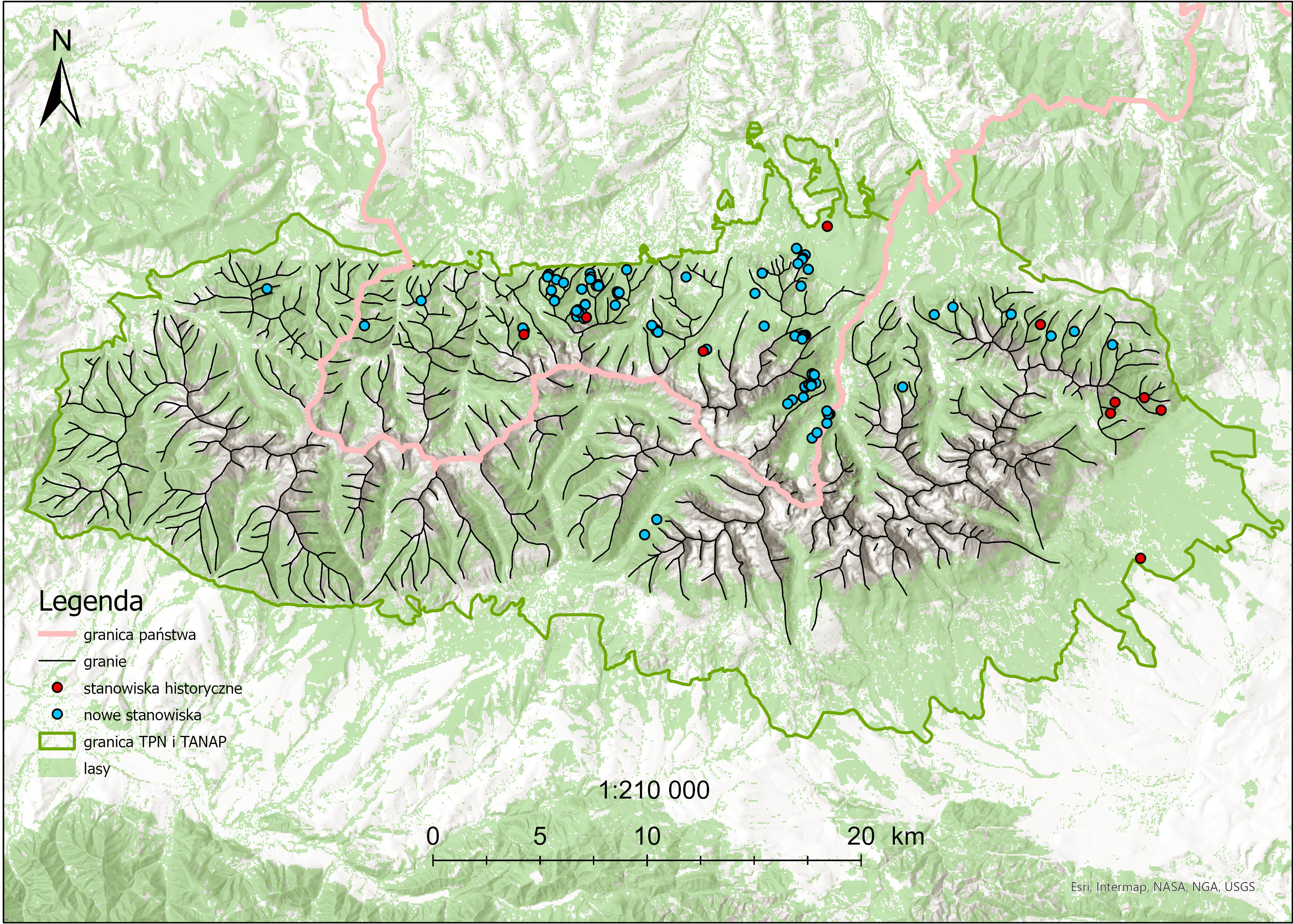
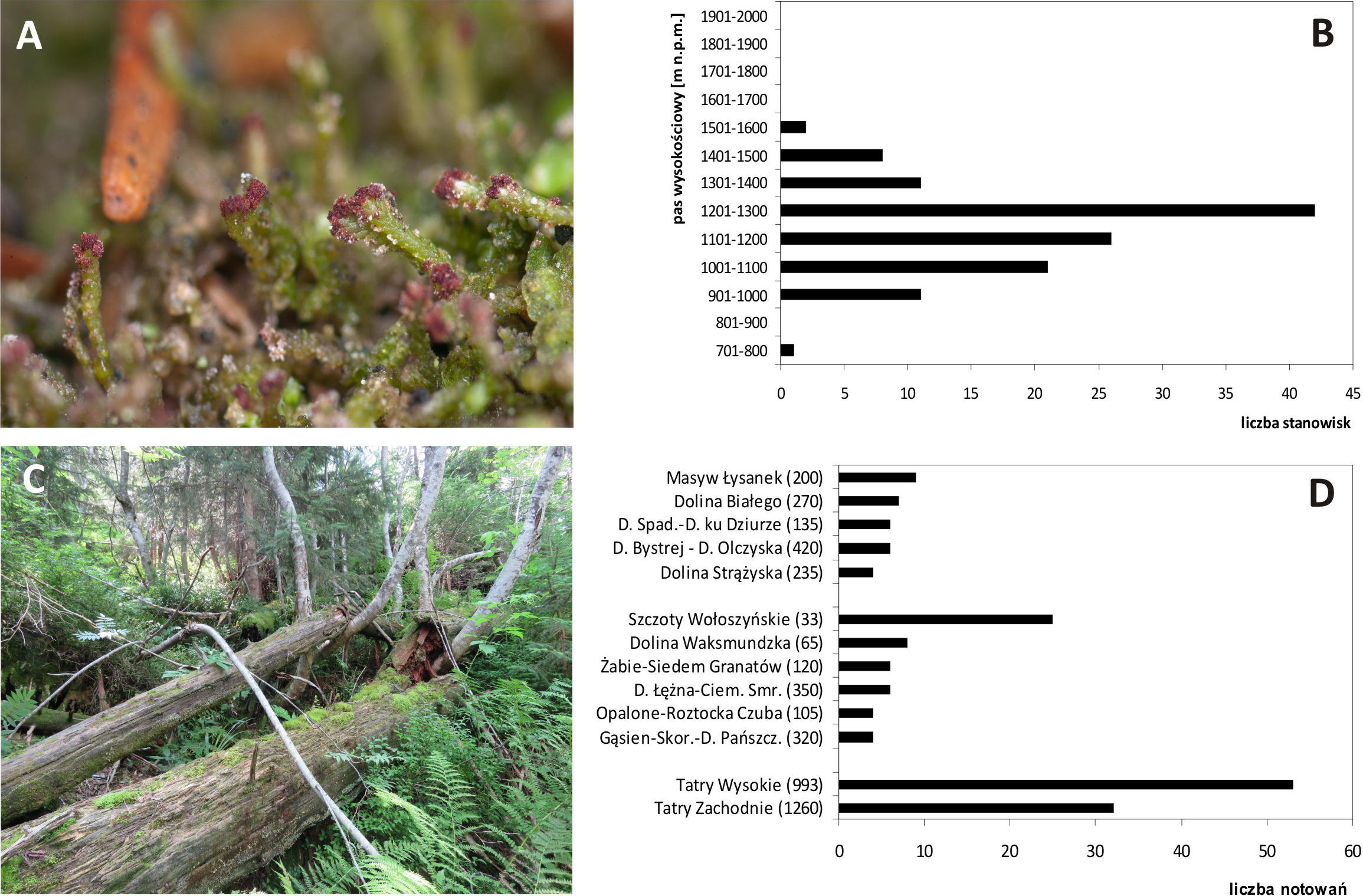
Crossocalyx hellerianus jest gatunkiem niżowo-górskim. W Tatrach jego stanowiska koncentrują się w reglu dolnym, a maksimum liczby notowań przypada na pas przejściowy między reglem dolnym i górnym, na wysokości 1201–1300 m n.p.m. (por. Rycina 2B). Maksimum wysokościowe odnaleziono w Polskich Tatrach Wysokich, w kompleksie Żabie-Siedem Granatów, na wysokości 1522 m n.p.m. (por. Tabela 1; Górski, 2025). Najwyższe stanowisko słowackie znajduje się w Tatrach Bielskich [w lesie świerkowym na wschodnich stokach szczytu Fajksowa Czuba (Faixová), wys. 1450 m n.p.m., leg. J. Szweykowski, 21.07.1956, rev. J. Váňa, POZW 4795; Szweykowski, 1960]. Najniższe stanowisko w całym masywie odnaleziono w Tatrach Wysokich Słowackich, na wysokości 800 m n.p.m. (por. Tabela 1; Duda & Váňa, 1984); w polskiej części Tatr zlokalizowane jest ono na wysokości 921 m n.p.m. (por. Wykaz nowych stanowisk, nr 26).
Rycina 2
Crossocalyx hellerianus w Tatrach: A – pokrój rośliny z widocznymi amarantowymi rozmnóżkami na szczycie pędu (fot. M. Romański), B – występowanie gatunku w profilu pionowym Tatr, C – laski jarzębinowe z bogactwem rumoszu drzewnego i towarzyszącą mu roślinnością epiksyliczną (fot. P. Górski, 16.07.2024, Dolina Waksmundzka), D – liczby notowań gatunku w poszczególnych kompleksach leśnych Tatr (w nawiasie podano powierzchnię w ha; zastosowane skróty: D. – dolina, Spad. – Spadowiec, Ciem. Smr. – Ciemne Smreczyny – Filipczański Wierch, Gąsien-Skor. – Las Gąsienicowy-Skoruśniak, Pańszcz. – Pańszczyca).
. Crossocalyx hellerianus w badanych kompleksach leśnych Tatr Polskich
Różnice w liczbie notowań Crossocalyx hellerianus w badanych 11 kompleksach leśnych są duże i wynoszą od 4 do 25. Interpretacja tego obrazu nie jest prosta i każdy obszar należy oceniać indywidualnie. Najważniejszymi zmiennymi są tutaj historia użytkowania lasu oraz jego wyniesienie nad poziomom morza. Ten ostatni parametr powoduje, że nawet najlepiej zachowane lasy górnoreglowe nie będą siedliskiem licznego występowania dolnoreglowej rośliny. W 7 obszarach liczba notowań C. hellerianus jest dość niska, od 4 do 6. W największym powierzchniowo kompleksie tj. Dolina Bystrej-Dolina Olczyska (420 ha), Crossocalyx hellerianus ma zaledwie 6 notowań i to skupionych tylko przy potoku w Dolinie Stare Szałasiska. Brak tego gatunku w Dolinie Suchej Kasprowej czy Olczyskiej, pomimo iż w wielu miejscach tego kompleksu są już spore zasoby martwego drewna. W tym obszarze oddziaływanie człowieka w przeszłości było bardzo duże (por. opis w Metodyce, kompleks nr 7). Niewiele notowań (4) C. hellerianus w Gąsienicowym Lesie, Skoruśniaku i Dolinie Pańszczycy związane jest jednocześnie z antropogenicznymi przekształceniami lasu w dolnej części obszaru, a w górnej – głównie znacznym wyniesieniem nad poziom morza. Ten ostatni czynnik ogranicza występowanie C. hellerianus także w kompleksie Żabie-Siedem Granatów (6 notowań). Wyjątkowym obszarem, z największą liczbą (25!) obserwacji, są lasy na Szczotach Wołoszyńskich (wschodnie stoki doliny Roztoki). Opisywany teren ma jednocześnie najmniejszą powierzchnię z badanych. Przedstawia on mozaikę wszystkich stadiów życia lasu – od dojrzałych (starych) drzewostanów, przez młodniki, laski jarzębinowe po fragmenty lasu z całkowitym rozpadem. Wszystkie te postaci cechowała obfitość rumoszu drzewnego. Warto zauważyć, że ta niezwykła różnorodność biologiczna na Szczotach realizuje się w pobliżu silnie obciążonego turystycznie szlaku biegnącego dnem doliny Roztoki w kierunku Doliny Pięciu Stawów Polskich, będącego równocześnie od wieków szlakiem wędrówek pasterskich (Hołub-Pacewiczowa, 1931). Znaczna niedostępność terenu (las urwiskowy) zdecydowała o zachowaniu pierwotnego charakteru lasu.
W badanych dolinach Tatr Zachodnich tj. Strążyska, Białego, za Bramką, ku Dziurze występowanie Crossocalyx hellerianus koncentruje się poza główną osią doliny, w której przebiega szlak turystyczny. Stanowiska tej rośliny obecne są natomiast już w bocznych dolinkach czy żlebach odchodzących od doliny głównej. Zaobserwowana zależność może być związana z faktem, że obecne szlaki turystyczne wiodą starymi traktami pasterskimi, górniczymi, bądź drogami leśnymi (w tym zrywkowymi), a lasy w ich pobliżu były prawdopodobnie intensywniej użytkowane niż w bardziej odległych bocznych odnogach. Na obszarach nieudostępnionych turystycznie, a zwłaszcza w małych i węższych dolinkach i żlebach (Mały Żlebek, Spadowiec, Suchy Żleb) relikty puszczańskie występują w osi głównej doliny.
Pomimo zbliżonej liczby stanowisk Crossocalyx hellerianus w Polskich Tatrach Wysokich i Zachodnich (por. Tabela 1), duże różnice zaznaczają się w liczbie notowań. W Tatrach Wysokich jest ich 53 (na 993 ha), w Zachodnich zaś – 32 na 1260 ha. Wyraźnie można to wiązać z lepszym stopniem zachowania lasów Tatr Wysokich, większą ich niedostępnością i mniejszym stopniem użytkowania w przeszłości. Pamiętać jednocześnie należy, że omawiany gatunek związany jest z rozkładającym się drewnem świerka i jodły, których udział w drzewostanach Tatr Zachodnich jest mniejszy z uwagi na rozpowszechnione tutaj lasy liściaste (głównie buczyny) i mieszane.
Tabela 1
Rozmieszczenie pionowe i poziome Crossocalyx hellerianus w Tatrach (↑↓ – maksimum i minimum wysokościowe gatunku w całym masywie, * – po raz pierwszy w tej części Tatr, por. Wykaz nowych stanowisk, nr 69).
| Region | Kraj | Liczba stanowisk | Zakres wysokości |
|---|---|---|---|
| Tatry Bielskie | Słowacja | 13 | 925–1450 |
| Tatry Wysokie | Słowacja | 5 | ↓800–1435 |
| Polska | 32 | 921–1522↑ | |
| Tatry Zachodnie | Słowacja | 1* | 1135 |
| Polska | 35 | 960–1383 |
[i] Maksimum wysokościowe: Polska, Tatry Wysokie, Żabie, lasy na NE od Morskiego Oka, bór limbowo-świerkowy Vaccinio-Pinetum cembrae, próchniejąca kłoda, 49.209387°N, 20.08569°E, wys. 1522 m, MGRS 34UDV3351, leg. P. Górski 1916/2024, 6.09.2024 (POZNB 5553) (Górski, 2025).
[ii] Minimum wysokościowe: [stanowisko o niedokładnie określonej wysokości]: Słowacja, Tatry Wysokie, Tatrzańska Łomnica (Tatranská Lomnica), wys. 800–1000 m, leg. A. Boros, det. L. Vajda (Duda & Váňa, 1984).
. Fitocenozy z Crossocalyx hellerianus w Tatrach
Analizie poddano 62 wystąpienia Crossocalyx hellerianus w polskiej części Tatr (11 kompleksów leśnych, zob. Metodyka). Większość z tych notowań dotyczyła siedlisk epiksylicznych (59), pozostałe były epifityczne. Najwięcej kłód udokumentowano na Szczotach Wołoszyńskich (15), dolinie Waksmundzkiej (8) i Masywie Łysanek (7). Łącznie, w fitocenozach z C. hellerianus porastających rozkładające się drewno, odnotowano 38 gatunków wątrobowców (minimalnie w jednym zdjęciu fitosocjologicznym – 5, maksymalnie 19, średnio 11; mediana 12). Pokrycie mszaków na kłodzie było zróżnicowane, od wartości 5% po 100 % (średnio 57%). Z gatunków towarzyszących najczęściej rosły następujące wątrobowce (z V i IV stopniem stałości): Tritomaria exsecta, Lepidozia reptans, Blepharostoma trichophyllum, Mylia taylorii, Calypogeia suecica oraz Cephalozia bicuspidata. Najobfitszym gatunkiem z wymienionych była T. exsecta. W 40 zdjęciach (na 59) Crossocalyx hellerianus osiągał najniższe stopnie skali ilościowości (r, +). Obwód leżących kłód (w odległości ok. 1,3 m od nasady pnia) wahał się od 55 cm do 168 cm (średnio 105 cm). Analizowane kłody z C. hellerianus zlokalizowane były w pasie wysokościowym 927–1522 m n.p.pm.
Wystąpienia Crossocalyx hellerianus na korze żywych drzew (3 stanowiska) zlokalizowane były w dolinie Waksmundzkiej i dolinie Stare Szałasiska. Dotyczyły one wyłącznie grubych świerków (pierśnice 119, 153 i 181 cm). Najwyżej na pniu C. hellerianus występował na wysokości 65 cm od gruntu. Wszystkie fitocenozy epifityczne miały po 9 gatunków i zarejestrowano je w zakresie wysokości 1283–1315 m n.p.m.
W 36% fitocenozach porastających martwe drewno, w których udokumentowano Crossocalyx hellerianus, na tej samej kłodzie rosły także inne wątrobowce z grupy reliktów puszczańskich. Najczęściej były to Fuscocephaloziopsis catenulata, Anastrophyllum michauxii lub Harpanthus scutatus. Maksymalnie na jednej kłodzie rosły razem trzy relikty. Najczęściej były to dwa pierwsze wymienione gatunki. Sytuacje, w których na tym samym podłożu C. hellerianum występował dodatkowo z jednym reliktem, dotyczyły 28% spisów florystycznych. Był to głównie F. catenulata. W 36% fitocenozach epiksylicznych C. hellerianus nie towarzyszyły wątrobowce diagnostyczne lasów puszczańskich. Zauważyć można zależność, że im więcej w spisie występowało gatunków reliktowych tym bogatsze gatunkowo były kłody we florę wątrobowców. Kłody z trzema roślinami diagnostycznymi porastało średnio 13 gatunków, z 2 – 11, z 1 – 10.
. Strategia rozmnażania
W ogromnej większości obserwacji Crossocalyx hellerianus rozmnaża się wegetatywnie, wytwarzając obficie rozmnóżki w górnej części pędów. Z całą pewnością jest to główny sposób opanowywania mikrosiedlisk w obrębie danej kłody. Na większości badanych stanowisk C. hellerianus występował w znikomych ilościach („r” w skali ilościowości Brauna-Blanqueta). Tak było w 20 przypadkach na 30 udokumentowanych fitocenoz. Były jednak sytuacje (6) masowego występowania, gdzie wątrobowiec ten pokrywał do 25% powierzchni płatów. Pomimo drobnych rozmiarów pędy rozmnóżkowe wykazują wyraźny wzrost ortotropowy i nie można wykluczyć, że rozmnóżki są podrywane przez wiatr i przenoszone na następne kłody. Te strategię uprawdopodabnia fakt, że gatunek ten często rośnie w prześwietleniach, odsłonięciach drzewostanu (wykroty różnego pochodzenia) lub dolinach potoków (od strony wody, na oświetlonych kłodach w poprzek potoków), gdzie ruch powietrza jest większy niż w rozległym i zwartym kompleksie leśnym. Sytuacji, w których pędy omawianej rośliny nie wytwarzają rozmnóżek jest stosunkowo niewiele. Odnotowano je trzykrotnie. Warto dodać, że w tym stanie roślina jest trudna w identyfikacji.
Na 123 notowania Crossocalyx hellerianus w Tatrach okazy z peryancjum obserwowano 9 razy, a okazy męskie tego dwupiennego gatunku, jeden raz. Zazwyczaj peryancja w obrębie jednej populacji wytwarzane są licznie. Sądząc po dość równomiernym rozmieszczeniu tego wątrobowca w badanych kompleksach leśnych Polskich Tatr rozmnażanie generatywne jest skuteczne i wystarczające. Ma to ważne znaczenie w prognozowaniu zasiedlania poprzez daleki transport zarodników także obecnych drzewostanów, które określane są jako zniekształcone, a które – w warunkach ochrony ścisłej – będą zwiększały stopień naturalności.
. Wykaz nowych stanowisk
Objaśnienia
leg. PG 1641/2024 – zebrał P. Górski, indywidualny numer zbioru; not. PG 612/2015 zanotował P. Górski, numer obserwacji;
oddzielne stanowiska oddalone od siebie w terenie przynajmniej o 100 m zanumerowano (pogrubiona czcionka); w obrębie jednego stanowiska może być kilka notowań
Polska, Tatry Wysokie
1. Skalnite, za Żlebem Podspad, kłoda przy potoku, 49.275975°N, 20.049245°E, wys. 1124 m, leg. PG 1213/2023, 15.08.2023 (POZNB 4588); 2. Żleb za Skałką (w górnej części), kłoda przy potoku, na krawędzi wodospadu, 49.277916°N, 20.078816°E, wys. 1080 m, leg. PG 1227/2023, 16.08.2023 (POZNB 4598); 3. Dolina Filipka, powyżej połączenia Potoku Złotego i Filipczańskiego, na kłodzie przy Potoku Filipczańskim (poniżej drogi gruntowej), 49.27072°N, 20.074208°E, wys. 1059 m, leg. PG 1387/2023, 16.09.2023 (POZNB 4755); 4. Dolina Roztoki, lasy pod granią Opalone, ok. 150 m od Potoku Roztoka, gruba martwa kłoda w borze świerkowym (powyżej blokowisk z kosówką), 49.224169°N, 20.076587°E, wys. 1271 m, leg. PG 1641/2024, 6.07.2024 (POZNB 5117); 5. Dolina Roztoki (w połowie długości), lasy pod granią Opalone, ok. 75 m od Potoku Roztoka, martwe drewno w borze świerkowym, 49.222928°N, 20.069463°E, wys. 1287 m, leg. PG 1655/2024, 9.07.2024 (POZNB 5148); 6. Dolina Roztoki (bliżej Polany Nowa Roztoka), lasy pod granią Opalone, ok. 120 m od Potoku Roztoka, stojący, przełamany pień w luce boru świerkowego, 49.221381°N, 20.066608°E, wys. 1297 m, leg. PG 1659/2024, 9.07.2024 (POZNB 5154); 7. Dolina Roztoki (bliżej Wodogrzmotów Mickiewicza), lasy pod Roztocką Czubą, ok. 75 m od Potoku Roztoka, w borze świerkowym z dużym udziałem Vaccinium myrtillus, niedaleko szlaku, 49.230035°N, 20.084645°E, wys. 1162 m, leg. PG 1672/2024, 10.07.2024 (POZNB 5173); 8. Las Gąsienicowy, w borze między rozchodzącymi się szlakami żółtym i zielonym, próchniejąca kłoda przy potoku, 49.243602°N, 20.01416°E, wys. 1406 m, leg. PG 1833/2024, 20.08.2024 (POZNB 5427); 49.243745°N, 20.014078°E, wys. 1419 m, leg. PG 1835/2024, 20.08.2024 (POZNB 5431); 9. Przy zielonym szlaku między Waksmundzką Polaną a Polaną Pańszczyca, próchniejąca kłoda w prześwietlonym borze poniżej szlaku, 49.253737°N, 20.050777°E, wys. 1414 m, leg. PG 1831/2024, 18.08.2024 (POZNB 5423); 10. Wschodnia część Wielkiej Pańszczyckiej Młaki, kikut świerka w borze bagiennym, 49.267446°N, 20.044777°E, wys. 1258 m, leg. PG 1784/2024, 15.08.2024 (POZNB 5373); 11. Dolina Roztoki, Szczoty, w pobliżu Zagonnego Żlebu, laski jarzębinowe z dużą ilością martwego drewna, próchniejąca kłoda, 49.234125°N, 20,082098°E, wys. 1283 m, leg. PG 1983/2024, 11.09.2024 (POZNB 5687); 49.234041°N, 20.081913°E, wys. 1287 m, leg. PG 1986/2024, 11.09.2024 (POZNB 5694); 49.233989°N, 20.082107°E, wys. 1276 m, leg. PG 1981/2024, 11.09.2024 (POZNB 5683); 49.233937°N, 20.082197°E, wys. 1269 m, leg. PG 1979/2024, 11.09.2024 (POZNB 5679); 49.23397°N, 20.082197°E, wys. 1275 m, leg. PG 1982/2024, 11.09.2024 (POZNB 5685); 49.233953°N, 20.082299°E, wys. 1272 m, leg. PG 1980/2024, 11.09.2024 (POZNB 5680); 49.233731°N, 20.082435°E, wys. 1261 m, leg. PG 1977/2024, 11.09.2024 (POZNB 5674); 49.23378°N, 20.081979°E, wys. 1277 m, leg. PG 1988/2024, 11.09.2024 (POZNB 5696); Dolina Roztoki, Szczoty, w pobliżu Zagonnego Żlebu, próchniejąca kłoda pod wysokimi wychodniami skalnymi, 49.233474°N, 20.082294°E, wys. 1248 m, leg. PG 1974/2024, 11.09.2024 (POZNB 5671); 12. Dolina Roztoki, Szczoty, przy Zagonnym Żlebie, próchniejąca kłoda w borze świerkowym, tuż przy korycie żlebu, 49.233583°N, 20.083471°E, wys. 1185 m, leg. PG 1994/2024, 11.09.2024 (POZNB 5706); 13. Dolina Roztoki, lasy pod Turnią nad Szczotami, powyżej Potoku Roztoka, próchniejąca kłoda na granicy grechotów i ściany lasu, prześwietlone miejsce, 49.229726°N, 20.081664°E, wys. 1210 m, leg. PG 1967/2024, 8.09.2024 (POZNB 5659); Dolina Roztoki, lasy pod Turnią nad Szczotami, tuż powyżej Potoku Roztoka, młodnik świerkowy ze strumykiem, próchniejąca kłoda, 49.229016°N, 20.081705°E, wys. 1175 m, leg. PG 2013/2024, 13.09.2024 (POZNB 5741); 14. Dolina Roztoki, lasy pod Turnią nad Szczotami, powyżej Potoku Roztoka, próchniejąca kłoda pod ścianami skalnymi, 49.229565°N, 20.079978°E, wys. 1277 m, leg. PG 1959/2024, 8.09.2024 (POZNB 5650); 49.229527°N, 20.08004°E, wys. 1273 m, leg. PG 1960/2024, 8.09.2024 (POZNB 5651); 49.229105°N, 20.079984°E, wys. 1222 m, leg. PG 1930/2024, 7.09.2024 (POZNB 5578); 49.229324°N, 20.079732°E, wys. 1269 m, leg. PG 1932/2024, 7.09.2024 (POZNB 5586); 49.229085°N, 20.080708°E, wys. 1194 m, leg. PG 1929/2024, 7.09.2024 (POZNB 5575); 15. Dolina Roztoki, lasy pod Turnią nad Szczotami, powyżej Potoku Roztoka, próchniejąca kłoda, 49.228769°N, 20.079202°E, wys. 1247 m, leg. PG 1936/2024, 7.09.2024 (POZNB 5594); 16. Dolina Roztoki, lasy pod Turnią nad Szczotami, powyżej Potoku Roztoka, próchniejąca kłoda, 49.228585°N, 20.077423°E, wys. 1296 m, leg. PG 1952/2024, 8.09.2024 (POZNB 5635); 49.228484°N, 20.077995°E, wys. 1266 m, leg. PG 1945/2024, 7.09.2024 (POZNB 5610); 49.22836°N, 20.078099°E, wys. 1267 m, leg. PG 1943/2024, 7.09.2024 (POZNB 5605); 49.228425°N, 20.078167°E, wys. 1267 m, leg. PG 1944/2024, 7.09.2024 (POZNB 5607); 49.228283°N, 20.077953°E, wys. 1260 m, leg. PG 1947/2024, 7.09.2024 (POZNB 5617); 49.228191°N, 20.077762°E, wys. 1244 m, leg. PG 1950/2024, 8.09.2024 (not.); 49.228298°N, 20.077716°E, wys. 1261 m, leg. PG 1951/2024, 8.09.2024 (POZNB 5631); 17. Dolina Waksmundzka, w dolnej części kompleksu leśnego, powyżej szlaku, na E od Waksmundzkiego Potoku, ułamany pień świerka ok. 1 m na wysokości, 49.250111°N, 20.077524°E, wys. 1301 m, leg. PG 1680/2024, 12.07.2024 (POZNB 5187), martwa kłoda w borze świerkowym, 49.250043°N, 20.077321°E, wys. 1292 m, leg. PG 1683/2024, 12.07.2024 (POZNB 5192), gruba kłoda w borze świerkowym, 49.250216°N, 20.076923°E, wys. 1291 m, leg. PG 1684/2024, 12.07.2024 (POZNB 5193); na korze żywego świerku (pierśnica 119 cm), 49.250034°N, 20.076136°E, wys. 1298 m, leg. PG 1687/2024, 12.07.2024 (POZNB 5197); mocno spróchniały, pochylony fragment pnia świerka w borze świerkowym, 49.249952°N, 20.075709°E, wys. 1305 m, leg. PG 1688/2024, 12.07.2024 (POZNB 5198); 18. Dolina Waksmundzka, w dolnej części kompleksu leśnego, powyżej szlaku, na grubej i martwej kłodzie w borze świerkowym, 49.249412°N, 20.075892°E, wys. 1316 m, leg. PG 1710/2024, 16.07.2024 (POZNB 5230); 19. Dolina Waksmundzka, w środkowej części kompleksu leśnego, powyżej szlaku, na grubej i martwej kłodzie w borze świerkowym z dużym udziałem jarzębiny, 49.248527°N, 20.075447°E, wys. 1343 m, leg. PG 1713/2024, 16.07.2024 (POZNB 5234); 20. Dolina Waksmundzka, Stare Szałasiska, w środkowej części kompleksu leśnego, na W od Waksmundzkiego Potoku, bloki skalne z kosówką pośród boru świerkowego, naga próchniejąca kłoda, 49.249822°N, 20.070748°E, wys. 1370 m, leg. PG 1702/2024, 15.07.2024 (POZNB 5217); 21. Żabie, bory świerkowe na S od Wanty, przy Rybim Potoku, próchniejąca kłoda na skarpie przypotokowej, 49.218475°N, 20.09171°E, wys. 1189 m, leg. PG 2040/2024, 18.09.2024 (POZNB 5786); 22. Żabie, bory świerkowe na S od Wanty, niedaleko grani granicznej (Polska/Słowacja), duży głaz w odsłonięciu drzewostanu, 49.217168°N, 20.092487°E, wys. 1230 m, leg. PG 2037/2024, 18.09.2024 (POZNB 5778); 23. Żabie, bory świerkowe na S od Wanty, przy grani granicznej (Polska/Słowacja), próchniejąca kłoda w drzewostanie świerkowo-jarzębinowym, 49.21715°N, 20.093857°E, wys. 1235 m, leg. P. Górski 2033/2024, 18.09.2024 (POZNB 5768); 24. Żabie, lasy na NE od Morskiego Oka, laski jarzębinowe, na grani granicznej (Polska/Słowacja), próchniejąca kłoda w prześwietlonym miejscu, 49.213301°N, 20.091958°E, wys. 1488 m, leg. PG 1925/2024, 6.09.2024 (POZNB 5569); 25. Żabie, lasy na NE od Morskiego Oka, bór limbowo-świerkowy Vaccinio-Pinetum cembrae, martwe drewno, 49.207015°N, 20.082425°E, wys. 1501 m, leg. PG 1909/2024, 6.09.2024 (POZNB 5542); 26. Zazadnia, Ciemne Smreczyny, próchniejąca kłoda przewieszona przez potok Przyporniak, 49.286675°N, 20.07095°E, wys. 921 m, leg. PG 1856/2024, 21.08.2024 (POZNB 5466); Ciemne Smreczyny, powyżej (na E) Potoku Przyporniak, próchniejąca kłoda w prześwietleniu boru, 49.286502°N, 20.071213°E, wys. 927 m, leg. PG 1775/2024, 14.08.2024 (POZNB 5360); 27. Zazadnia, Dolina Łężna, u wylotu Jaworzyńskiego Żlebu, próchniejąca kłoda przy Potoku Łężnym, 49.283894°N, 20.076615°E, wys. 928 m, leg. PG 1735/2024, 10.08.2024 (POZNB 5282); 28. Zazadnia, Dolina Łężna, w środkowej części Jaworzyńskiego Żlebu (ramię wschodnie), próchniejąca kłoda w żyznym lesie, 49.282608°N, 20.075153°E, wys. 966 m, leg. PG 1738/2024, 10.08.2024 (POZNB 5287); 49.282038°N, 20.07487°E, wys. 995 m, leg. PG 1740/2024, 10.08.2024 (POZNB 5292); 29. Zazadnia, Dolina Łężna, w górnej części Jaworzyńskiego Żlebu, próchniejąca kłoda na dnie żlebu, 49.280282°N, 20.07218°E, wys. 1025 m, leg. PG 1745/2024, 11.08.2024 (POZNB 5303).
Polska, Tatry Zachodnie
30. Dolina Stare Szałasiska, u wylotu, pod Zawracikiem Kasprowym, próchniejąca kłoda kilka metrów powyżej potoku na stoku północnym, 49.253565°N, 19.978807°E, wys. 1252 m, not. PG 2531/2025, 21.09.2025; 31. Dolina Stare Szałasiska, pod Zawracikiem Kasprowym, u nasady żywego świerka, na dnie doliny, mocno oświetlone miejsce, wokoło rozpad drzewostanu, 49.251736°N, 19.981422°E, wys. 1283, leg. PG, 2510/2025, 20.09.2025 (POZNB 6357); na kłodzie świerka na dnie doliny (oświetlone miejsce), 49.251457°N, 19.981505°E, wys. 1284 m, leg. PG 2513/2025, 20.09.2025 (POZNB 6359); próchniejąca kłoda zawieszona w poprzek dna doliny, nad korytem okresowego potoku, 49.251181°N, 19.981802°E, wys. 1300 m, leg. PG, 2515/2025, 20.09.2025 (POZNB 6365); 32. Dolina Stare Szałasiska, na wysokości granicy Zawracik/Zawrat Kasprowy, na martwym pniu świerka tuż przy dnie doliny, 49.250911°N, 19.982867°E, wys. 1315 m, leg. PG 2517/2025, 20.09.2025 (POZNB 6368); próchniejąca kłoda zawieszona w poprzek dna doliny, nad korytem okresowego potoku, 49.25074°N, 19.982853°E, wys. 1316 m, leg. PG 2519/2025, 20.09.2025 (POZNB 6370); 33. Dolina Białego, Siwarowy Żleb, w środkowej części, powyżej (na S) od żlebu (w kierunku Siwarowe Gazdowskie), laski z jarzębiną, gnijąca kłoda, 49.266475°N, 19.956853°E, wys. 1148 m, leg. PG 2096/2025, 30.06.2025 (POZNB 5900); 34. Dolina Białego, Siwarowy Żleb, w środkowej części, powyżej (na S) od żlebu (w kierunku Siwarowe Gazdowskie), laski z jarzębiną (skoruśniak), gnijąca kłoda, 49.267402°N, 19.956409°E, wys. 1093 m, leg. PG 2102/2025, 30.06.2025 (POZNB 5906); 49.267363°N, 19.956309°E, wys. 1085, leg. PG 2110/2025, 1.07.2025 (POZNB 5915); 49.267449°N, 19.956481°E, wys. 1074 m, leg. PG 2111/2025, 1.07.2025 (POZNB 5916); 49.267349°N, 19.956556°E, wys. 1079 m, leg. PG 2112/2025, 1.07.2025 (POZNB 5919); 35. Dolina Białego, Siwarowy Żleb, w środkowej części, powyżej (na S) od żlebu (w kierunku Siwarowe Gazdowskie), skoruśniak, gnijąca gruba kłoda, 49.267028°N, 19.957484°E, wys. 1103 m, leg. PG 2118/2025, 1.07.2025 (POZNB 5924); 36. Dolina Białego, w górnej części, powyżej wodospadu i poniżej szlaku Ścieżka nad Reglami, w żlebie odchodzącym od głównej osi doliny na SE, gnijąca kłoda oparta o wapienne wychodnie skalne, 49.261823°N, 19.955219°E, wys. 1136 m, leg. PG 2157/2025, 5.07.2025 (POZNB 5968); 38. Dolina ku Dziurze, powyżej Jaskini Dziura, główna oś doliny, stok wschodni, niewiele powyżej dna doliny, gnijąca gruba kłoda w prześwietlonym miejscu, 49.269751°N, 19.942826°E, wys. 1064 m, leg. PG 2216/2025, 11.07.2025 (POZNB 6038); 39. Dolina ku Dziurze, powyżej Jaskini Dziura, w żlebie odchodzącym na E od głównej osi doliny, kłoda przewieszona przez potok w skoruśniaku, 49.270261°N, 19.943888°E wys. 1061 m, leg. PG 2220/2025, 11.07.2025 (POZNB 6041); powyżej Jaskini Dziura, stok zachodni, kłoda w prześwietlonym miejscu w skoruśniaku, 49.269704°N, 19.944266°E, wys. 1094 m, leg. PG 2222/2025, 11.07.2025 (POZNB 6042); 40. Dolina ku Dziurze, w dolnej części, stok wschodni (poniżej grani Grześkówki), niewielka kłoda prześwietleniu, w buczynie, 49.274842°N, 19.938706°E, wys. 991 m, leg. PG 2253/2025, 14.07.2025 (POZNB 6070); 41. Dolina ku Dziurze, w żlebie odchodzącym od głównej osi doliny (w dolnej części) w kierunku SW (poniżej grani Grześkówki), długa kłoda niewiele powyżej potoku w kierunku grani Grześkówki, 49.273408°N, 19.939261°E, wys. 986 m, leg. PG 2258/2025, 14.07.2025 (POZNB 6078); 42. Dolina ku Dziurze, w żlebie odchodzącym od głównej osi doliny (w dolnej części) w kierunku SW (poniżej grani Grześkówki), kłoda przy potoku, 49.272562°N, 19.938828°E, wys. 1010 m, leg. PG 2261/2025, 14.07.2025 (POZNB 6082); 43. Dolina Strążyska, w żlebie na stokach zachodnich doliny, naprzeciwko Skały Jelinka, kłoda przy skalistym dnie żlebu, miejsce odsłonięte, 49.26835°N, 19.933507°E, wys. 1043 m, leg. PG 2314/2025, 15.08.2025 (POZNB 6131); 44. Dolina Strążyska, Dolina Wielkiej Równi, w dolnej części, na stoku o ekspozycji południowej, kilka metrów powyżej potoku, gnijąca kłoda świerkowa, 49.259631°N, 19.931193°E, wys. 1125 m, leg. PG 2355/2025, 18.08.2025 (POZNB 6175); 45. Dolina Strążyska, Dolina Wielkiej Równi, w środkowej części, gnijąca kłoda w korycie wyschniętego potoku, 49.258335°N, 19.933751°E, wys. 1172 m, leg. PG 2366/2025, 18.08.2025 (POZNB 6189); 46. Dolina Strążyska, Mała Dolinka, w środkowej części, przy ścieżce w młodym drzewostanie świerkowym, gnijąca kłoda, 49.256747°N, 19.930526°E, wys. 1190 m, leg. PG 2466/2025, 24.08.2025 (POZNB 6206); 47. W połowie pomiędzy Polaną Strążyską a Czerwoną Przełęczą (na Sarnią Skałę), stok powyżej szlaku, laski jarzębinowe, martwe drewno, 49.261987°N, 19.935935°E, wys. 1161 m, leg. PG 860/2022, 21.10.2022, c.per. (POZNB 4341); 49.261831°N, 19.935892°E, wys. 1171 m, leg. PG 864/2022, 21.10.2022 (POZNB 4351); 48. Dolina za Bramką, w środkowej części, na stoku zachodnim wysoko powyżej potoku, próchniejąca kłoda w ciemnej buczynie, 49.272212°N, 19.916945°E, wys. 1008 m, leg. PG 2425/2025, 21.08.2025 (POZNB 6259); 49. Mały Żlebek, w środkowej części, próchniejąca kłoda tuż powyżej potoku, na stoku wschodnim, 49.274381°N, 19.912211°E, wys. 1015 m, not. PG 2445/2025, 23.08.2025; 50. Mały Żlebek, w górnej części, stok zachodni dużo powyżej potoku, laski jarzębinowe, próchniejąca kłoda, 49.273548°N, 19.911473°E, wys. 1018 m, leg. PG 2452/2025, 23.08.2025 (POZNB 6293); 49.273383°N, 19.911336°E, wys. 1016 m, leg. PG 2454/2025, 23.08.2025 (POZNB 6295); 49.273281°N, 19.911415°E, wys. 1018 m, leg. PG 2455/2025, 23.08.2025 (POZNB 6298); 51. Dolina za Bramką, stoki północne pod Łysankami, laski jarzębinowe, próchniejąca kłoda w prześwietlonym miejscu, 49.263273°N, 19.916382°E, wys. 1383 m, leg. PG 2477/2025, 25.08.2025 (POZNB 6312); 52. Dolina za Bramką, stoki północne pod Łysankami, laski jarzębinowe, próchniejąca kłoda w ziołoroślach, 49.263233°N, 19.91606°E, wys. 1378 m, leg. PG 2478/2025, 25.08.2025 (POZNB 6315); 53. Dolina za Bramką, stoki północne pod Łysankami, wielka gnijąca kłoda w dodatkowym żlebie bocznym, 49.267614°N, 19.913998°E, wys. 1149 m, leg. PG 2487/2025, 25.08.2025 (POZNB 6328); 54. Suchy Żleb, w górnej części, stoki wschodnie wysoko powyżej dna żlebu, buczyna, próchniejąca kłoda w lekko prześwietlonym miejscu, 49.270868°N, 19.921637°E, wys. 1151 m, leg. PG 2491/2025, 26.08.2025 (POZNB 6333); 55. W górnej części doliny Głębowiec, próchniejąca kłoda, 49.25158°N, 19.79424°E, wys. 1223 m, leg. PG 40/2019, 24.06.2019 (POZNB 2713); 56. Wielka Sucha Dolina (w systemie Doliny Chochołowskiej), w górnej części, 49.262553°N, 19.830625°E, wys. 1194 m, leg. PG 319/2020, 6.11.2020 (POZNB 3588): //Materiały zielnikowe z POZW//; 57. Dolina Olczyska, spróchniałe drewno przy potoku, wys. 960 m, leg. M. Koźlicka, J. Szweykowski, 27.08.1984, c. gemm., det. J. Szweykowski (POZW 23323); 58. Północne stoki góry Krokiew, na spróchniałym drewnie, wys. 1060 m, 21.09.1966, leg., det. J. Szweykowski (POZW 4804); 59. Wielka Rówień pod Giewontem, kłody w lesie świerkowym (regiel górny), brak wysokości, leg., det. J. Szweykowski, 27.07.1948 (POZW 4794); 60. Między Wielką Równią a Doliną Strążyską, na spróchniałym drewnie w jasnych miejscach, wys. 1120–1135 m, 18.08.1959, leg., det. J. Szweykowski (POZW 4805), wys. 1150 m, 18.08.1959, leg., det. J. Szweykowski, c. spor. (POZW 4806); 61. Dolina Strążyska, pobliżu wodospadu Siklawica, na spróchniałym drewnie nad potokiem, w jasnym miejscu, wys. 1100 m, leg., det. J. Szweykowski, 18.08.1959 (POZW 4807); 62. Dolina Miętusia, Wantule, spróchniałe drewno w borze świerkowym, wys. 1140 m, 23.06.1954, leg., det. J. Szweykowski (POZW 4792) oraz 1170 m n.p.m., leg., det. J. Szweykowski, 12.09.1955 (POZW 4791).
Słowacja, Tatry Bielskie
63. Strzystarski Żleb (Tristarská dolina), w środkowej części Złotego Żlebu (Zlatý žľab), na kłodzie świerka, 49.25995°N, 20.20928°E, wys. 1215 m, not. PG 612/2015, 7.11.2015; 64. Dolina za Tokarnią (Babilovská dolina), w górnej części, martwe drewno, 49.24766°N, 20.27452°E, wys. 970 m, not. PG 710/2016, 28.07.2016; 65. Dolina Jaworzynka Bielska (Dolina Javorinka), dolna część Wielkiego Żlebu (Veľký žľab), 49.2531°N, 20.25008°E, wys. 1113 m, not. PG 137/2019, 8.08.2019; 66. Dolina Kępy (Dolina Kempy), górna część doliny, poniżej Polany pod Siką (Poľana pod Sikou), 49.25097°N, 20.23516°E, wys. 1173 m, not. PG 131/2019, 6.08.2019; 67. Międzyścienna Dolina (Medzistenná dolina), świerczyny w lewej (orograficznie) części doliny, przy nieoznakowanej ścieżce do Nowej Doliny (Nová dolina), laski jarzębinowe, martwe drewno, 49.262761°N, 20.171902°E, 49.262752°N, 20.171997°E, wys. 1285 i 1289 m, not. PG 178 i 179/2020, 24.08.2020; 68. Międzyścienna Dolina (Medzistenná dolina), w środkowej części, martwa kłoda, 49.25941°N, 20.15993°E, wys. 1055 m, not. PG 591/2015, 5.11.2015.
. Dyskusja
Obecnie, po polskiej stronie Tatr, populacja rzadkiego wątrobowca epiksylicznego Crossocalyx hellerianus, zagrożonego wyginięciem w Polsce (kategoria EN, Klama & Górski, 2018), jest stabilna i niezagrożona. W Polskich Tatrach gatunek ten odnaleziony został po raz pierwszy w 1948 roku (Szweykowski, 1960) i do końca 2020 roku miał zaledwie 4 stanowiska. Tylko w ciągu 2 sezonów badawczych, w wymienionych 11 kompleksach leśnych Polskich Tatr, odnaleziono 56 nowych, a uwzględniając wszystkie zgromadzone do niniejszej pracy dane tatrzańskie – 70 stanowisk. W tej chwili Tatry są obszarem występowania najliczniejszej populacji Crossocalyx hellerianus w Polsce. Dla porównania, w innych obszarach kraju, liczby te nie osiągają nawet wartości 10. W pozostałych, dobrze zbadanych masywach górskich opracowanych w postaci monografii, obraz jest następujący: Góry Stołowe – 4 stanowiska (Szweykowski, 1953b), Pieniny – 2 (Vončina et al., 2023), Beskid Śląski – 2 (Rejment-Grochowska, 1950), Gorce – 1 (Mierzeńska, 1994), Beskid Żywiecko-Orawski – 1 (Klama, 1996). Pewnym zaskoczeniem dla polskiej części Karpat Wschodnich jest brak C. hellerianus w Bieszczadach (Szweykowski & Buczkowska, 1996; Mierzeńska, 2006). Na niżu jedynie Wigierski Park Narodowy ma 9 stanowisk tej rośliny (Górski & Romański, materiały niepublikowane). W pozostałych obszarach (Puszcza: Białowieska, Romincka, Knyszyńska) są to jedynie pojedyncze lokalizacje (Klama, 2002a; Karczmarz & Sokołowski, 1995).
Zasoby populacyjne Crossocalyx hellerianus w Tatrach Słowackich są trudne do oceny. Sądząc po rozległości powierzchni tej części masywu (trzykrotnie większy obszar niż Polskie Tatry) liczba stanowisk powinna być dużo większa. Pomimo, iż gatunek ten stwierdzony był tutaj już z końcem XIX wieku w Tatrach Bielskich (Limpricht, 1877a, b), to późniejszych (i współczesnych) badań w zasadzie brak. Zestawione dane florystyczne są raczej wynikiem przypadkowych eksploracji briologicznych. Szczególnie niedobadane pod tym względem są słowackie Tatry Zachodnie, na co wskazywano już wcześniej w opracowaniu podsumowującym tatrzańskie dane hepatikologiczne począwszy od roku 1814 (por. Górski & Váňa, 2014). W niniejszej pracy, po raz pierwszy, publikowane jest stanowisko C. hellerianus właśnie dla tej części masywu. Można podejrzewać, że stanowisk C. hellerianus w słowackiej części masywu powinno być więcej, jednak szacować należy ostrożnie z uwagi na znaczny stopień przekształcenia lasów dolnoreglowych Tatr Słowackich, m.in. na skutek długotrwałego użytkowania i prowadzonych w ostatnim czasie zabiegów leśnych w drzewostanach objętych wielkoobszarowymi zaburzeniami (usuwanie martwych drzew, a w konsekwencji ograniczone zasoby martwego drewna).
W ocenie stopnia naturalności kompleksów leśnych na podstawie obecności gatunków uznawanych za reliktowe ważnym parametrem jest całkowita liczba miejsc występowania w obrębie badanego obszaru. W niniejszych badaniach wprowadzono rozróżnienie pomiędzy definicją stanowiska i notowania (por. Metodyka) oraz zrezygnowano z losowego poboru prób na rzecz ukierunkowanego przeszukiwania potencjalnych siedlisk gatunków reliktowych. Zmiana tego podejścia wynika z wcześniejszych obserwacji w Tatrach, wskazujących, że odnalezienie niektórych reliktowych gatunków na jednym stanowisku, w określonym obszarze, może nie być wynikiem wysokiego stopnia naturalności kompleksu leśnego jako całości, a jedynie korzystną sytuacją mikrosiedliskową (np. obecność rzadkiego gatunku tylko na kłodzie w trudno dostępnym miejscu przy potoku, w obrębie rozległego lasu z wyraźnymi śladami gospodarki leśnej). W każdym badanym kompleksie leśnym stwierdzono podobną liczbę stanowisk Crossocalyx hellerianus, jednak dopiero liczba notowań wykazała znaczne różnice pomiędzy nimi uwarunkowane głównie stopniem naturalności lasu.
Ciekawym wątkiem obecności gatunków reliktowych mszaków w lasach puszczańskich jest ich występowanie także w stadiach regeneracyjnych lasu po naturalnych zaburzeniach. Jest to właściwość mało udokumentowana w literaturze. Raczej myśląc o takich gatunkach uwagę koncentrujemy na starych drzewostanach ze znacznym zróżnicowaniem mikrosiedlisk (por. Cieśliński at al., 1996). Jest to obserwacja trafna szczególnie w kontekście lasów liściastych i mieszanych, których procesy zamierania i odnowienia drzewostanu sterowane są przez małoobszarowe zaburzenia. Natomiast naturalna dynamika górskich borów świerkowych związana jest z zaburzeniami o większej skali przestrzennej (Bodziarczyk et al., 2019; Holeksa et al., 2017; Veblen, 1992). W trakcie prowadzonych badań udokumentowano obecność gatunków diagnostycznych dla pralasów w tzw. laskach jarzębinowych (skoruśniakach), gdzie Sorbus aucuparia tworzy zwarte zarośla (lub drzewostany) i osiąga wysokość kilku metrów. Jest to prawdopodobnie związane z tym, że jarzębina odnawia się obficie już pod okapem dojrzałych drzewostanów świerkowych, tworząc tzw. banki nalotu i podrostu. Dzięki temu w relatywnie krótkim czasie po wystąpieniu rozległego zaburzenia eliminującego stary drzewostan świerkowy, reaguje gwałtownym wzrostem, tworząc gęste młode zarośla i laski (Żywiec, 2008; Żywiec & Ledwoń, 2008; Żywiec et al., 2013). Tego typu fitocenozy wykształcają się po całkowitym rozpadzie drzewostanu świerkowego. Sorbus aucuparia osiąga jako gatunek maksymalną wysokość w wieku około 20 (30) lat, przy szacowanym wieku życia osobniczego na 80–100 lat (Zerbe, 2001). Na Babiej Górze jarząb pospolity w tego typu w lukach odnowieniowych miał wiek od 21 do 45 lat (Żywiec, 2013). Czas na ukształtowanie się tego typu fitocenoz, z wykształceniem drzewiastych form Sorbus aucuparia, jest wystarczający do rozkładu bogatych po naturalnym zaburzeniu zasobów drewna na dnie lasu. Badania wskazują, że rosną już tutaj relikty lasu puszczańskiego tj. Crossocalyx hellerianus (26 obserwacji) oraz Fuscocpehaloziopsis catenulata i Anastrophyllum michauxii. W przypadku wszystkich wymienionych wątrobowców obserwowano także tworzenie peryancjów, a więc warunki siedliskowe w laskach jarzębinowych ze względu na wymagania tych mszaków, są podobne do tych jakie cechują starodrzew. Mikroklimat wnętrza lasu skoruśniaków jest także korzystny dla najrzadszych, reliktowych epifitów. Na zachowanych jaworach obserwowano kilkukrotnie Frullania fragilifolia, a jeden raz także Lophoziopsis longidens (na korze Sorbus aucuparia). Odnalezienie gatunków reliktowych w stadiach regeneracyjnych lasu pokazuje jak ważnym elementem bioróżnorodności lasu jest pozostawienie całości martwego drewna po rozpadzie drzewostanu, a także ochrona ścisła. Zaobserwowane w ostatnim czasie obfite odnowienie jarzębiny w ekosystemach leśnych Tatr (Szwagrzyk et al., 2021) oraz znaczące zwiększenie obszaru ochrony ścisłej w TPN (Rozporządzenie, 2021) może w przyszłości korzystnie wpłynąć na proces renaturalizacji tatrzańskich lasów oraz zasięg występowania reliktów puszczańskich we florze wątrobowców.
Podziękowania
Badania dofinansowano ze środków funduszu leśnego przekazanych przez PGL Lasy Państwowe. Autorzy serdecznie dziękują Leśniczym Obwodów Ochronnych (OO) Tatrzańskiego Parku Narodowego (OO Morskie Oko – Panu Grzegorzowi Bryniarskiemu, OO Łysa Polana – Panu Tadeuszowi Figurze, OO Zazadnia – Panu Zbigniewowi Mierczakowi, OO Kuźnice – Panu Marcinowi Helios-Strączek, OO Strążyska – Panu Tadeuszowi Zwijaczowi) za pomoc w organizacji badań terenowych. Pani dr hab. Katarzynie Buczkowskiej-Chmielewskiej, prof. UAM dziękujemy za udostępnienie zbiorów zielnikowych Crossocalyx hellerianus zdeponowanych w herbarium Uniwersytetu im. Adama Mickiewicza w Poznaniu (POZW).