Current Issue
Archive
About the Journal
Introducing the KFUPM Journal of Undergraduate Research International
Journal Submission Scope
Editorial Office
Editorial Board
Open Access
Instructions for Authors
Guide for Authors
Authorship Policy
Peer Review Process
Research Ethics Policy
AI Guidelines
Open Access
Plagiarism Policy

ORIGINAL ARTICLE
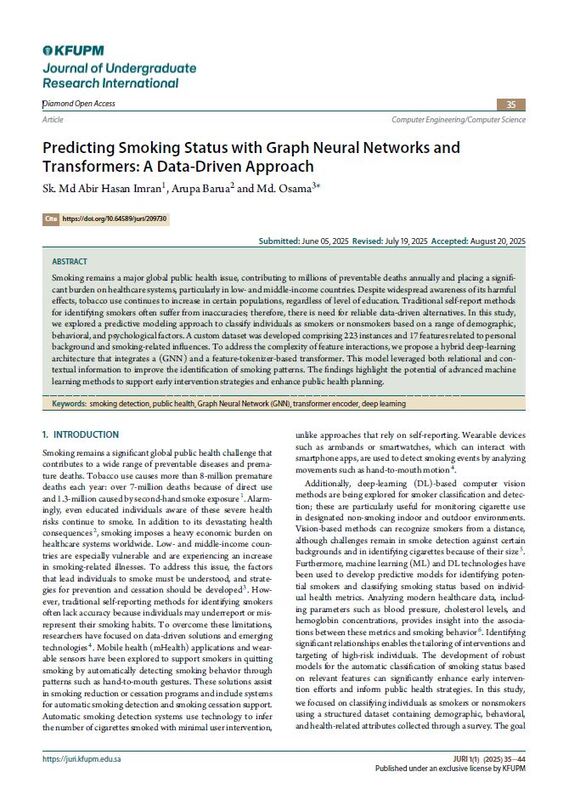
Predicting Smoking Status with Graph Neural Networks and Transformers: A Data-Driven Approach
1
Computer science and Engineering, Bangladesh Army University of Science
And Technology, Bangladesh
2
Computer Science and Engineering, Chittagong University of Engineering and Technology, Bangladesh
Submission date: 2025-06-05
Final revision date: 2025-07-19
Acceptance date: 2025-08-20
Publication date: 2025-08-24
Journal of Undergraduate Research International 2025;1(1):35-44
KEYWORDS
TOPICS
ABSTRACT
Smoking remains a major global public health issue, contributing to millions of preventable deaths each year and placing a significant burden on healthcare systems, particularly in low- and middle-income countries. Despite widespread awareness of its harmful effects, tobacco use continues to rise in certain populations, including educated individuals. Traditional self-reported methods for identifying smokers often suffer from inaccuracy, underscoring the need for reliable, data-driven alternatives. This study explores a predictive modeling approach to classify individuals as smokers or non-smokers based on a range of demographic, behavioral, and psychological factors. A custom dataset was developed, comprising 223 instances and 17 features related to personal background and smoking-related influences. To address the complexity of feature interactions, we propose a hybrid deep learning architecture that integrates Graph Neural Networks (GNN) and a Feature Tokenizer-based Transformer. This model leverages both relational and contextual information to improve the identification of smoking patterns. The findings highlight the potential of advanced machine learning methods in supporting early intervention strategies and enhancing public health planning.
ACKNOWLEDGEMENTS
The authors express their sincere gratitude to the Department of Computer Science and Engineering, Bangladesh Army University of Science and Technology (BAUST), Saidpur Cantonment, Nilphamari, Bangladesh, for providing continuous support, valuable guidance, and necessary resources throughout this research.
REFERENCES (14)
1.
Ali, N., Paul, Y., Husain, A.&Hussain, H. in The International Conference on Recent Innovations in Computing. 93–116 (Springer).
2.
Carney, R. et al. The clinical and behavioral cardiometabolic risk of children and young people on mental health inpatient units: A systematic review and meta-analysis. General Hospital Psychiatry 70, 80–97 (2021).
3.
Khan, A., Elhassan, M. A., Khan, S. & Deng, H. Deep learningbased smoker classification and detection: An overview and evaluation. Expert Systems with Applications, 126208 (2024).
4.
Ortis, A., Caponnetto, P., Polosa, R., Urso, S. & Battiato, S. A report on smoking detection and quitting technologies. International journal of environmental research and public health 17, 2614 (2020).
5.
Khan, A. A., Laghari, A. A.&Awan, S. A. Machine learning in computer vision:Areview. EAI Endorsed Transactions on Scalable Information Systems 8 (2021).
6.
Melchior, M., Chastang, J.-F., Mackinnon, D., Galéra, C. & Fombonne, E. The intergenerational transmission of tobacco smoking—the role of parents’ long-term smoking trajectories. Drug and alcohol dependence 107, 257–260 (2010).
7.
Becker, T. D., Arnold, M. K., Ro, V., Martin, L. & Rice, T. R. Systematic review of electronic cigarette use (vaping) and mental health comorbidity among adolescents and young adults. Nicotine and Tobacco Research 23, 415–425 (2021).
8.
Mahabee-Gittens, E. M., Xiao, Y., Gordon, J. S. & Khoury, J. C. The dynamic role of parental influences in preventing adolescent smoking initiation. Addictive behaviors 38, 1905–1911 (2013).
9.
Mays, D. et al. Parental smoking exposure and adolescent smoking trajectories. Pediatrics 133, 983–991 (2014).
10.
Scalici, F. & Schulz, P. J. Parents’ and peers’ normative influence on adolescents’ smoking: results from a Swiss-Italian sample of middle schools students. Substance abuse treatment, prevention, and policy 12, 1– 9 (2017).
11.
Fluharty, M., Taylor, A. E., Grabski, M. & Munafò, M. R. The association of cigarette smoking with depression and anxiety: a systematic review. Nicotine & Tobacco Research 19, 3–13 (2016).
12.
De Luna, R. G. et al. in 2024 7th International Conference on Informatics and Computational Sciences (ICICoS). 84–89 (IEEE).
13.
Ali, N., Paul, Y., Husain, A. & Hussain, H. in Proceedings of International Conference on Recent Innovations in Computing. 93 (Springer Nature).
14.
Jarvis, M., Tunstall-Pedoe, H., Feyerabend, C., Vesey, C. & Salloojee, Y. Biochemical markers of smoke absorption and self reported exposure to passive smoking. Journal of Epidemiology & Community Health 38, 335–339 (1984).

We process personal data collected when visiting the website. The function of obtaining information about users and their behavior is carried out by voluntarily entered information in forms and saving cookies in end devices. Data, including cookies, are used to provide services, improve the user experience and to analyze the traffic in accordance with the Privacy policy. Data are also collected and processed by Google Analytics tool (more).
You can change cookies settings in your browser. Restricted use of cookies in the browser configuration may affect some functionalities of the website.
You can change cookies settings in your browser. Restricted use of cookies in the browser configuration may affect some functionalities of the website.