Current Issue
Archive
About the Journal
Introducing the KFUPM Journal of Undergraduate Research International
Journal Submission Scope
Editorial Office
Editorial Board
Open Access
Instructions for Authors
Guide for Authors
Authorship Policy
Peer Review Process
Research Ethics Policy
AI Guidelines
Open Access
Plagiarism Policy

ORIGINAL ARTICLE
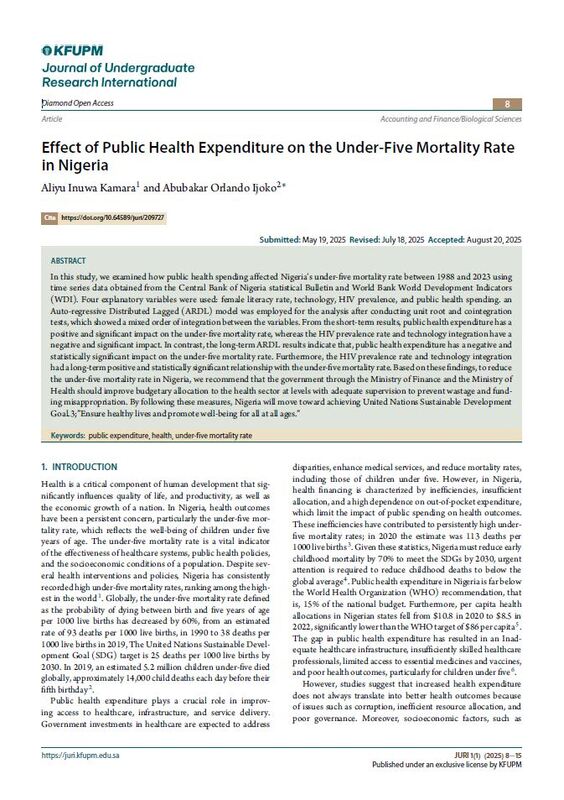
Effect of Public Health Expenditure on the Under-Five Mortality Rate in Nigeria
1
Economics, Nigerian Army University Biu, Nigeria
2
Economics, Nigerian Army University Biu
Submission date: 2025-05-19
Final revision date: 2025-07-18
Acceptance date: 2025-08-20
Publication date: 2025-08-24
Journal of Undergraduate Research International 2025;1(1):8-15
KEYWORDS
TOPICS
ABSTRACT
The study examined how public health spending affects Nigeria's under-five mortality rate between 1988 and 2023 using time series data obtained from the CBN statistical Bulletin and World Development Indicators (WDI). Four explanatory variables were used in the study: the rate of female literacy, technology, HIV prevalence, and public health spending. After conducting unit root and co-integration tests, which showed a mixed order of integration among the variables, the Auto-regressive Distributed Lagged (ARDL) model was employed for the analysis. From the short run results, it was evident that Public Health Expenditure (PHE) has a positive and significant impact on under-five mortality rate, while HIV Prevalence Rate (HIVPR) and Technology (TCH) have a negative and significant impact on under-five mortality rate. In contrast, the long-run ARDL results indicated that, (PHE) has negative and statistically significant impact on under five mortality rate. Furthermore, HIVPR and TECH has a long-run positive and statistically significant relationship with under five mortality rate in Nigeria. Based on these findings, the study recommend that, to continuously reduce the under-five mortality rate in Nigeria, the government through the Ministry of Finance and Ministry of Health should improve budgetary allocation to the health sector at level at levels with adequate supervision to prevent wastage and misappropriation of funds. With these measures in place, Nigeria is believed to be on the right path toward achieving Sustainable Development Goal (SDG 3).
ACKNOWLEDGEMENTS
First and foremost, the authors would like to express their profound gratitude to Almighty Allah for giving them the strength, wisdom and good health to carry out this research work. We also praise Him for his grace, guidance, blessings and infinite mercy on us. We are most grateful to acknowledge the support provided by the staffs and students of Economics Department, Nigerian Army University Biu. The authors also extend their appreciation to the reviewer of this research for their outstanding support toward ensuring this research is in line with the standard, and finally to family and friends thank you for your individual contributions.
REFERENCES (26)
1.
Ijoko, A. O.,Magaji, S. & Gombe, B. M. An empirical analysis of the impact of public expenditure on health infrastructure in primary healthcare centres in FCT. Proc. First Int.Conf. Dept. Econ., Gombe State univ., Nigeria, 74-81,(2021).
3.
World Health Organization. Children: Reducing mortality and improving well-being. WHO Fact Sheet. https://www.who.int/fr/ news-room/fact-sheets/detail/children-reducing-mortality (2020).
6.
Ijoko, A. O. Impact of public expenditure on health services delivery in Federal Capital Territory, Nigeria. (Unpublished PhD thesis, 2023).
7.
Edeme, R. K., Emecheta, C. & Omeje, M. O. O. Public health expenditure and health outcomes in Nigeria. Am. J. Biomed. Life Sci. 5(5), (2017).
8.
Zubair, K. T. Impact of public health expenditure on health status in Nigeria. (PhD thesis, Kwara State University, Nigeria, 2018).
9.
Yaqub, J. & Ojapinwa, T. V. Public health expenditure and health outcome in Nigeria: The impact of governance. Eur. Sci. J. 8(13), 189–201 (2018). https://eujournal.org/index.ph... viewFile/206/248.
10.
David, J. Infant mortality and public health expenditure in Nigeria: Empirical explanation of the nexus 1980 – 2016. Timisoara J. Econ. Bus. 11(2), 149–164. (2018).
11.
Aderopo, R. A., & Emmanuel, E. Can public health spending and maternal education predict future under-5 mortality rate in Nigeria. Indian J. Econ. Dev. 7 (12), 1–9. (2019).
12.
Azuh, D. E., Osabohien, R., Orbih, M. & Godwin, A. Public health expenditure and under-five mortality in Nigeria: An overview for policy intervention. J. Med. Sci. 8(E), 353–362 (2020).
13.
Ojo, O. O. et al. Health expenditure and life expectancy in Nigeria. Lead City J. Soc. Sci. 5(1), 66–71 (2020).
14.
Iyakwari, A. D. B., Awujola, A.,&Ogwuche, D. D. Effect of health expenditure onlife expectancy in Nigeria. Lafia J. Econ. Manage. Sci. 8, 105–118 (2023).
15.
Orji, A. et al. Are wealthy countries always healthy? Health outcomes and public health spending nexus in Nigeria. SAGE Open 11(3), 21582440211040793 (2021).
16.
Kato, K. et al. Exploring effect of public health spending on under-five mortality rate in Uganda. Afr. J. Econ. Rev.6(1), 1–14 (2018).
17.
Rana, R. H., Alam, K. & Gow, J. Health expenditure, child and maternal mortality nexus: A comparative global analysis. BMC Int. Health Hum. Rights 18(29), 1–15 (2018).
18.
Rahman, M. M., Khanam, R.&Rahman, M. Health care expenditure and health outcome nexus:Newevidence from the SAARC-ASEAN region. Global Health 14(1), 1–11 (2018).
19.
Shahraki, M. Public and private health expenditure and life expectancy in Iran. Payesh (Health Monitor) 18(3), 221–230 (2019).
20.
Logarajan, R. D., Mohamed Nor, N., Sirag, A., Said, R., & Ibrahim, S. The impact of public, private, and out-of-pocket health expenditures on under-five mortality in Malaysia. Healthcare (Basel), 10(3), 589 (2022).
21.
Ayipe, F. I. & Tanko, M. Public health expenditure and underfive mortality in low-income sub-Saharan African countries: A panel data analysis. SSRN 4389168 (2023).
22.
Li, Y. et al. Impact of healthy lifestyle factors on life expectancies in the US population. Circulation 138(4), 345–355 (2021).
23.
Fayissa, B.&Gutema, P. Estimating a health production function for sub-Saharan Africa (SSA). Appl. Econ. 37(2), 155–164 (2005).
24.
Grossman, M. On the concept of health capital and the demand for health. J. Polit. Econ. 80(2), 223–255 (1972).
25.
Mubarak, A. Impact of public expenditure and health outcomes (maternal mortality rate and under-five mortality rates) in Nigeria. Dept. Econ., Nigerian Army Univ., Biu, 13–14 (2023).
26.
Central bank of Nigeria. Annual Statistical Bulletin. https://www. cbn.gov.ng/documents/Statbulletin.html (2023).

We process personal data collected when visiting the website. The function of obtaining information about users and their behavior is carried out by voluntarily entered information in forms and saving cookies in end devices. Data, including cookies, are used to provide services, improve the user experience and to analyze the traffic in accordance with the Privacy policy. Data are also collected and processed by Google Analytics tool (more).
You can change cookies settings in your browser. Restricted use of cookies in the browser configuration may affect some functionalities of the website.
You can change cookies settings in your browser. Restricted use of cookies in the browser configuration may affect some functionalities of the website.