Current Issue
Archive
About the Journal
Introducing the KFUPM Journal of Undergraduate Research International
Journal Submission Scope
Editorial Office
Editorial Board
Open Access
Instructions for Authors
Guide for Authors
Authorship Policy
Peer Review Process
Research Ethics Policy
AI Guidelines
Open Access
Plagiarism Policy

ORIGINAL ARTICLE
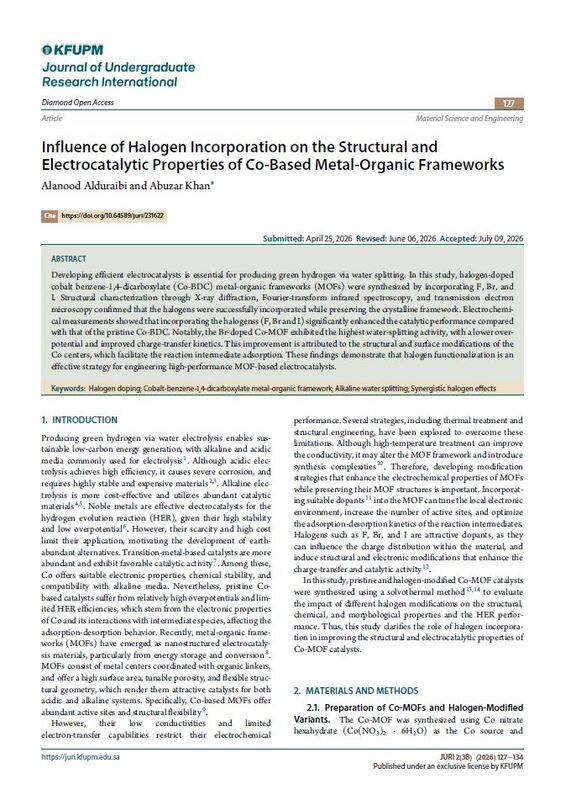
Influence of Halogen Incorporation on the Structural and
Electrocatalytic Properties of Co-Based Metal-Organic Frameworks
1
Interdisciplinary Center for Hydrogen Technologies and Carbon Management, King Fahd University of Petroleum and Minerals
2
Department of Materials Science & Engineering, King Fahd University of Petroleum and Minerals, Saudi Arabia
Submission date: 2026-04-25
Final revision date: 2026-06-06
Acceptance date: 2026-08-24
Publication date: 2026-11-16
Corresponding author
Abuzar Khan
Interdisciplinary Center for Hydrogen Technologies and Carbon Management, King Fahd University of Petroleum and Minerals
Interdisciplinary Center for Hydrogen Technologies and Carbon Management, King Fahd University of Petroleum and Minerals
Journal of Undergraduate Research International 2026;2(3B):127-134
KEYWORDS
halogen dopingcobalt-benzene-24-dicarboxylate metal-organic frameworkalkaline water splittingSynergistic halogen effects
TOPICS
ABSTRACT
Developing efficient electrocatalysts is essential for producing green hydrogen via water splitting. In this study, halogen-doped
cobalt benzene-1,4-dicarboxylate (Co-BDC) metal-organic frameworks (MOFs) were synthesized by incorporating F, Br, and
I. Structural characterization through X-ray diffraction, Fourier-transform infrared spectroscopy, and transmission electron
microscopy confirmed that the halogens were successfully incorporated while preserving the crystalline framework. Electrochemical
measurements showed that incorporating the halogenss (F, Br and I) significantly enhanced the catalytic performance compared
with that of the pristine Co-BDC. Notably, the Br-doped Co-MOF exhibited the highest water-splitting activity, with a lower overpotential
and improved charge-transfer kinetics. This improvement is attributed to the structural and surface modifications of the
Co centers, which facilitate the reaction intermediate adsorption. These findings demonstrate that halogen functionalization is an
effective strategy for engineering high-performance MOF-based electrocatalysts.

We process personal data collected when visiting the website. The function of obtaining information about users and their behavior is carried out by voluntarily entered information in forms and saving cookies in end devices. Data, including cookies, are used to provide services, improve the user experience and to analyze the traffic in accordance with the Privacy policy. Data are also collected and processed by Google Analytics tool (more).
You can change cookies settings in your browser. Restricted use of cookies in the browser configuration may affect some functionalities of the website.
You can change cookies settings in your browser. Restricted use of cookies in the browser configuration may affect some functionalities of the website.