Current Issue
Archive
About the Journal
Introducing the KFUPM Journal of Undergraduate Research International
Journal Submission Scope
Editorial Office
Editorial Board
Open Access
Instructions for Authors
Guide for Authors
Authorship Policy
Peer Review Process
Research Ethics Policy
AI Guidelines
Open Access
Plagiarism Policy

ORIGINAL ARTICLE
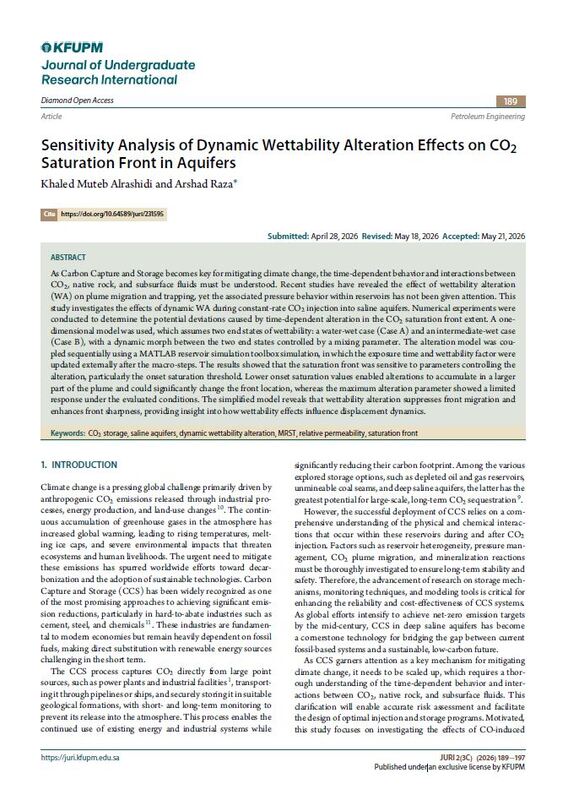
Sensitivity Analysis of Dynamic Wettability Alteration effects on CO₂ Saturation Front in Aquifers
1
Petroleum Engineering, KFUPM
Submission date: 2026-04-28
Final revision date: 2026-05-18
Acceptance date: 2026-08-23
Publication date: 2026-11-22
Journal of Undergraduate Research International 2026;2(3C):189-197
KEYWORDS
TOPICS
ABSTRACT
As Carbon Capture and Storage becomes key for mitigating climate change, the time-dependent behavior and interactions between
CO₂, native rock, and subsurface fluids must be understood. Recent studies have revealed the effect of wettability alteration
(WA) on plume migration and trapping, yet the associated pressure behavior within reservoirs has not been given attention. This
study investigates the effects of dynamic WA during constant-rate CO₂ injection into saline aquifers. Numerical experiments were
conducted to determine the potential deviations caused by time-dependent alteration in the CO₂ saturation front extent. A onedimensional
model was used, which assumes two end states of wettability: a water-wet case (Case A) and an intermediate-wet case
(Case B), with a dynamic morph between the two end states controlled by a mixing parameter. The alteration model was coupled
sequentially using a MATLAB reservoir simulation toolbox simulation, in which the exposure time and wettability factor were
updated externally after the macro-steps. The results showed that the saturation front was sensitive to parameters controlling the
alteration, particularly the onset saturation threshold. Lower onset saturation values enabled alterations to accumulate in a larger
part of the plume and could significantly change the front location, whereas the maximum alteration parameter showed a limited
response under the evaluated conditions. The simplified model reveals that wettability alteration suppresses front migration and
enhances front sharpness, providing insight into how wettability effects influence displacement dynamics.

We process personal data collected when visiting the website. The function of obtaining information about users and their behavior is carried out by voluntarily entered information in forms and saving cookies in end devices. Data, including cookies, are used to provide services, improve the user experience and to analyze the traffic in accordance with the Privacy policy. Data are also collected and processed by Google Analytics tool (more).
You can change cookies settings in your browser. Restricted use of cookies in the browser configuration may affect some functionalities of the website.