Current Issue
Archive
About the Journal
Introducing the KFUPM Journal of Undergraduate Research International
Journal Submission Scope
Editorial Office
Editorial Board
Open Access
Instructions for Authors
Guide for Authors
Authorship Policy
Peer Review Process
Research Ethics Policy
AI Guidelines
Open Access
Plagiarism Policy

ORIGINAL ARTICLE
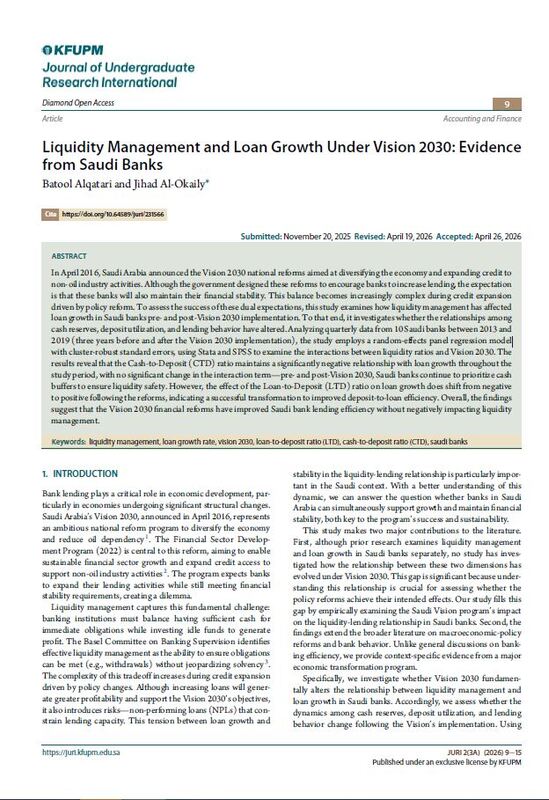
Liquidity Management and Loan Growth Under Vision 2030: Evidence
from Saudi Banks
1
Department of Accounting and Finance, King Fahd University of Petroleum & Minerals, Dhahran, Saudi Arabia
2
Department of Accounting and Finance, King Fahd University of Petroleum & Minerals, Saudi Arabia
Submission date: 2025-11-20
Final revision date: 2026-04-19
Acceptance date: 2026-08-22
Publication date: 2026-09-27
Corresponding author
Batool Alqatari
Department of Accounting and Finance, King Fahd University of Petroleum & Minerals, Dhahran, 31261, Dhahran, Saudi Arabia
Department of Accounting and Finance, King Fahd University of Petroleum & Minerals, Dhahran, 31261, Dhahran, Saudi Arabia
Journal of Undergraduate Research International 2026;2(3A):9-15
KEYWORDS
liquidity managementloan growth ratevision 2030loan-to-deposit ratio (LTD)cash-to-deposit ratio (CTD)Saudi banks
TOPICS
ABSTRACT
In April 2016, Saudi Arabia announced the Vision 2030 national reforms aimed at diversifying the economy and expanding credit to
non-oil industry activities. Although the government designed these reforms to encourage banks to increase lending, the expectation
is that these banks will also maintain their financial stability. This balance becomes increasingly complex during credit expansion
driven by policy reform. To assess the success of these dual expectations, this study examines how liquidity management has affected
loan growth in Saudi banks pre- and post-Vision 2030 implementation. To that end, it investigates whether the relationships among
cash reserves, deposit utilization, and lending behavior have altered. Analyzing quarterly data from 10 Saudi banks between 2013 and
2019 (three years before and after the Vision 2030 implementation), the study employs a random-effects panel regression model
with cluster-robust standard errors, using Stata and SPSS to examine the interactions between liquidity ratios and Vision 2030. The
results reveal that the Cash-to-Deposit (CTD) ratio maintains a significantly negative relationship with loan growth throughout the
study period, with no significant change in the interaction term—pre- and post-Vision 2030, Saudi banks continue to prioritize cash
buffers to ensure liquidity safety. However, the effect of the Loan-to-Deposit (LTD) ratio on loan growth does shift from negative
to positive following the reforms, indicating a successful transformation to improved deposit-to-loan efficiency. Overall, the findings
suggest that the Vision 2030 financial reforms have improved Saudi bank lending efficiency without negatively impacting liquidity
management.

We process personal data collected when visiting the website. The function of obtaining information about users and their behavior is carried out by voluntarily entered information in forms and saving cookies in end devices. Data, including cookies, are used to provide services, improve the user experience and to analyze the traffic in accordance with the Privacy policy. Data are also collected and processed by Google Analytics tool (more).
You can change cookies settings in your browser. Restricted use of cookies in the browser configuration may affect some functionalities of the website.
You can change cookies settings in your browser. Restricted use of cookies in the browser configuration may affect some functionalities of the website.