Current Issue
Archive
About the Journal
Introducing the KFUPM Journal of Undergraduate Research International
Journal Submission Scope
Editorial Office
Editorial Board
Open Access
Instructions for Authors
Guide for Authors
Authorship Policy
Peer Review Process
Research Ethics Policy
AI Guidelines
Open Access
Plagiarism Policy

ORIGINAL ARTICLE
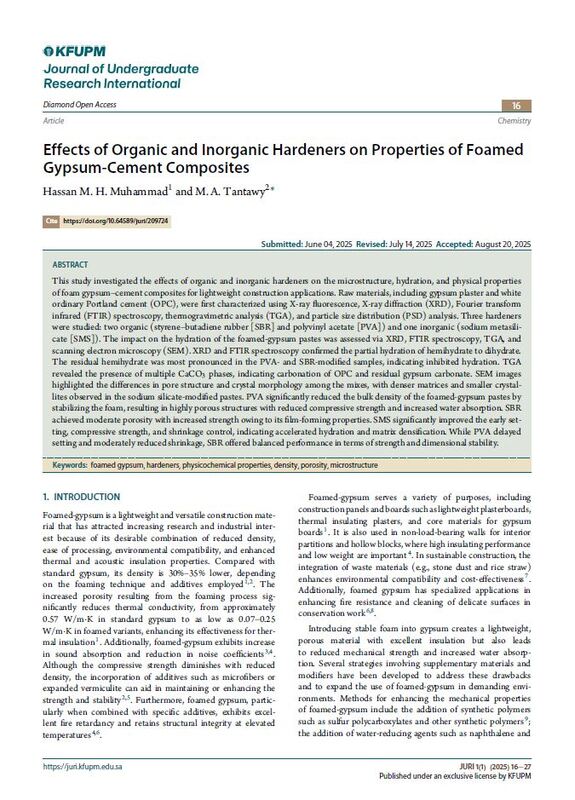
Effects of Organic and Inorganic Hardeners on Properties of Foamed Gypsum-Cement Composites
1
Chemistry department, Faculty of Science, Minia University, Egypt, Egypt
Submission date: 2025-06-04
Final revision date: 2025-07-14
Acceptance date: 2025-08-20
Publication date: 2025-09-22
Journal of Undergraduate Research International 2025;1(1):16-27
KEYWORDS
TOPICS
ABSTRACT
This study investigates the influence of organic and inorganic hardeners on the microstructure, hydration, and physical properties of foamed gypsum–cement composites for lightweight construction applications. Raw materials, including gypsum plaster and white OPC, were first characterized using XRF, XRD, FTIR, TGA, and particle size distribution (PSD) analysis. Three hardeners were studied: two organic (styrene–butadiene rubber [SBR] and polyvinyl acetate [PVA]) and one inorganic (sodium metasilicate [SMS]). The impact on hydration of foamed gypsum pastes was assessed via XRD, FTIR, TGA, and SEM analyses. XRD and FTIR confirmed partial hydration of hemihydrate to dihydrate. Residual hemihydrate was most pronounced in PVA- and SBR-modified samples, indicating inhibited hydration. TGA revealed the presence of multiple CaCO₃ phases, indicating carbonation of OPC and residual gypsum carbonate. SEM micrographs highlighted differences in pore structure and crystal morphology among mixes, with denser matrices and finer crystallinity observed in sodium silicate-modified pastes. PVA significantly lowered the bulk density of foamed gypsum pastes by stabilizing foam, resulting in highly porous structures with reduced compressive strength and increased water absorption. SBR achieved moderate porosity with enhanced strength due to its film-forming properties. SMS significantly improved early setting, compressive strength, and shrinkage control, indicating accelerated hydration and matrix densification. While PVA delayed setting and reduced shrinkage moderately, SBR offered balanced performance in strength and dimensional stability.

We process personal data collected when visiting the website. The function of obtaining information about users and their behavior is carried out by voluntarily entered information in forms and saving cookies in end devices. Data, including cookies, are used to provide services, improve the user experience and to analyze the traffic in accordance with the Privacy policy. Data are also collected and processed by Google Analytics tool (more).
You can change cookies settings in your browser. Restricted use of cookies in the browser configuration may affect some functionalities of the website.
You can change cookies settings in your browser. Restricted use of cookies in the browser configuration may affect some functionalities of the website.