Current Issue
Archive
About the Journal
Introducing the KFUPM Journal of Undergraduate Research International
Journal Submission Scope
Editorial Office
Editorial Board
Open Access
Instructions for Authors
Guide for Authors
Authorship Policy
Peer Review Process
Research Ethics Policy
AI Guidelines
Open Access
Plagiarism Policy

ORIGINAL ARTICLE
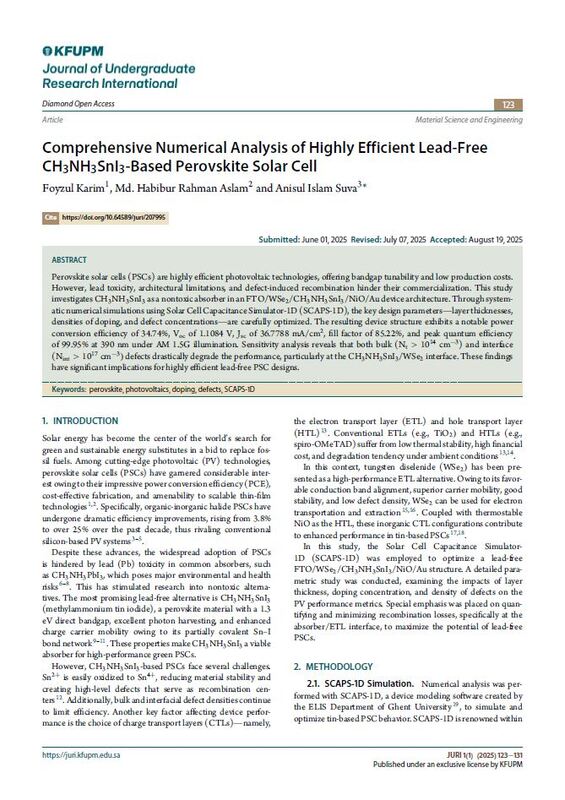
Comprehensive Numerical Analysis of High Efficient Lead-Free CH3NH3SnI3 based Perovskite Solar Cell
1
Electrical and Electronic Engineering, Chittagong University of Engineering & Technology (CUET), Bangladesh
2
Institute of Energy Technology, Chittagong University of Engineering & Technology (CUET), Bangladesh
Submission date: 2025-06-01
Acceptance date: 2025-07-07
Publication date: 2025-08-19
Journal of Undergraduate Research International 2025;1(1):123-131
KEYWORDS
TOPICS
ABSTRACT
Perovskite solar cells (PSCs) have been among the most promising highly efficient next-generation photovoltaic devices with bandgap tunability and low production cost. However, lead toxicity, architectural limitations, along with defect-induced recombination hinder their commercialization. To address these limitations, this study investigates CH3NH3SnI3 as a non-toxic absorber in an FTO/WSe2/CH3NH3SnI3/NiO/Au device architecture. Through systematic numerical simulations using SCAPS-1D, the key design parameters—layer thicknesses, doping densities and defect concentrations—are carefully optimized. The resulting device structure shows a high power conversion efficiency of 34.74%, with Voc of 1.1084 V, Jsc of 36.7788 mA/cm2, fill factor of 85.22% and peak quantum efficiency of 99.95% at 390 nm wavelength under AM 1.5G illumination. Sensitivity analysis reveals that both bulk (Nt>1014 cm-3) and interface (Nint>1017 cm-3) defects drastically degrade the performance, particularly at the CH3NH3SnI3/WSe2 interface. These findings have significant implications for the design principles required for high-efficiency lead-free PSCs.
ABBREVIATIONS
Perovskite solar cells (PSCs)
ACKNOWLEDGEMENTS
The authors acknowledge the use of the SCAPS-1D simulation software in this study and sincerely thank Dr. Marc Burgelman of Ghent University, Belgium, for his generous provision of access to this valuable tool for the broader scientific community.
FUNDING
This study was conducted independently and did not receive any external funding.
CONFLICT OF INTEREST
The authors declare no conflict of interest.
PEER REVIEW INFORMATION
Article has been screened for originality
REFERENCES (32)
1.
Olabi, A. G., et al. “Renewable energy systems: Comparisons, challenges and barriers, sustainability indicators, and the contribution to UN sustainable development goals.” International Journal of Thermofluids 20 (2023): 100498.
2.
Hu, Zhelu, et al. “The current status and development trend of perovskite solar cells.” Engineering 21 (2023): 15–19.
3.
Kojima, Akihiro, et al. “Organometal halide perovskites as visiblelight sensitizers for photovoltaic cells.” Journal of the american chemical society 131.17 (2009): 6050–6051.
4.
Kim, Gi-Hwan, and Dong Suk Kim. “Development of perovskite solar cells with >25% conversion efficiency.” Joule 5.5 (2021): 1033– 1035.
5.
Machín, Abniel, and Francisco Márquez. “Advancements in photovoltaic cell materials: silicon, organic, and perovskite solar cells.” Materials 17.5 (2024): 1165.
6.
Mandadapu, Usha, et al. “Design and simulation of high efficiency tin halide perovskite solar cell.” Int. J. Renew. Energy Res 7.4 (2017): 1603–1612.
7.
Hima, Abdelkader, and Nacereddine Lakhdar. “Enhancement of efficiency and stability of CH3NH3GeI3 solar cells with CuSbS2.” Optical Materials 99 (2020): 109607.
8.
Dutta, Sriman, and Saurabh Kumar Pandey. “Device Engineering and Materials Perspective Analysis of Highly Efficient Lead-Free MASnI3 Perovskite Solar Cell.” IEEE Journal of Selected Topics in Quantum.
10.
Jayan, K. Deepthi, and Varkey Sebastian. “Comprehensive device modelling and performance analysis of MASnI3 based perovskite solar cells with diverse ETM,HTMand back metal contacts.” Solar Energy 217 (2021): 40–48.
11.
Ke, Weijun, and Mercouri G. Kanatzidis. “Prospects for lowtoxicity lead-free perovskite solar cells.” Nature communications 10.1 (2019): 965.
12.
Alipour, Hossein, and Abbas Ghadimi. “Optimization of leadfree perovskite solar cells in normal-structure with WO3 and water-free PEDOT: PSS composite for hole transport layer by SCAPS-1D simulation.” Optical Materials 120 (2021): 111432.
13.
Mahmoudi, Tahmineh, et al. “Suppression of Sn2+/Sn4+ oxidation in tin-based perovskite solar cells with graphene-tin quantum dots composites in active layer.” Nano Energy 90 (2021): 106495.
14.
Hossain, M. Khalid, et al. “An extensive study on multiple ETL and HTL layers to design and simulation of high-performance leadfree CsSnCl3-based perovskite solar cells.” Scientific Reports 13.1 (2023): 2521.
15.
Fatima, Qawareer, et al. “A critical review on advancement and challenges in using TiO2 as electron transport layer for perovskite solar cell.” Materials Today Sustainability (2024): 100857.
16.
Paul, Indrojit, Abu Rayhan, and M. A. Khan. “Design and Performance Analysis of Photovoltaic Solar Cells Using WSe2 as an Absorber Layer with SnS2 Electron Transport Layer.” New Energy Exploitation and Application 4.1 (2025): 83–101.
17.
Morshed, Md Saklain, Kanak Kanti Bhowmik, and Md Shafiqul Islam. “Investigation of MoS2/Perovskite/WSe2 on Si Tandem Structure of Solar Cell.” 2022 12th International Conference on Electrical and Computer Engineering (ICECE). IEEE, 2022.
18.
Danjumma, Sani Garba, Yakubu Abubakar, and Sahabi Suleiman. “Nickel oxide (NiO) devices and applications: a review.” J. Eng. Res. Technol 8 (2019): 12–21.
19.
Mitoff, S. P. “Electrical conductivity and thermodynamic equilibrium in nickel oxide.“ The Journal of Chemical Physics 35.3 (1961): 882-889.
20.
Niemegeers, A.; Burgelman, M.; Decock, K.; Verschraegen, J.; Degrave, S. SCAPS Manual. Ph.D. Thesis, University of Gent, Gent, Belgium, 2014. https://scaps.elis.ugent.be/.
21.
Alam, Intekhab, Rahat Mollick, and Md Ali Ashraf. “Numerical simulation of Cs2AgBiBr6-based perovskite solar cell with ZnO nanorod and P3HT as the charge transport layers.” Physica B: Condensed Matter 618 (2021): 413187.
22.
Gautam, Sakshi, et al. “Performance analysis of WSe2 solar cell with Cu2O hole transport layer by optimization of electrical and optical properties.” Journal of Computational Electronics 21.6 (2022): 1373–1385.
23.
Mehrabian, Masood, Elham Norouzi Afshar, and Omid Akhavan. “TiO2 and C60 transport nanolayers in optimized Pb-free CH3NH3SnI3-based perovskite solar cells.” Materials Science and Engineering: B 287 (2023): 116146.
24.
Ahmmed, Shamim, et al. “Enhancing the open circuit voltage of the SnS based heterojunction solar cell using NiO HTL.” Solar Energy 207 (2020): 693–702.
25.
Qasim, Irfan, et al. “Design and numerical investigations of ecofriendly, non-toxic (Au/CuSCN/CH3NH3SnI3/CdTe/ZnO/ITO) perovskite solar cell and module.” Solar Energy 237 (2022): 52–61.
26.
Shamna, M. S., K. S. Nithya, and K. S. Sudheer. “Simulation and optimization of CH3NH3SnI3 based inverted perovskite solar cell with NiO as Hole transport material.” Materials Today: Proceedings 33 (2020): 1246–1251.
27.
Du, Hui-Jing, Wei-Chao Wang, and Jian-Zhuo Zhu. “Device simulation of lead-free CH3NH3SnI3 perovskite solar cells with high efficiency.” Chinese Physics B 25.10 (2016): 108802.
28.
Sahoo, Arpita, Ipsita Mohanty, and Sutanu Mangal. “Effect of acceptor density, thickness and temperature on device performance for tin-based perovskite solar cell.” Materials Today: Proceedings 62 (2022): 6210–6215.
29.
Arif, Fozia, et al. “Simulation and numerical modeling of high performance CH3NH3SnI3 solar cell with cadmium sulfide as electron transport layer by SCAPS-1D.” Results in Optics 14 (2024): 100595.
30.
Imani, Shayesteh, et al. “Simulation and characterization of CH3NH3SnI3-based perovskite solar cells with different Cu-based hole transporting layers.” Applied Physics A 129.2 (2023): 143.
31.
Omarova, Zhansaya, et al. “In silico investigation of the impact of hole-transport layers on the performance ofCH3NH3SnI3 perovskite photovoltaic cells.” Crystals 12.5 (2022): 699.
32.
Patel, Piyush K. “Device simulation of highly efficient ecofriendly CH3NH3SnI3 perovskite solar cell.” Scientific reports 11.1 (2021): 3082.

We process personal data collected when visiting the website. The function of obtaining information about users and their behavior is carried out by voluntarily entered information in forms and saving cookies in end devices. Data, including cookies, are used to provide services, improve the user experience and to analyze the traffic in accordance with the Privacy policy. Data are also collected and processed by Google Analytics tool (more).
You can change cookies settings in your browser. Restricted use of cookies in the browser configuration may affect some functionalities of the website.
You can change cookies settings in your browser. Restricted use of cookies in the browser configuration may affect some functionalities of the website.