Current Issue
Archive
About the Journal
Introducing the KFUPM Journal of Undergraduate Research International
Journal Submission Scope
Editorial Office
Editorial Board
Open Access
Instructions for Authors
Guide for Authors
Authorship Policy
Peer Review Process
Research Ethics Policy
AI Guidelines
Open Access
Plagiarism Policy

ORIGINAL ARTICLE
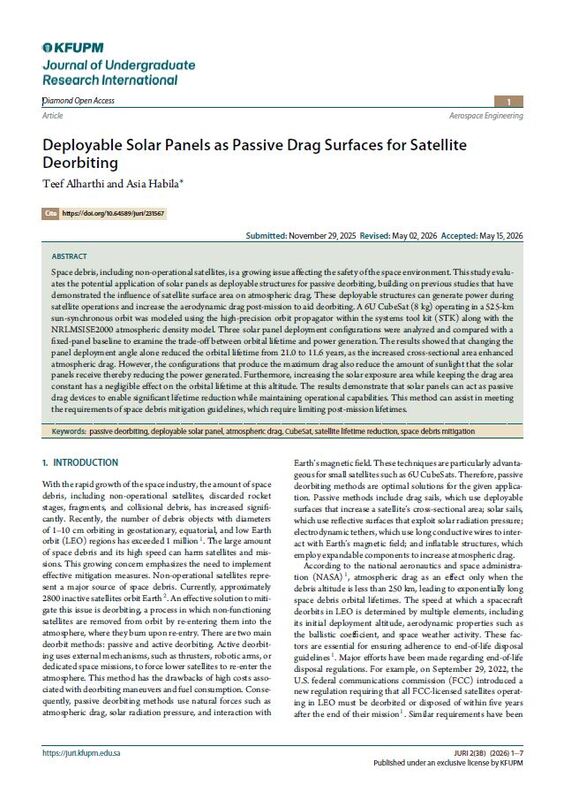
Deployable Solar Panels as Passive Drag Surfaces for Satellite
Deorbiting
1
AE, KFUPM
2
IRC, KFUPM
Submission date: 2025-11-29
Final revision date: 2026-05-15
Acceptance date: 2026-08-22
Publication date: 2026-11-16
Journal of Undergraduate Research International 2026;2(3B):1-7
KEYWORDS
passive deorbitingdeployable solar panelatmospheric dragCubeSatsatellite lifetime reductionspace debris mitigation
TOPICS
ABSTRACT
Space debris, including non-operational satellites, is a growing issue affecting the safety of the space environment. This study evaluates
the potential application of solar panels as deployable structures for passive deorbiting, building on previous studies that have
demonstrated the influence of satellite surface area on atmospheric drag. These deployable structures can generate power during
satellite operations and increase the aerodynamic drag post-mission to aid deorbiting. A 6U CubeSat (8 kg) operating in a 525-km
sun-synchronous orbit was modeled using the high-precision orbit propagator within the systems tool kit (STK) along with the
NRLMSISE2000 atmospheric density model. Three solar panel deployment configurations were analyzed and compared with a
fixed-panel baseline to examine the trade-off between orbital lifetime and power generation. The results showed that changing the
panel deployment angle alone reduced the orbital lifetime from 21.0 to 11.6 years, as the increased cross-sectional area enhanced
atmospheric drag. However, the configurations that produce the maximum drag also reduce the amount of sunlight that the solar
panels receive thereby reducing the power generated. Furthermore, increasing the solar exposure area while keeping the drag area
constant has a negligible effect on the orbital lifetime at this altitude. The results demonstrate that solar panels can act as passive
drag devices to enable significant lifetime reduction while maintaining operational capabilities. This method can assist in meeting
the requirements of space debris mitigation guidelines, which require limiting post-mission lifetimes.

We process personal data collected when visiting the website. The function of obtaining information about users and their behavior is carried out by voluntarily entered information in forms and saving cookies in end devices. Data, including cookies, are used to provide services, improve the user experience and to analyze the traffic in accordance with the Privacy policy. Data are also collected and processed by Google Analytics tool (more).
You can change cookies settings in your browser. Restricted use of cookies in the browser configuration may affect some functionalities of the website.
You can change cookies settings in your browser. Restricted use of cookies in the browser configuration may affect some functionalities of the website.