Current Issue
Archive
About the Journal
Introducing the KFUPM Journal of Undergraduate Research International
Journal Submission Scope
Editorial Office
Editorial Board
Open Access
Instructions for Authors
Guide for Authors
Authorship Policy
Peer Review Process
Research Ethics Policy
AI Guidelines
Open Access
Plagiarism Policy

ORIGINAL ARTICLE
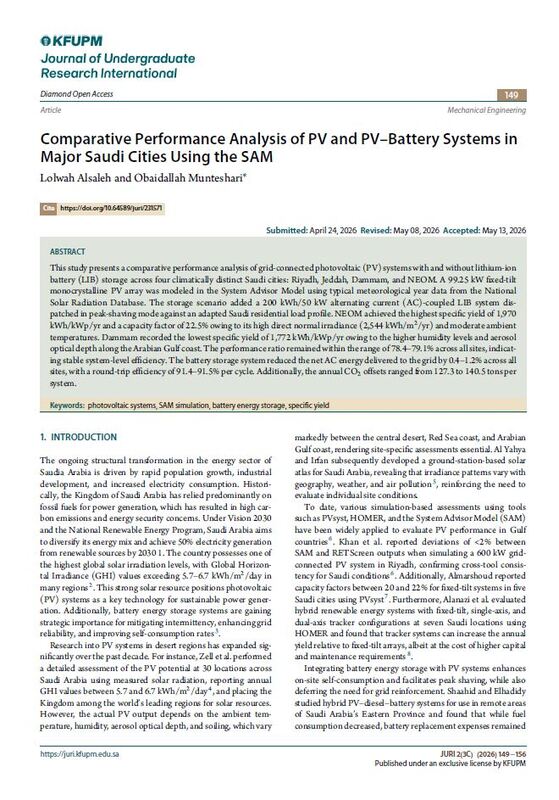
Comparative Performance Analysis of PV and PV–Battery Systems in
Major Saudi Cities Using the SAM
1
Mechanical Engineering Department, King Fahd University of Petroleum & Minerals, Saudi Arabia
Submission date: 2026-04-24
Final revision date: 2026-05-08
Acceptance date: 2026-08-23
Publication date: 2026-11-22
Corresponding author
Obaidallah Munteshari
Mechanical Engineering Department, King Fahd University of Petroleum & Minerals, 63 Kfupm, 34464, Dhahran, Saudi Arabia
Journal of Undergraduate Research International 2026;2(3C):149-156
KEYWORDS
TOPICS
ABSTRACT
This study presents a comparative performance analysis of grid-connected photovoltaic (PV) systems with and without lithium-ion
battery (LIB) storage across four climatically distinct Saudi cities: Riyadh, Jeddah, Dammam, and NEOM. A 99.25 kW fixed-tilt
monocrystalline PV array was modeled in the System Advisor Model using typical meteorological year data from the National
Solar Radiation Database. The storage scenario added a 200 kWh/50 kW alternating current (AC)-coupled LIB system dispatched
in peak-shaving mode against an adapted Saudi residential load profile. NEOM achieved the highest specific yield of 1,970
kWh/kWp/yr and a capacity factor of 22.5% owing to its high direct normal irradiance (2,544 kWh/m2/yr) and moderate ambient
temperatures. Dammam recorded the lowest specific yield of 1,772 kWh/kWp/yr owing to the higher humidity levels and aerosol
optical depth along the Arabian Gulf coast. The performance ratio remained within the range of 78.4–79.1% across all sites, indicating
stable system-level efficiency. The battery storage system reduced the net AC energy delivered to the grid by 0.4–1.2% across all
sites, with a round-trip efficiency of 91.4–91.5% per cycle. Additionally, the annual CO2 offsets ranged from 127.3 to 140.5 tons per
system.

We process personal data collected when visiting the website. The function of obtaining information about users and their behavior is carried out by voluntarily entered information in forms and saving cookies in end devices. Data, including cookies, are used to provide services, improve the user experience and to analyze the traffic in accordance with the Privacy policy. Data are also collected and processed by Google Analytics tool (more).
You can change cookies settings in your browser. Restricted use of cookies in the browser configuration may affect some functionalities of the website.