Current Issue
Archive
About the Journal
Introducing the KFUPM Journal of Undergraduate Research International
Journal Submission Scope
Editorial Office
Editorial Board
Open Access
Instructions for Authors
Guide for Authors
Authorship Policy
Peer Review Process
Research Ethics Policy
AI Guidelines
Open Access
Plagiarism Policy

ORIGINAL ARTICLE
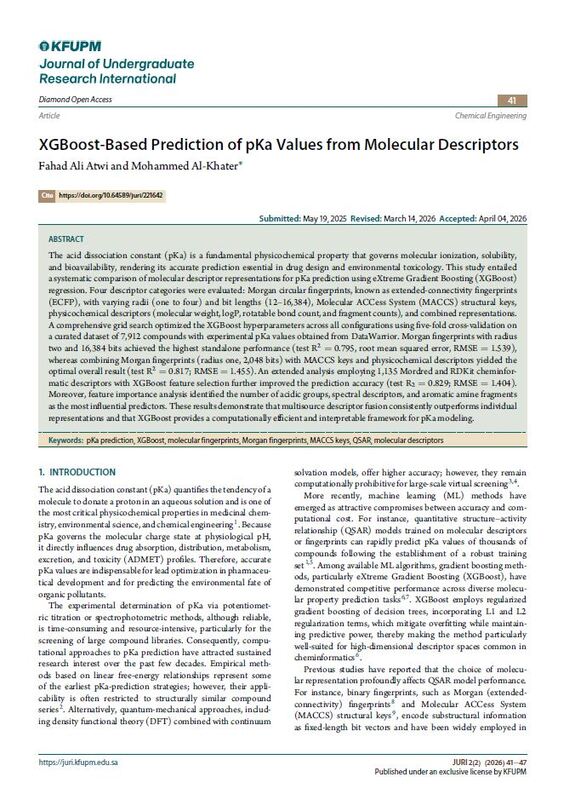
XGBoost-Based Prediction of pKa Values from Molecular Descriptors
1
Department of Chemical Engineering, King Fahd University of Petroleum and Minerals, Saudi Arabia
2
Interdisciplinary Research Center for Refining & Advanced
Chemicals, King Fahd University of Petroleum & Minerals, Saudi Arabia
Submission date: 2025-05-19
Final revision date: 2026-03-13
Acceptance date: 2026-05-10
Publication date: 2026-09-07
Corresponding author
Mohammed Fahad Al-Khater
Department of Chemical Engineering, King Fahd University of Petroleum and Minerals, 31261, Dhahran, Saudi Arabia
Department of Chemical Engineering, King Fahd University of Petroleum and Minerals, 31261, Dhahran, Saudi Arabia
Journal of Undergraduate Research International 2026;2(2):41-47
KEYWORDS
TOPICS
ABSTRACT
The acid dissociation constant (pKa) is a fundamental physicochemical property that governs molecular ionization, solubility, and bioavailability, rendering its accurate prediction essential in drug design and environmental toxicology. This study entailed a systematic comparison of molecular descriptor representations for pKa prediction using eXtreme Gradient Boosting (XGBoost) regression. Four descriptor categories were evaluated: Morgan circular fingerprints, known as extended-connectivity fingerprints (ECFP), with varying radii (one to four) and bit lengths (12–16,384), Molecular ACCess System (MACCS) structural keys, physicochemical descriptors (molecular weight, logP, rotatable bond count, and fragment counts), and combined representations. A comprehensive grid search optimized the XGBoost hyperparameters across all configurations using five-fold cross-validation on a curated dataset of 7,912 compounds with experimental pKa values obtained from DataWarrior. Morgan fingerprints with radius two and 16,384 bits achieved the highest standalone performance (test R2 = 0.795, root mean squared error, RMSE = 1.539), whereas combining Morgan fingerprints (radius one, 2,048 bits) with MACCS keys and physicochemical descriptors yielded the optimal overall result (test R2 = 0.817; RMSE = 1.455). An extended analysis employing 1,135 Mordred and RDKit cheminformatic descriptors with XGBoost feature selection further improved the prediction accuracy (test R2 = 0.829; RMSE = 1.404). Moreover, feature importance analysis identified the number of acidic groups, spectral descriptors, and aromatic amine fragments as the most influential predictors. These results demonstrate that multisource descriptor fusion consistently outperforms individual representations and that XGBoost provides a computationally efficient and interpretable framework for pKa modeling.

We process personal data collected when visiting the website. The function of obtaining information about users and their behavior is carried out by voluntarily entered information in forms and saving cookies in end devices. Data, including cookies, are used to provide services, improve the user experience and to analyze the traffic in accordance with the Privacy policy. Data are also collected and processed by Google Analytics tool (more).
You can change cookies settings in your browser. Restricted use of cookies in the browser configuration may affect some functionalities of the website.
You can change cookies settings in your browser. Restricted use of cookies in the browser configuration may affect some functionalities of the website.