Current Issue
Archive
About the Journal
Introducing the KFUPM Journal of Undergraduate Research International
Journal Submission Scope
Editorial Office
Editorial Board
Open Access
Instructions for Authors
Guide for Authors
Authorship Policy
Peer Review Process
Research Ethics Policy
AI Guidelines
Open Access
Plagiarism Policy

ORIGINAL ARTICLE
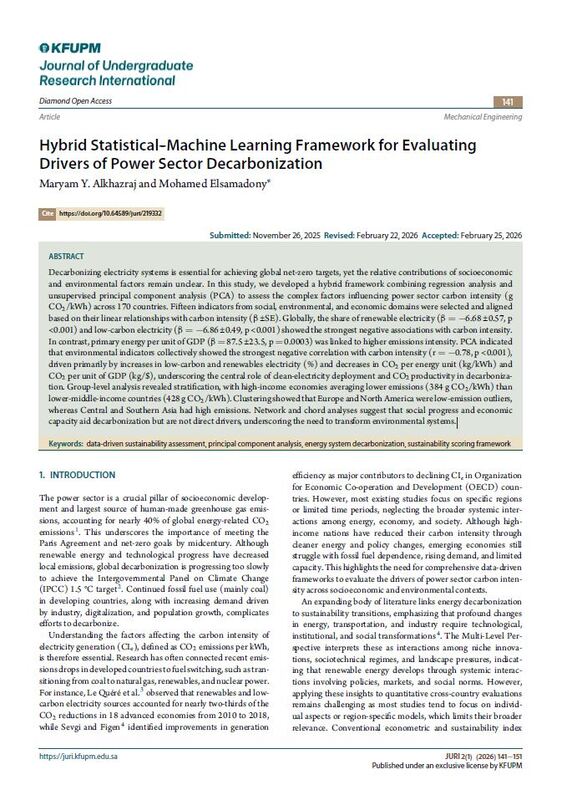
Hybrid Statistical--Machine Learning Framework for Evaluating Drivers of Power Sector Decarbonization
1
Mechanical Engineering, King Fahd University of Petroleum & Minerals, Saudi Arabia
Submission date: 2025-11-26
Final revision date: 2026-02-22
Acceptance date: 2026-03-14
Publication date: 2026-04-07
Journal of Undergraduate Research International 2026;2(1):141-151
KEYWORDS
data-driven sustainability assessmentprincipal component analysisenergy system decarbonizationsustainability scoring framework
TOPICS
ABSTRACT
Decarbonizing electricity systems is essential for achieving global net-zero targets, yet the relative contributions of socioeconomic
and environmental factors remain unclear. In this study, we developed a hybrid framework combining regression analysis and
unsupervised principal component analysis (PCA) to assess the complex factors influencing power sector carbon intensity (g
CO2/kWh) across 170 countries. Fifteen indicators from social, environmental, and economic domains were selected and aligned based on their linear relationships with carbon intensity (β ±SE). Globally, the share of renewable electricity (β = −6.68 ±0.57, p
<0.001) and low-carbon electricity (β = −6.86 ±0.49, p <0.001) showed the strongest negative associations with carbon intensity.
In contrast, primary energy per unit of GDP (β=87.5 ±23.5, p=0.0003) was linked to higher emissions intensity. PCA indicated
that environmental indicators collectively showed the strongest negative correlation with carbon intensity (r = −0.78, p <0.001),
driven primarily by increases in low-carbon and renewables electricity (%) and decreases in CO2 per energy unit (kg/kWh) and CO2 per unit of GDP (kg/$), underscoring the central role of clean-electricity deployment and CO2 productivity in decarbonization. Group-level analysis revealed stratification, with high-income economies averaging lower emissions (384 g CO2/kWh) than lower-middle-income countries (428 gCO2/kWh). Clustering showed that Europe and North America were low-emission outliers, whereas Central and Southern Asia had high emissions. Network and chord analyses suggest that social progress and economic capacity aid decarbonization but are not direct drivers, underscoring the need to transform environmental systems.

We process personal data collected when visiting the website. The function of obtaining information about users and their behavior is carried out by voluntarily entered information in forms and saving cookies in end devices. Data, including cookies, are used to provide services, improve the user experience and to analyze the traffic in accordance with the Privacy policy. Data are also collected and processed by Google Analytics tool (more).
You can change cookies settings in your browser. Restricted use of cookies in the browser configuration may affect some functionalities of the website.
You can change cookies settings in your browser. Restricted use of cookies in the browser configuration may affect some functionalities of the website.