Current Issue
Archive
About the Journal
Introducing the KFUPM Journal of Undergraduate Research International
Journal Submission Scope
Editorial Office
Editorial Board
Open Access
Instructions for Authors
Guide for Authors
Authorship Policy
Peer Review Process
Research Ethics Policy
AI Guidelines
Open Access
Plagiarism Policy

ORIGINAL ARTICLE
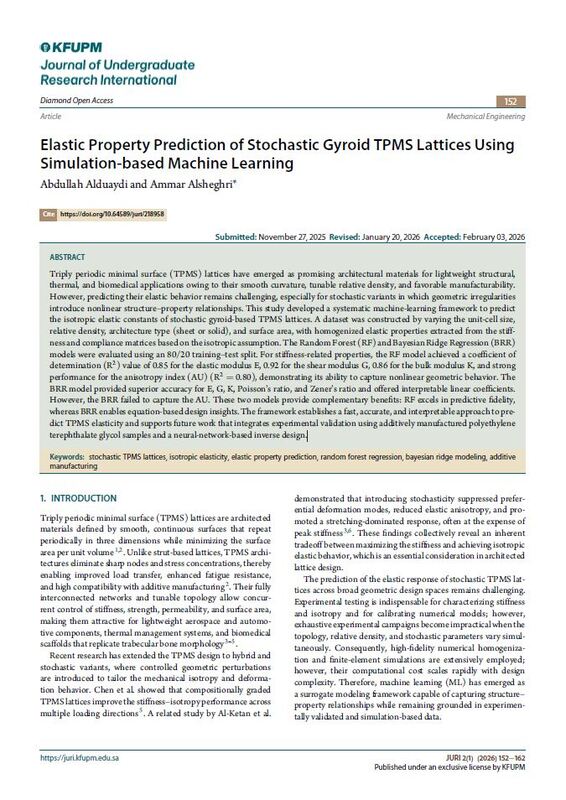
Elastic Property Prediction of Stochastic Gyroid TPMS Lattices Using Simulation-based Machine Learning
1
Mechanical Engineering Department, King Fahd University of Petroleum & Minerals, Dhahran 31261, Saudi Arabia
Submission date: 2025-11-27
Final revision date: 2026-01-20
Acceptance date: 2026-03-06
Publication date: 2026-04-07
Journal of Undergraduate Research International 2026;2(1):152-162
KEYWORDS
stochastic TPMS latticesisotropic elasticityelastic property predictionrandom forest regressionbayesian ridge modelingadditive manufacturing
TOPICS
ABSTRACT
Triply periodic minimal surface (TPMS) lattices have emerged as promising architectural materials for lightweight structural,
thermal, and biomedical applications owing to their smooth curvature, tunable relative density, and favorable manufacturability.
However, predicting their elastic behavior remains challenging, especially for stochastic variants in which geometric irregularities
introduce nonlinear structure–property relationships. This study developed a systematic machine-learning framework to predict
the isotropic elastic constants of stochastic gyroid-based TPMS lattices. A dataset was constructed by varying the unit-cell size,
relative density, architecture type (sheet or solid), and surface area, with homogenized elastic properties extracted from the stiffness
and compliance matrices based on the isotropic assumption. The Random Forest (RF) and Bayesian Ridge Regression (BRR)
models were evaluated using an 80/20 training–test split. For stiffness-related properties, the RF model achieved a coefficient of
determination (R2) value of 0.85 for the elastic modulus E, 0.92 for the shear modulus G, 0.86 for the bulk modulus K, and strong performance for the anisotropy index (AU) (R2 = 0.80), demonstrating its ability to capture nonlinear geometric behavior. The BRR model provided superior accuracy for E, G, K, Poisson’s ratio, and Zener’s ratio and offered interpretable linear coefficients. However, the BRR failed to capture the AU. These two models provide complementary benefits: RF excels in predictive fidelity, whereas BRR enables equation-based design insights. The framework establishes a fast, accurate, and interpretable approach to predict TPMS elasticity and supports future work that integrates experimental validation using additively manufactured polyethylene terephthalate glycol samples and a neural-network-based inverse design.

We process personal data collected when visiting the website. The function of obtaining information about users and their behavior is carried out by voluntarily entered information in forms and saving cookies in end devices. Data, including cookies, are used to provide services, improve the user experience and to analyze the traffic in accordance with the Privacy policy. Data are also collected and processed by Google Analytics tool (more).
You can change cookies settings in your browser. Restricted use of cookies in the browser configuration may affect some functionalities of the website.
You can change cookies settings in your browser. Restricted use of cookies in the browser configuration may affect some functionalities of the website.