Current Issue
Archive
About the Journal
Introducing the KFUPM Journal of Undergraduate Research International
Journal Submission Scope
Editorial Office
Editorial Board
Open Access
Instructions for Authors
Guide for Authors
Authorship Policy
Peer Review Process
Research Ethics Policy
AI Guidelines
Open Access
Plagiarism Policy

ORIGINAL ARTICLE
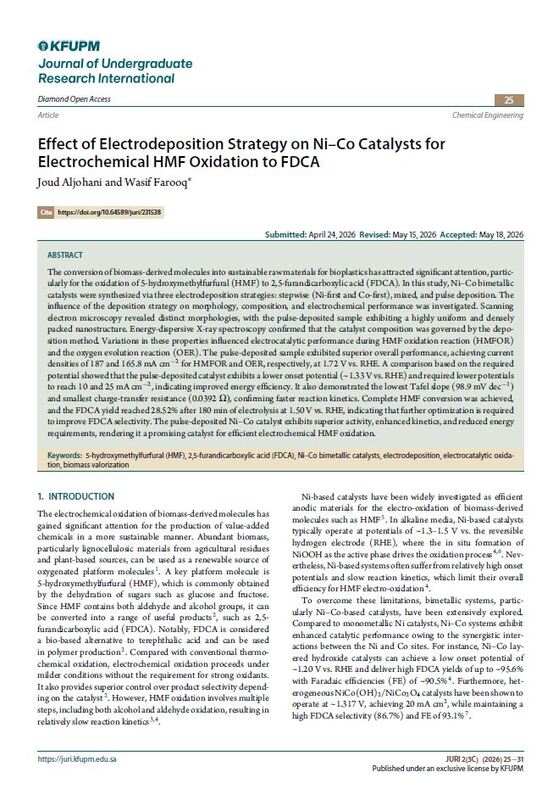
Effect of Electrodeposition Strategy on Ni–Co Catalysts for
Electrochemical HMF Oxidation to FDCA
1
Department of Chemical Engineering, King Fahd University of Petroleum & Minerals, Saudi Arabia
Submission date: 2026-04-24
Final revision date: 2026-05-15
Acceptance date: 2026-08-22
Publication date: 2026-11-22
Corresponding author
Wasif Farooq
Department of Chemical Engineering, King Fahd University of Petroleum & Minerals, 31261, Dhahran, Saudi Arabia
Journal of Undergraduate Research International 2026;2(3C):25-31
KEYWORDS
5-hydroxymethylfurfural (HMF)5-furandicarboxylic acid (FDCA)Ni–Co bimetallic catalystselectrodepositionelectrocatalytic oxidationbiomass valorization
TOPICS
ABSTRACT
The conversion of biomass-derived molecules into sustainable raw materials for bioplastics has attracted significant attention, particularly
for the oxidation of 5-hydroxymethylfurfural (HMF) to 2,5-furandicarboxylic acid (FDCA). In this study, Ni–Co bimetallic
catalysts were synthesized via three electrodeposition strategies: stepwise (Ni-first and Co-first), mixed, and pulse deposition. The
influence of the deposition strategy on morphology, composition, and electrochemical performance was investigated. Scanning
electron microscopy revealed distinct morphologies, with the pulse-deposited sample exhibiting a highly uniform and densely
packed nanostructure. Energy-dispersive X-ray spectroscopy confirmed that the catalyst composition was governed by the deposition
method. Variations in these properties influenced electrocatalytic performance during HMF oxidation reaction (HMFOR)
and the oxygen evolution reaction (OER). The pulse-deposited sample exhibited superior overall performance, achieving current
densities of 187 and 165.8 mA cm−2 for HMFOR and OER, respectively, at 1.72 V vs. RHE. A comparison based on the required
potential showed that the pulse-deposited catalyst exhibits a lower onset potential (~1.33 V vs. RHE) and required lower potentials
to reach 10 and 25 mA cm−2, indicating improved energy efficiency. It also demonstrated the lowest Tafel slope (98.9 mV dec−1)
and smallest charge-transfer resistance (0.0392 ), confirming faster reaction kinetics. Complete HMF conversion was achieved,
and the FDCA yield reached 28.52% after 180 min of electrolysis at 1.50 V vs. RHE, indicating that further optimization is required
to improve FDCA selectivity. The pulse-deposited Ni–Co catalyst exhibits superior activity, enhanced kinetics, and reduced energy
requirements, rendering it a promising catalyst for efficient electrochemical HMF oxidation.

We process personal data collected when visiting the website. The function of obtaining information about users and their behavior is carried out by voluntarily entered information in forms and saving cookies in end devices. Data, including cookies, are used to provide services, improve the user experience and to analyze the traffic in accordance with the Privacy policy. Data are also collected and processed by Google Analytics tool (more).
You can change cookies settings in your browser. Restricted use of cookies in the browser configuration may affect some functionalities of the website.