Current Issue
Archive
About the Journal
Introducing the KFUPM Journal of Undergraduate Research International
Journal Submission Scope
Editorial Office
Editorial Board
Open Access
Instructions for Authors
Guide for Authors
Authorship Policy
Peer Review Process
Research Ethics Policy
AI Guidelines
Open Access
Plagiarism Policy

ORIGINAL ARTICLE
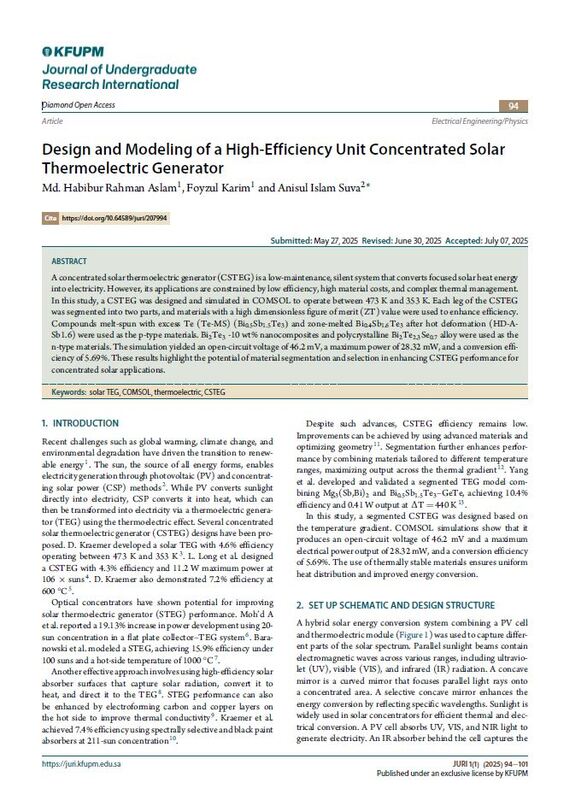
Design and Modeling of a High-Efficiency Unit Concentrated Solar Thermoelectric Generator
1
Electrical & Electronic Engineering, Chittagong University of Engineering and Technology, Bangladesh
2
Institute of Energy Technology, Chittagong University of Engineering and Technology, Bangladesh
Submission date: 2025-05-27
Final revision date: 2025-06-30
Acceptance date: 2025-07-07
Publication date: 2025-08-19
Journal of Undergraduate Research International 2025;1(1):94-101
KEYWORDS
TOPICS
ABSTRACT
A concentrated solar thermoelectric generator (CSTEG) is a low-maintenance, silent system that converts focused solar heat into electricity. However, its applications are limited by low efficiency, high material costs, and the need for complex thermal management. In this study, an efficient CSTEG unit was designed and simulated using COMSOL simulation software to operate within 473 K to 353 K. Each leg of CSTEG was segmented into two parts, and materials with a high dimensionless figure of merit (ZT) value were used to enhance efficiency. Melt-spun with excess Te (Te-MS) compound (Bi0.5Sb1.5Te3) and zone-melted Bi0.4Sb1.6Te3 after hot deformation (HD-A-Sb1.6) were used as P-type materials. Bi2Te3 -10 wt% nanocomposites and polycrystalline Bi2Te2.3Se0.7 alloy were used as n-type materials. The simulation results indicate that the CSTEG unit produces an open-circuit voltage of 46.2 mV and a maximum electrical power output of 28.32 mW, with a conversion efficiency of 5.69%. These results demonstrate the potential of material segmentation and optimization in CSTEG design for enhancing thermoelectric performance in concentrated solar applications.
ABBREVIATIONS
concentrated solar thermoelectric generator (CSTEG)
ACKNOWLEDGEMENTS
The authors acknowledge the support and resources provided by the COMSOL Community. The extensive user forums, tutorials, and shared simulation insights greatly facilitated the modeling and validation process in this study. The collaborative knowledge base offered by COMSOL users worldwide significantly contributed to overcoming technical challenges and improving simulation accuracy.
FUNDING
The authors received no specific funding for this work.
CONFLICT OF INTEREST
The authors declare that there are no conflicts of interest regarding the publication of this manuscript.
REFERENCES (26)
1.
Adrian, Maisarah, et al. “Energy transition towards renewable energy in Indonesia.” Heritage and Sustainable Development 5.1 (2023): 107–118.
2.
Desideri, Umberto, and Pietro Elia Campana. “Analysis and comparison between a concentrating solar and a photovoltaic power plant.” Applied energy 113 (2014): 422–433.
3.
Kraemer, Daniel, et al. “High-performance flat-panel solar thermoelectric generators with high thermal concentration.” Nature materials 10.7 (2011): 532–538.
4.
Li, Long, et al. “Combined solar concentration and carbon nanotube absorber for high performance solar thermoelectric generators.” Energy Conversion and Management 183 (2019): 109–115. Fan, Shufen, et al. “Influence of nanoinclusions on thermoelectric properties of n-type Bi2 Te3 nanocomposites.” Journal of Electronic materials 40 (2011): 1018–1023.
5.
Kraemer, Daniel, et al. “Concentrating solar thermoelectric generators with a peak efficiency of 7.4%.” Nature Energy 1.11 (2016): 1–8.
6.
Al-Nimr, M. A., B. M. Tashtoush, M. A. Khasawneh, and I. Al- Keyyam. “A Hybrid Concentrated Solar Thermal Collector/Thermo- Electric Generation System.” Energy, vol. 134, 2017, pp. 1001–1012. Elsevier, https://doi.org/10.1016/J.ENER....
7.
Baranowski, L. L., G. J. Snyder, and E. S. Toberer. “Concentrated Solar Thermoelectric Generators.” Energy & Environmental Science, vol. 5, no. 9, 2012, pp. 9055–9067. Royal Society of Chemistry, https://doi. org/10.1039/C2EE22248E.
8.
Kraemer, D., B. Poudel, H. P. Feng, J. C. Caylor, B. Yu, X. Yan, Y. Ma, et al. “High-Performance Flat-Panel Solar Thermoelectric Generators with High Thermal Concentration.” Nature Materials, vol. 10, 2011, pp. 532–538. Nature Publishing Group, https://doi.org/10.1038/ nmat3013.
9.
Piarah, W. H., Z. Djafar, A. S. Rosali, A. Halim, and B. H. J. Mustofa. “The Effect of Copper Coating on the Hot-Side on the Performance of a Thermoelectric Generator Using the Electroforming Method.” International Journal of Design & Nature and Ecodynamics, vol. 17, no. 6, 2022, pp. 823–830. https://doi.org/10.18280/IJDNE. 170602.
10.
Kraemer, D., Q. Jie, K. McEnaney, F. Cao, W. Liu, L. A. Weinstein, J. Loomis, Z. Ren, and G. Chen. “Concentrating Solar Thermoelectric Generators with a Peak Efficiency of 7.4%.” Nature Energy, vol. 1, 2016, pp. 1–8. Nature Publishing Group, https://doi.org/10.1038/ nenergy.2016.153.
11.
Chen, Wei-Hsin, and Yi-Bin Chiou. “Geometry design for maximizing output power of segmented skutterudite thermoelectric generator by evolutionary computation.” Applied Energy 274 (2020): 115296.
12.
Snyder, G. J., and T. S. Ursell. “Thermoelectric Efficiency and Compatibility.” Physical Review Letters, vol. 91, no. 14, 2003, p. 148301. https://doi.org/10.1103/PhysRe....
13.
Yang, Kai-Yu, et al. “General Screening Rules and Segmented Optimization Strategy for Efficient Thermoelectric Devices Validated by Mg3(Sb,Bi)2 and Bi0.5Sb1.5Te3-GeTe Module.” Advanced Science, first published 5 May 2025, https://doi.org/10.1002/advs.2....
14.
Chen, Wei-Hsin, et al. “Optimization of a segmented thermoelectric generator with various doping amounts using central composite design, multi-objective genetic algorithm, and artificial neural network.” Energy 316 (2025): 134469.
15.
Xu, Z. J., et al. “Enhanced thermoelectric and mechanical properties of zone melted p-type (Bi, Sb) 2Te3 thermoelectric materials by hot deformation.” Acta Materialia 84 (2015): 385–392.
16.
Kim, Sang Il, et al. “Dense dislocation arrays embedded in grain boundaries for high-performance bulk thermoelectrics.” Science 348.6230 (2015): 109–114.
17.
Hu, Lipeng, et al. “Point defect engineering of high-performance bismuth-telluride-based thermoelectric materials.” Advanced Functional Materials 24.33 (2014): 5211–5218.
18.
Fan, Shufen, et al. “Influence of nanoinclusions on thermoelectric properties of n-type Bi2Te3 nanocomposites.” Journal of Electronic materials 40 (2011): 1018–1023.
19.
Prasad, Asutosh, and Raj CN Thiagarajan. “Multiphysics modeling and multilevel optimization of thermoelectric generator for waste heat recovery.” Proceedings of the COMSOL Conference. 2018.
20.
Zebarjadi, M., et al. “Perspectives on Thermoelectrics: From Fundamentals to Device Applications.” Energy & Environmental Science, vol. 5, no. 1, 2012, pp. 5147–5162. https://doi.org/10.1039/ C1EE02497C.
21.
Baranowski, L. L., G. J. Snyder, and E. S. Toberer. “Concentrated Solar Thermoelectric Generators.” Energy & Environmental Science, vol. 5, no. 7, 2012, pp. 9055–9067. https://doi.org/10.1039/C2EE22....
22.
Telkes, M. “Solar Thermoelectric Generators.” Journal of Applied Physics, vol. 25, 1954, pp. 765–777.
23.
Candadai, A. A., V. P. Kumar, and H. C. Barshilia. “Performance Evaluation of a Natural Convective-Cooled Concentration Solar Thermoelectric Generator Coupled with a Spectrally Selective High Temperature Absorber Coating.” Solar Energy Materials and Solar Cells, vol. 145, 2016, pp. 333–341. https://doi.org/10.1016/J.SOLM....
24.
Pereira, A., et al. “High Temperature Solar Thermoelectric Generator–Indoor Characterization Method and Modeling.” Energy, vol. 84, 2015, pp. 485–492. https://doi.org/10.1016/J.ENER.... 03.053.
25.
Jaziri, N., A. Boughamoura, J. Müller, B. Mezghani, F. Tounsi, and M. Ismail. “A Comprehensive Review of Thermoelectric Generators: Technologies and Common Applications.” Energy Reports, vol. 6, 2020, pp. 264–287. https://doi.org/10.1016/j.egyr....
26.
Maksymuk, M., B. Dzundza, O. Matkivsky, I. Horichok, R. Shneck, and Z. Dashevsky. “Development of the High Performance Thermoelectric Unicouple Based on Bi2Te3 Compounds.” Journal of Power Sources, vol. 530, 2022, Article 231301. https://doi.org/10.1016/ j.jpowsour.2022.231301.

We process personal data collected when visiting the website. The function of obtaining information about users and their behavior is carried out by voluntarily entered information in forms and saving cookies in end devices. Data, including cookies, are used to provide services, improve the user experience and to analyze the traffic in accordance with the Privacy policy. Data are also collected and processed by Google Analytics tool (more).
You can change cookies settings in your browser. Restricted use of cookies in the browser configuration may affect some functionalities of the website.
You can change cookies settings in your browser. Restricted use of cookies in the browser configuration may affect some functionalities of the website.